Re: inside out tracking - have you seen Bridge? It's a mobile, spatially aware headset for IOS. It uses an onboard Structure Sensor to power positionally tracked VR + high end MR. All on an iphone (no remote processing), and < $400 :)
We've been working on it in secret for a couple of years, and just launched it in December.
What did you find wrong with the Hololens tracking? I use it a couple times a week and have been super impressed with it so far. Seems to very solidly lock on locations, and I can walk to the far end of the office and my content is still right where I left it. You can use is in huge unbound areas and it doesn't mind at all.
The Hololens still has a lot of issues, the FOV's crappy, hand tracking needs a lot of work, occlusion isn't great, etc. but tracking is one place that they're top of the game.
It's probably fine if you just want "if I go back to my desk, this window is on the left hand side". If you want more precision and accuracy, or consistency with physical measurements/other tracking systems, it's not so good in my experience. Happy to revise/update that experience though!
That kind of precision isn't necessary for tracking position accurately for VR/AR though, Hololens' current system is pretty damn good and I'm sure internally it's improved a bunch as they roll out their own VR headsets too.
It absolutely is needed for many AR applications. VR is a bit more forgiving, particularly if you are talking consumer and games. Any time you need maintain a relationship to the physical space you are in you can run into trouble though.
Their current gen glasses do not do any AR - but they've been acquiring / hiring very aggressively in space for a couple of years now. It's pretty transparent what their long term goal is with their glasses.
I think it's actually a really smart approach. MS spent ~2 billion and multiple years of R+D to get the Hololens built. Snapchat's coming at it from another angle, start simple and build up with each successive generation. The fact that they already have people clamoring for something this basic is telling...
I don't know much about this space, how do you know it's definitely not positionally tracked? My reason is that they didn't talk about it, so I figure it isn't but I'm not certain.
None of the controlled objects in VR responded to any of the positional movement. You can see that the wand / pole is just rotating around a center-point attached to the user.
Positional tracking is a really challenging problem with a lot of limitations. If they were using computer vision to track the controller it would need to be held within the device's FOV and have identifiable elements such as a marker or LEDs. There are other approaches, but nothing I've seen that would work well on an HMD.
I've been working with AR/VR for the better part of a decade, and controller tracking's come up several times. I can tell from my own work that the device they're showing off is IMU only. It's too bad, something equivalent to the Vive controllers for mobile VR would be fantastic.
And at the end of the day - you're right. If it was spatially tracked then they definitely would have mentioned it.
> Positional tracking is a really challenging problem with a lot of limitations. If they were using computer vision to track the controller it would need to be held within the device's FOV ...
First, I think positional tracking of the person within his/her environment is one of the main things that makes the difference between VR and AR. So there's value in that. If you can do it with computer vision maybe it can work in almost any environment.
Second, there are RF based positional tracking systems. They're more expensive, true (not if you can design chips yourself, so might even be cheaper for google), but you don't need the controller to have visible elements.
Third, hand tracking like this should be able to work usefully, shouldn't it ? I know it doesn't do distance, but ... Just hang it off the viewer pointing downwards with a large volume immediately in front of the user. Not great for gaming probably, but for a virtual keyboard it should work, no ? http://www.ctxtechnologies.com/products/vk-200-keyfob-virtua...
Because good enough IMUs and optical systems for positional tracking are hella expensive compared to where in the market this thing is targeted.
There'd need to be either:
    - a very expensive IMU in the controller, talking $300-500
    - a camera and hefty CPU in the controller,
    - a camera and dedicated image processing CPU on the headset
Vive positional tracking works because you control the environment. Oculus positional tracking works because you're already running on a hefty PC. You don't have either of those advantages on mobile, so you're left with either IMU sensor integration or SLAM, both of which are more expensive than $100 to do well and leave processing time for graphics.
The Gear VR/Oculus IMU is only good for orientation. Positional tracking with the Oculus Rift is done with an external camera, detecting a constellation of infrared LEDs on the headset itself. Gear VR thus does not have positional tracking.
To be able to integrate the acceleration data from an IMU to get positional data out of it is not something you can do with commodity IMUs, even the one made for Oculus. They're too imprecise and too inaccurate and too slow, and any analysis tricks to improve the results all introduce latency. Oculus' sensor has very little drift (though it still has drift, which is another thing the camera system on the desktop Rift can correct for) and the noise in the orientation data is not noticeable or can be filtered much more simply without introducing "too much" latency.
There are IMUs that are good enough to integrate acceleration data to position data, but they are prohibitively expensive for this application.
For what it's worth, I used to see a marked difference in the quality of orientation tracking between my Galaxy Note 4 in Google Cardboard vs. the Gear VR, but I see no different between GC and GVR on my Galaxy S7.
We’re looking for a full-stack Unreal Editor 4 developer to join us in downtown SF on a ground breaking new venture building immersive Virtual Reality and Augmented Reality experiences with new hardware.
This is a full-time on-site role in an accelerator/incubator startup funded by of one of the worlds largest technology companies. We’re a small group of programmers, artists and hardware designers. Attention to detail, strong communication skills, an ability to do design and implementation from end-to-end are critical.
We’re looking for a full-stack Unreal Editor 4 developer to join us in downtown SF on a ground breaking new venture building immersive Virtual Reality and Augmented Reality experiences with new hardware.
This is a full-time on-site role in an accelerator/incubator startup funded by of one of the worlds largest technology companies. We’re a small group of programmers, artists and hardware designers. Attention to detail, strong communication skills, an ability to do design and implementation from end-to-end are critical.
This was a long time coming. It definitely shakes up the AR space. They were one of the only real independent players in the industry.
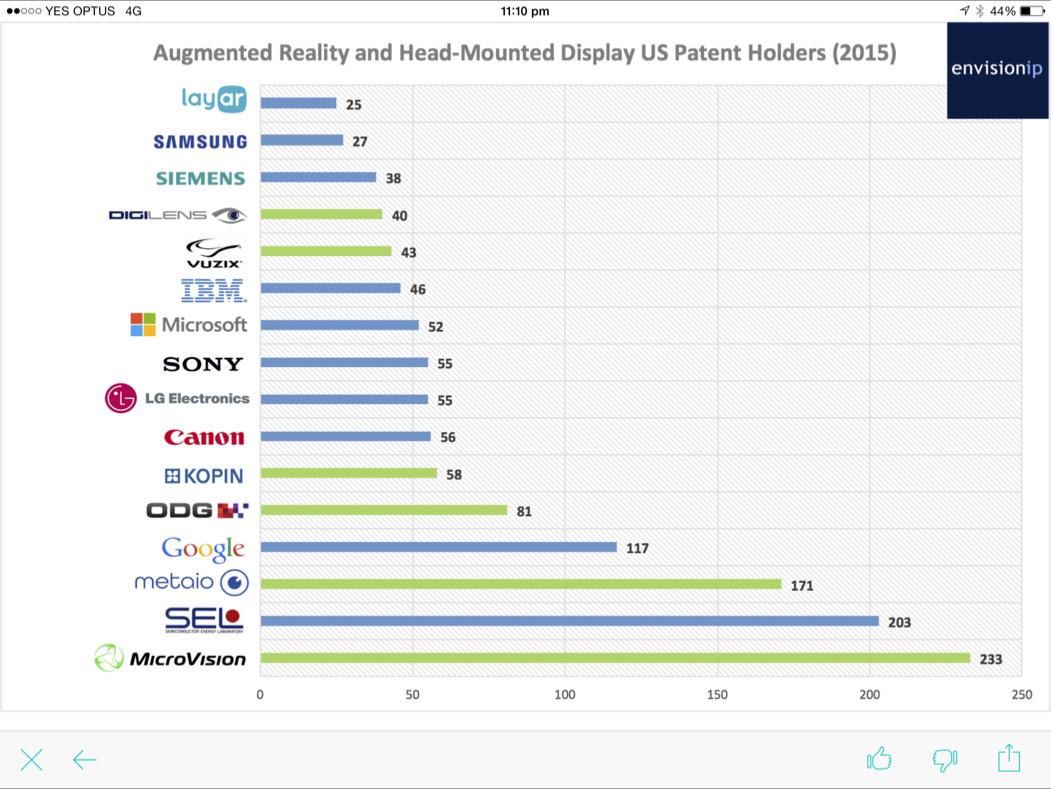
It's a good play by apple too. It almost brings them up to speed with the other major players. MS has the Hololens team, google's got Tango, Oculus has been snapping up computer vision companies left and right. Up until now Apple didn't have anything in the AR space.
This was a long time coming. It definitely shakes up the AR space. They were one of the only real independent players in the industry.
It's a good play by apple too. It almost brings them up to speed with the other major players. MS has the Hololens team, google's got Tango, Oculus has been snapping up computer vision companies left and right.
We’re looking for a full-stack Unreal Editor 4 developer to join us in downtown SF on a ground breaking new venture building immersive Virtual Reality and Augmented Reality experiences with new hardware.
This is a full-time on-site role in an accelerator/incubator startup funded by of one of the worlds largest technology companies. We’re a small group of programmers, artists and hardware designers. Attention to detail, strong communication skills, an ability to do design and implementation from end-to-end are critical.
Core requirements:
- Extensive experience building games in Unreal Engine
- Knowledge of blueprints customization
- The ability to script VFX animations in UE4
- Strong C++ / C# skills with the ability to code and architect gameplay mechanics
- Experience building complex technical products
- Comfortable with version control
- Good background in 3D and applied mathematics
-Direct experience using VR/AR devices such Oculus Rift, Razer Hydra, Leap Motion etc is a plus


We've been working on it in secret for a couple of years, and just launched it in December.
https://www.youtube.com/watch?v=Iys8yo0sjYg