And several days to learn a task? Is that supposed to be a dis? In 2026 with reinforcement learning maybe it is, but darn that seems super quick to me.
There's no good definition. To some people it literally means "artificial general intelligence". If you agree that toddlers and dogs have general intelligence at a low level (and most do), that low bar has been met IMO.
Some people think it means "better than human intelligence in every way". We'll be able to find niches that humans are better at for a very long time, so that definition hasn't been met, but is getting increasingly pedantic.
Some people think it means "smart enough to improve itself independently, thus triggering the singularity". The frontier labs are using AI to help improve itself, but it's not working independently, yet, AFAICT. So that definition isn't met yet.
KDE is an experiment to pack 20 big things in a bag that can only hold 5 things. Then add one more thing in next release. And make every pixel clickable.
KDE 6's out of box experience is really good. You can tweak it to your heart's content, but you don't need to. It's not "every pixel clickable" unless you deliberately made it so. Older versions of KDE were more like you describe.
Yeah, they're hidden in three-level deep burger menus. Konsole and KWrite are particularly egregious.
There is a middle ground between GNOME's minimalist wasteland and KDE's kitchen sink. And yet for some reason, the patch to add smart copy/paste to Konsole, like most modern terminals have and default to, has been stuck for years waiting for approval from the design team just to add a checkbox hidden in the settings.
This might sound heretic but maybe running mostly GNOME apps on a KDE desktop might be an interesting "best of both worlds" situation to investigate...
Care to point out what improvements KDE 6 has got that isn't something that's already been done in some other DE or OS, and isn't a bugfix or polish?
I haven't daily driven KDE to see what it's truly like, but from a distance it doesn't seem to be doing anything revolutionary or truly new, but I'd love to be proven wrong.
Not necessarily 6, but KDE Connect is such a seamless experience of integrating your phone with your computer out of the box. Sharing clipboard, files, notifications, controlling cursor and keyboard from your phone, controlling media - all of that just works really well, without online accounts, on your local network.
Sure, there's Apple Continuity, but looks like it was released 2014 (KDE Connect - 2013) and it's tightly locked to the Apple ecosystem. And yes, the 2013 version doesn't have the same feature parity or stability as the current one, but that's ok because we're not discussing bugfixes or polish.
It's innovative enough that GSConnect is the Gnome implementation of the KDE Connect.
KDE Connect is over 10 years old by now. Hardly new. I also think it's sort of an extension of Apple's Messages app on MacOS, which let you send and receive messages through iMessage from a Mac, and thus pick up where you left of with your phone. That might be a stretch though, since KDE Connect and later Continuity does a lot more (although I'd be very surprised if Continuity wasn't viewed as that inside Apple at that time).
I'm also pretty sure the basic feature set you're mentioning, like clipboard and file sharing, using your phone to control your desktop, was part of the 1.0 release. Are there any features in KDE Connect that are new-ish?
That said, props to KDE for actually making a feature that hadn't been done before. But if KDE Connect is the most recent example of genuine improvements in the desktop experience that aren't just fixes, that goes to show that nobody's actually doing anything significant (in a good way) to the desktop experience.
KDE used to be terrible. However today, despite some grievances, it's probably the most polished modern Linux DE experience. Enough so that Valve chose it for SteamOS. I am also enjoying it on a Bazzite system.
I used xfce for pretty much my entire life because yes, there's been very little meaningful improvement to the DE experience in 25 years. Modern KDE finally convinced me to switch, and it does feel like a much more mature, refined experience than the shit show that was past KDE. It's also stable and fast. You should give it a spin!
I'm very happy on Cinnamon, but it's nice to have an escape hatch. KDE probably isn't going away or in a ditch any time soon (even when it was shit, they seemed to have had their minds in the right place). Nor is xfce for that matter (I wouldn't be surprised if there's still an active xfce dev after the bombs fall).
You should not be doing anything revolutionary. UX design is a well understood field with a lot of research into it. Doing something revolutionary or new is a bad idea. I'm sure there are new things in KDE, but nobody will be able to think of them for a long time because the new things are minor things that nobody is going to notice or care about.
You sound like you're disagreeing with me, yet what you write is inline with my opinion, but I might just be misreading your comment.
I wrote in my OP that 'even on Linux, the changes happening are stuff like bugfixes and reducing jank; small incremental improvements that have already been done, but are just getting their final round of polish'. The comment I was responding to claimed disagree, and said that KDE does get improvements. I wanted to clarify what improvements those are, since I can't see why they would disagree with my original comment in the only improvements in KDE are 'stuff like bugfixes and reducing jank; small incremental improvements that have already been done, but are just getting their final round of polish'.
Ah, in that case I've misread their comment. If their opinion is that the desktop doesn't need change because KDE is good and only delivers small incremental improvements, then I can definitely see their point.
How long have we had tiling? It's not a new feature to me, but maybe I've just got my years off. Maybe the exact implementation in KDE is new, but the idea isn't.
You're one of today's lucky 10,000 then. If you've got a large screen, a properly flexibly tiling window manager is a game changer. Try out i3 or hyprland or press meta-T on KDE.
You're arguing from a position of ignorance. That's a great position to be in, because it means you get the thrill of experiencing something new and awesome.
I have no idea what you're talking about. It's as if you're responding to a comment I didn't write.
This subthread started with you disagreeing with me, saying that KDE continually gets better with each point upgrade. Then I asked you what new features KDE has implemented that already in some other OS or DE, and that aren't polish and bugfixes, since one of my points in the OP was that Linux largely isn't improving through new features, but just through polish and bugfixes.
You pointed out tiling as a new feature, which I pointed out isn't a new feature at all (unless I'm just wildly off base). KDE might do it well, but it polishing and fixing a feature, or reimplementing a feature which already exists in another DE, or some combination of those two, is not making something new (maybe their tiling is really good and actually revolutionary, but then you should tell me that, and not just tell me to try it out!).
I'm not interested in trying out tiling, even if it's good. I've known about it for a while, so I don't understand why you're telling me I'm one of today's lucky 10000. I literally wrote that it isn't a new feature to me. I have no idea why you're telling me to try it out. I'm very happy using fairly plain Cinnamon. I'm interested in knowing whether or not KDE has implemented features that aren't already in some other OS or DE, and that aren't polish and bugfixes. That's why I asked that question.
KDE is the only desktop that manages floating windows and tiling in one. Tiling WMs are tiling-first, gnome and crew is floating only, KDE is both.
But that’s not the only thing that KDE does that’s revolutionary and hard to find. I’ve written a whole blog on this, but to say a little here:
- full panel and widget customization with alternatives. Some panel designs are very space efficient and high-information, which you can’t find on Gnome, Windows or MacOS
- krunner, which lets you search everything all at once. Granted Apple has spotlight, but krunner is very good.
- activities, which is like virtual desktops on steroids. You can have completely different desktop configurations if you want, and switch between them.
dwm is only a window manager, not a desktop. Which is fine, but it’s not the most fair comparison because it’s not dwm vs KDE, it’s dwm vs kwin. Or dwm + 20 applications vs KDE.
For me the greatest thing about KDE is that once you have it, you don't miss anything from any other DE or OS. It has everything! I find gnome and the new gtk4 apps definitely more beautiful but I end up running KDE always.
This doesn't seem like a crazy take. The situation is horrible all around, and the reaction to the situation is hard to demonize from a humanistic point of view. This isn't the wealthy complaining about the homeless sleeping on benches. It's a dramatic crisis perpetuated by people who are not, largely, mentally ill in the sense that some homeless people are.
it only seems not-crazy if you also accept the implication "gypsys COULD live in housing like all of us normal people, but instead choose to live in parks and shit in bushes" - instead of framing it as a failure of housing policy or mental health, its being made a personal (moral) failure of individuals. That's the gross part.
Starting off with an analogy about shooting wolves frames things in a decidedly violent way that makes me uncomfortable. I would not, ever, compare a group of humans with a group of animals that i am advocating for culling. I know enough history to know who does that.
> The vagrants are literally shitting in the bushes
This is a simple failure of civics. If you have people somewhere, you provide them toilets or you get shit on the ground. Cities do it when festivals and street parties happen - but they don't do it when homeless poeple show up, and then they spin it as disgusting behaviour on the part of the people. Everybody shits. If you had no access to a toilet, or place to dispose of your shit, you would shit on the street or in the bushes too. Fixating on shit is also an attempt to rile up your disgust reaction, and link it to a group of people.
> Partly because it didn't tolerate vagrants and homeless people taking over public spaces (as has happened in so many American cities)
A leading lie. American cities have problems with public homelessness because they have no social safety net, and an economy that drives up homelessness. Crackdowns, like my city has done, only spreads the problem out and makes providing services like toilets impossible. It wasn't as bad before not because it "wasn't tolerated" but because the economic conditions were less harsh in the postwar era.
> You have to act. You have to protect the sheep. Standing idly by while your livestock is devoured by predators or your neighborhood is taken over by migrants is a pathetic abdication of any functioning society's most basic duty to its citizens.
This is a straight up fascist mentality. Us vs them. Protect our weak from their strong. It leads VERY dark places. Ask yourself this - why are the wolves the migrants? Could you not just as easily frame them as the sheep in need of protecting? Have they not been abandoned and pushed out by society? Without a barn to sleep in, the sheep will wander where they aren't welcome - is that the sheep's fault, or the shepherd's?
> If you have people somewhere, you provide them toilets or you get shit on the ground.
I have no idea if you've traveled much, but this has not been my experience traveling throughout major cities in Europe.
There's often NOT public bathrooms ANYWHERE yet streets are much cleaner than somewhere like San Francisco, where there actually are some public bathrooms.
Absolutely. I agree with 90% of what you're saying. The responsibility of civics (though I think you're oversimplifying - see my sibling comment), the dark implications of the animal analogy, etc. But I don't think what he is saying is so unreasonable, considering the catastrophe to which he is reacting, as to warrant an attitude of "demonize everything he does, even unrelated software projects" (yet).
Essentially I feel the same way as him (I wouldn't write about it in the same menacing way, but I feel the same way). There are multiple catastrophic culture clashes going on across the western world. It's a real, serious, hysterical crisis. We need to address it as humanely as possible.
As long as the suggestions remain similar to things like "enable them to stop the disruption on their own", "forcefully but lawfully stop the behavior", or "move them", then I have a hard time not at least sympathizing, even if I don't agree with the letter of the suggestion. Until the suggestions escalate to "kill them" or "imprison them indefinitely or in cruel conditions", then I don't believe we have crossed the line into absolutely indefensible territory.
It's tempting to portray what he is saying as "kill them" (since that's the obvious analogy with wolves), but it's simply not the case in reality. He is using a dramatic analogy, but not suggesting genocide.
I also don't believe in rhetorical analogies. They are a distraction. I'm not interested in extrapolating the wolf analogy from his post, to your post, and beyond. It's dumb, frankly (not on your part - on his).
The fact that nuclear is good at the easy part of power production is not a point in favor of nuclear. Grids are built to peak needs; any grid that can handle peak load can handle base load.
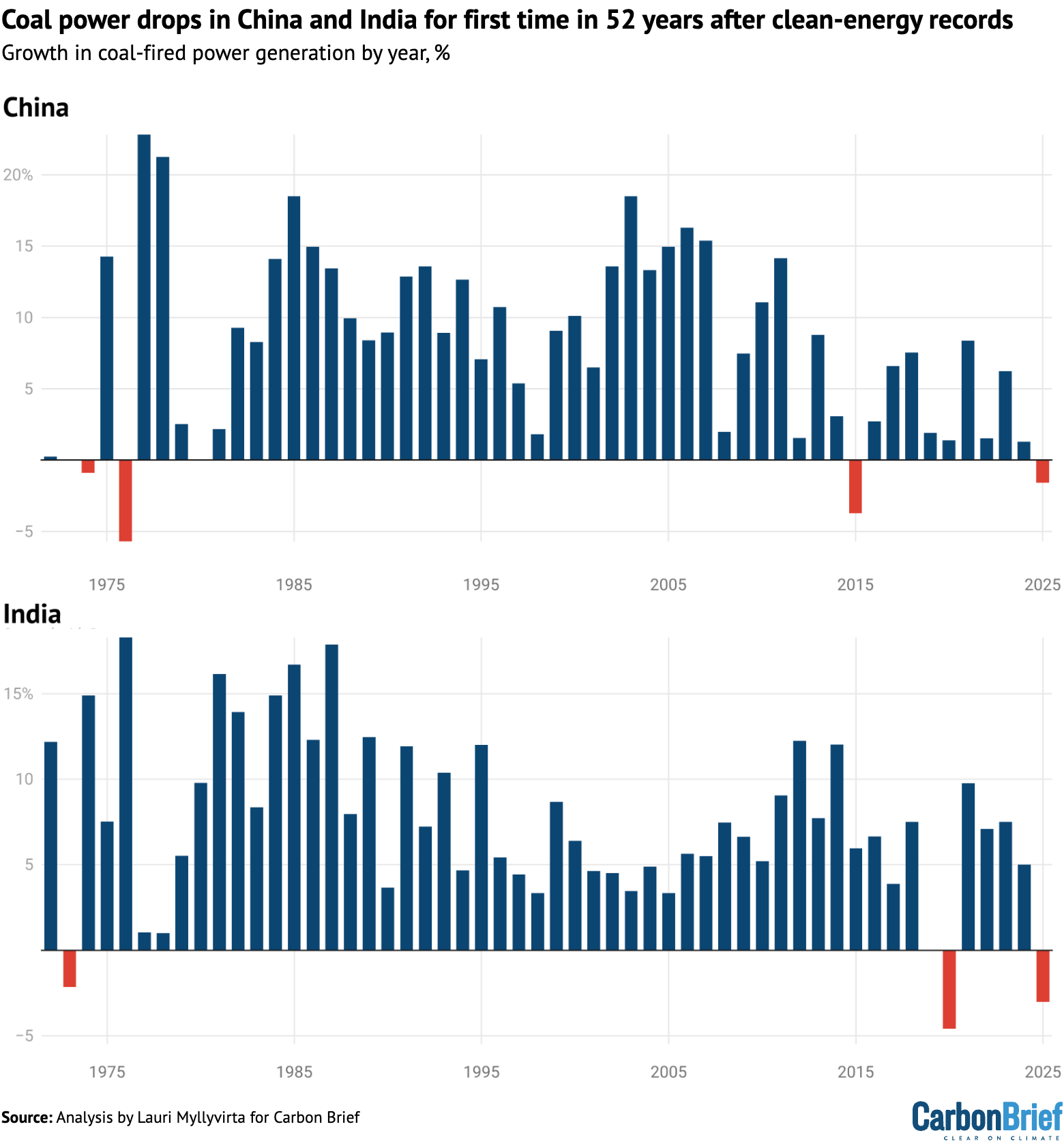
> After the first three quarters of the year, China’s CO2 emissions in 2025 are now finely balanced between a small fall or rise, depending on what happens in the last quarter.
And then goes on to describe how the largest drop (3%) is happening at a time when it just happens that fuel is increasingly expensive and scarce, shipping is increasingly expensive and slow, and the global economy has spent months grinding increasingly towards a terrible outcome.
People might as well brag about their incredible weight loss journey through amputation.
That's 50% of electricity, but not 50% of energy. Coal still provides ~80% of energy IIRC (roughly 10% is carbon-free and growing faster than the US). China burns so, so much coal, while much of the world has shifted to natural gas, which has much less carbon per energy.
You don't recall correctly. Coal is also 50% of energy. It's used a lot for heating, but that is dropping rapidly. It's used in manufacturing, but that is also doing rapidly, except for steel. It's not used for transportation.
Maybe emissions fell because industrial activity fell instead? Maybe oil and gas have been used less because the cost has risen. Maybe that explains coal as well depending on how it is used. I’m speculating coal might be used in the production of steel - what if that product is highly tariffed in the US and EU so China had to cut back?
China is “greening” but we should be skeptical that it’s out of some lofty moral goal. If it was they wouldn’t be hoarding the production of rare earth minerals and would be freely giving away technology for the sake of the planet.
You can see the same dips hit at the same time for the same reason.
In terms of Chinese coal though there's a reason boosters always talk about percentages and not absolute number... one goes down, but the other keeps rising. Even if China continues on the current course in terms of tonnage burned they won't reach "peak coal" until at least 2030.
> China is “greening” but we should be skeptical that it’s out of some lofty moral goal
Why does the "why" matter? Tons of carbon are tons of carbon, right? That's what people say when you tell them about per-capita emissions.
> they wouldn’t be hoarding the production of rare earth minerals and would be freely giving away technology for the sake of the planet.
You can freely buy as many cheap panels and batteries and EVs and heat pumps from China as you like (unless your country is stupid enough to tariff or ban them). Those come with minerals. When they reach end-of-life they can be recycled.
What exactly are they "hoarding" that the planet needs to go green? It hasn't prevented Pakistan or Vietnam from going ham on PV deployment.
Well it doesn’t entirely matter but we should just acknowledge that it’s a geopolitical strategy and not really something they are doing for the planet.
> You can freely buy as many cheap panels and batteries and EVs and heat pumps from China as you like (unless your country is stupid enough to tariff or ban them). Those come with minerals. When they reach end-of-life they can be recycled. What exactly are they "hoarding" that the planet needs to go green? It hasn't prevented Pakistan or Vietnam from going ham on PV deployment.
Are you unfamiliar with China’s restrictions on rare earth exports for example due to alleged “dual use” as they continue to apply military pressure on democratic Taiwan? I’d encourage you to read up on these restrictions with respect to Japan for example who is alarmed by Chinese and North Korean provocations.
You can buy so many cheap panels practically only from China because they subsidized the industry so other countries couldn’t compete and build their own solar panels. For some these tariffs and bans are responses to these anti-competitive strategies. It’s not just the US, by the way. The EU is tariffing China too.
They are entitled to pursue these strategies but we are also entitled in the west to recognize them and combat them how we see fit.
> not really something they are doing for the planet
If it doesn't matter why do you feel the need to acknowledge it?
> Are you unfamiliar with China’s restrictions on rare earth exports [to Japan] for example due to alleged “dual use”
How do these restrictions prevent Japan from using Chinese PV and batteries in their grid?
> You can buy so many cheap panels practically only from China because they subsidized the industry
Translation: they gave the world a ton of deeply discounted goods. And you said they didn't do anything nice for anyone!
> so other countries couldn’t compete and build their own solar panels
Other countries are free to subsidize their own solar and battery industries. Godspeed to the ones doing it right now. But also is it really that amazing an industry to have? Low-margins, constant price wars, undifferentiated commodity product without much of a moat. Rich economies tend not to have those industries anyway.
> For some these tariffs and bans are responses to these anti-competitive strategies
Surely then the US must be approving solar projects at record pace then? And wind too?
> The EU is tariffing China too.
There are no EU tariffs on Chinese solar panels or grid-scale batteries or heat pumps. They are considering tariffing heat pumps right now.
> If it doesn't matter why do you feel the need to acknowledge it?
Just to make sure nobody is ever confused. Why do you feel the need to defend China?
> How do these restrictions prevent Japan from using Chinese PV and batteries in their grid?
It limits Japan from developing their own home grown market or utilizing technology for what China considers dual use?
> Translation: they gave the world a ton of deeply discounted goods. And you said they didn't do anything nice for anyone!
Other translation: Those cheap goods weren’t worth the cost to the environment or to empower an autocratic regime.
> Other countries are free to subsidize their own solar and battery industries.
When that happens there can be retaliatory measures against countries who are in for example the WTO or have other trade agreements. You don’t just subsidize products in a vacuum.
> Godspeed to the ones doing it right now. But also is it really that amazing an industry to have? Low-margins, constant price wars, undifferentiated commodity product without much of a moat. Rich economies tend not to have those industries anyway.
You’re focusing on solar panels but that’s not all we’ve been discussing.
> Surely then the US must be approving solar projects at record pace then? And wind too?
That doesn’t follow from what you quoted.
> There are no EU tariffs on Chinese solar panels or grid-scale batteries or heat pumps. They are considering tariffing heat pumps right now.
They are tariffing other products/industries and working on additional ones.
That a country is acting in its own interests? I don't think that's news.
> Why do you feel the need to defend China?
I think climate change is the biggest problem of our lifetime. China's output of green tech is our best chance. I think useful idiots for the fossil fuel industry demonize China to transitively discredit renewables (i.e. not for "lofty moral reasons" like democracy). There's a genuine double standard.
> It limits Japan from developing their own home grown market
Drill deeper. How does this prevent Japan from "greening" today? That's the topic we're discussing.
> or utilizing technology for what China considers dual use?
Why can't Japan source "dual use" rare earths from somewhere else? They aren't actually that rare. Japan could invest in mines and processing facilities in Africa or the US or Canada.
> Those cheap goods weren’t worth the cost to the environment
Cheap, abundant PV and batteries that can decarbonize the world? I'm ok with localized damage to one country's environment, done voluntarily, for that. Climate change will wreck the global environment.
> empower an autocratic regime
Describes most oil-producing countries. This is virtue signalling.
> there can be retaliatory measures against countries who are in for example the WTO
How did China do it then?
> You’re focusing on solar panels but that’s not all we’ve been discussing.
Ok what else then? You want battery manufacturing? Motors? Has China somehow restricted countries from building their own industries?
> > Surely then the US must be approving solar projects at record pace then? And wind too?
> That doesn’t follow from what you quoted.
Ok what is the US doing for renewable energy under this administration?
> They are tariffing other products/industries and working on additional ones.
We're focusing on renewable tech here. That's the focus of this thread.
> That a country is acting in its own interests? I don't think that's news.
You changed the topic though, that wasn't what we were talking about.
> I think climate change is the biggest problem of our lifetime. China's output of green tech is our best chance. I think useful idiots for the fossil fuel industry demonize China to transitively discredit renewables (i.e. not for "lofty moral reasons" like democracy). There's a genuine double standard.
That basically proves my initial point lol. That's why it's important to make sure while the effects may be good for the climate, it's not done with any intention for the planet's benefit and specific tactics that are being used are harmful to other countries.
> Drill deeper. How does this prevent Japan from "greening" today? That's the topic we're discussing.
I'd challenge you to do the same thing. How can Japan "green" when China has restricted exports of rare earth materials to Japan because China and its junior partner North Korea are engaging in provocative military activities near Japan?
If your version of "Japan can green by buying China's products" you're being immature in your understanding of international relations, the importance for countries like Japan to maintain their industrial base, and how the environment is an important consideration, but just one of many.
> Why can't Japan source "dual use" rare earths from somewhere else? They aren't actually that rare. Japan could invest in mines and processing facilities in Africa or the US or Canada.
Well Japan and western allies and democracies are working on it, but the problem isn't the location of rare earths it is the ability (as far as I understand) to process them. It'll take time for those capabilities to be stood up, and they have to be subsidized or benefit from tariffs because China has built up so much excess industrial capacity that other countries can't build their own without such policies.
> Describes most oil-producing countries. This is virtue signalling.
Norway is an oil-producing country and not an autocracy. Your point was disproven.
> Cheap, abundant PV and batteries that can decarbonize the world? I'm ok with localized damage to one country's environment, done voluntarily, for that. Climate change will wreck the global environment.
That's your opinion but it's not the opinion of others. I disagree, for example.
> How did China do it then?
You want me to explain the history of the World Trade Organization, the US advocating for China to do it under the guise that China was going to liberalize and democratize, and then how China used most-favored nation status, a regime of state subsidies, and artificially depressing its currency to boost exports? If you're not aware of this stuff, are you sure you should be speaking on this topic without even the basics?
> Ok what else then? You want battery manufacturing? Motors? Has China somehow restricted countries from building their own industries?
Already explained above.
> Ok what is the US doing for renewable energy under this administration?
Idk? We'll have a new administration in a couple of years though.
> We're focusing on renewable tech here. That's the focus of this thread.
Ok then you can stop replying to me since that's not the only thing I'm talking about. I'm focused on more than renewable tech and that's of little concern to me in the grand scheme of things including climate change.
> If your version of "Japan can green by buying China's products" you're being immature in your understanding of international relations
Japan (and most other countries) are already "not green" by buying oil from other autocratic nations. Like I said this is all virtue signalling to avoid going renewable. The fossil fuel industry loves it.
"Rare earths" are a strategic necessity for defence, and China won't sell them for that reason - fine. Countries who still need them can nationalize processing capacity and run it at a loss for the sole use of defence industries. No need to participate or compete in the market at all. China's subsidies and the WTO don't matter.
Industrial output falling because of tariffs for example would be aligned with my initial post. You're being argumentative here for no good reason. If you just want to talk about the engineering technology I don't have much else to say about it. But if you want to talk about the important stuff, why it's not being adopted, why some countries are adopting it and others aren't, I think that's an interesting conversation to have.
> Japan (and most other countries) are already "not green" by buying oil from other autocratic nations. Like I said this is all virtue signalling to avoid going renewable. The fossil fuel industry loves it.
Well they're stuck between buying oil from autocratic nations (China also buys oil from autocratic nations) or buying green technology from autocratic nations which are also threatening them or stopping exports of the technology or industry. Saudi Arabia (or insert whatever country here) doesn't for example stop oil exports to Japan for example if Japan also does their own oil drilling or exploration. China does stop exports of certain technologies or even processed rare earth minerals.
> "Rare earths" are a strategic necessity for defence, and China won't sell them for that reason - fine. Countries who still need them can nationalize processing capacity and run it at a loss for the sole use of defence industries. No need to participate or compete in the market at all.
No lol they'll subsidize them and refuse to buy China's products to protect domestic industries and capabilities to build the products themselves. It won't be limited to defense. Plus as I have pointed out a few times China itself restricts exports because of the threat of dual-use (which is in response to Chinese provocations) so China will in effect stop the export of defense-related products even when they can be used by consumers.
Coal's share of electricity production in China fell below 50% in 2026 for the first time ever. This is despite idling nat gas plants due to the war in Iran messing up shipments.
Nuclear's share of electricity in China is below 4% and dropping. They do not use a significant amount of nuclear. That this insignificant amount of nuclear is more than any other country is quite telling.
Quite telling, but then so is climate change and it's not exactly hard to understand the motives of those who want(ed) to deny it for power and profit. We should be listening to their wise advice on this topic... why?
It's kind of too bad MMT came out during a long period of low inflation when a lot of people who should know better expected that to continue indefinitely. So then MMT sounds like "spend more money indefinitely".
Now that inflation is high and MMT says "increase taxes / reduce spending", it sounds far more reasonable.
> Now that inflation is high and MMT says "increase taxes / reduce spending", it sounds far more reasonable.
I don’t think the people that were appalled at loose “fiscal”—more specifically targeted—policy from Congress as a substitute for loose “monetary” policy from the Fed (under the MMT model that the real constraint on “fiscal” policy are its monetary effects rather than fiscal balance) would be any happier with tight “fiscal” policy substituting for tight “monetary” policy from the Fed.
I don’t think they would be happy for the “who pays the bill” when tightening is needed to be one members of Congress have to defend to their constituents anymore than they want “where does stimulus go” to be.
They may like selective appeals to constraints to avoid discussing the specific merits of spending proposals they don’t like, and dislike losing the myth of fiscal constraints, but they still don't want to subject the distributional impact of m monetary tightening to real policy debate.


reply