Because it imagines that no library other than libc has an ABI that depends on intmax_t.
Suppose I have a libfoo that has a public function that takes an intmax_t parameter. Or that has a public struct with an intmax_t field. It will be compiled for a particular definition of intmax_t. If you try to link it with a program that uses a different definition, it will fail.
The article's solution with the "MY_LIBC_NEW_CODE" define cannot work because no existing C code knows about "MY_LIBC_NEW_CODE".
The proposed mechanism is somewhat useful to a library that wants to provide multiple incompatible implementations of a function. (But this is mostly only interesting for libc implementations that need to handle historic incompatibilities between all the various Unix specs. Other libraries can just give their new, incompatible function a new name.) It's useless if you want to make an incompatible change to a type definition.
> Because it imagines that no library other than libc has an ABI that depends on intmax_t.
I don't get quite the same impression. The sense I get is more that such a change would basically need to happen "bottom-up":
> Some of [the scenarios that aren't fixed by this proposal] are just the normal dependency management issues. If you build a library on top of something else that uses one of the changed types (such as intmax_t or something else), then you can’t really upgrade until your dependents do.
> <snip>
> For those of us in large ecosystems who have to write plugins or play nice with other applications and system libraries, we’re generally the last to get the benefits.
In which case the benefit of the proposal (as far as I understand) is that such bottom-up changes can occur without forcibly breaking other consumers.
It was never really possible to compile a library with one C compiler and expect it to link against code produced by another C compiler, unless both compilers happen to agree on specific ABI details that are either defined outside the C standard or not at all.
And to be honest, this sort of compiler-specific ABI interoperability is a non-problem that doesn't need solving, it's at most relevant for software developers of closed source libraries who distribute the libraries as precompiled blobs. But those must be stamped out for different target-triples anyway.
Compiler interoperability is the only ABI related problem area that's remotely in the scope for the C standard, but IMHO not even that (it's really not a problem that needs solving).
Ultimately any ABI discussions need to happen between CPU and OS vendors, compiler toolchains implement whatever comes out of those discussions.
> Compiler interoperability is the only ABI related problem area that's remotely in the scope for the C standard
idk, given how ABI impacts the evolution of C I think it's not unreasonable to provide a mechanism by which ABI can be evolved even if it's not specifically for compiler interop.
> Ultimately any ABI discussions need to happen between CPU and OS vendors, compiler toolchains implement whatever comes out of those discussions.
I think part of the article author's reasoning for proposing this feature is that toolchains have implemented something like this feature to try to address ABI issues and that the rest of the ecosystem could benefit from a similar technique.
Huh, compiler interoperability is extremely useful. It usually works by ABI groups defining a common ABI for each architecture and compilers then following these ABIs (although not required a compilers that does not is poor)
It's useful for closed-source developers who want to sell their libraries as precompiled binary blobs for static linking, but as soon as MSVC is involved that idea of "one library for different compilers" is out the window anyway ;)
For areas like application plugins via DLLs it's the OS ABI that matters.
I don't understand this comment. There are well-defined ABIs for many platforms. Sometimes there is a defacto ABI defined by the first compiler supporting this platform, but generally there ABI groups that agree on a common ABI for each architecture. This then allows code compiled by different compiler to be linked against common libraries - not just glibc. I can compile my projects with either clang, gcc, or some other compiler and link statically or dynamically against all the same libraries distributed by my distribution regardless of which compiler was used to compile them. This is extremely useful.
Floppy reliability dropped of a cliff in the mid-90s. It came to a point where it wasn't unusual to see I/O errors even on completely new floppies.
But with older drives and older media, produced to a higher standard, they were pretty reliable. (After all, IBM invented them to store CPU microcode, they had to be.)
I think that's out of date. The banner at the top of the page says "you can request a free license for version 5.4 from us." According to archive.org that was added later than the text you quoted, somewhere between 2022 and 2024.
In the early 90s Microsoft distributed the full Win32 API documentation as a WinHelp file. It felt very much as hyperlinked man-pages. Super fast too, even on machines of the time. WIN32.HLP can still be easily found, but modern Windows versions no longer ship WinHelp :(
"Shipping" wouldn't be a problem, they could just run it from a network drive. Their PCs were networked, they needed to test deathmatches after all ;)
And the compilation speed difference wouldn't be small. The HP workstations they were using were "entry level" systems with (at max spec) a 100MHz CPU. Their Alpha server had four CPUs running at probably 275MHz. I know which system I would choose for compiles.
> "Shipping" wouldn't be a problem, they could just run it from a network drive.
This is exactly the shipping I'm talking about. The gains would be so miniscule (because, again, and incremental compile was never actually slow even on the PC) and the network overhead adds up. Especially back then.
> just run it from a network drive.
It still needs to be transferred to run.
> I know which system I would choose for compiles.
All else equal, perhaps. But were you actually a developer in the 90s?
Whats the problem? 1997? They were probably using 10BaseTX network, its 10Mbit...
Using Novel Netware would allow you to trasnfer data at 1MB/s.. quake.exe is < 0.5MB.. so trasnfer will take around 1 sec..
Networking in that era was not a problem. I also don’t know why you’re so steadfast in claiming that builds on local PCs were anything but painfully slow.
It’s also not just a question of local builds for development — people wanted centralized build servers to produce canonical regular builds. Given the choice between a PC and large Sun, DEC, or SGI hardware, the only rational choice was the big iron.
To think that local builds were fast, and that networking was a problem, leads me to question either your memory, whether you were there, or if you simply had an extremely non-representative developer experience in the 90s.
You keep claiming it somehow incurred substantial overhead relative to the potential gains from building on a large server.
Networking was a solved problem by the mid 90s, and moving the game executable and assets across the wire would have taken ~45 seconds on 10BaseT, and ~4 seconds on 100BaseT. Between Samba, NFS, and Netware, supporting DOS clients was trivial.
Large, multi-CPU systems — with PCI, gigabytes of RAM, and fast SCSI disks (often in striped RAID-0 configurations) — were not marginally faster than a desktop PC. The difference was night and day.
Did you actively work with big iron servers and ethernet deployments in the 90s? I ask because your recollection just does not remotely match my experience of that decade. My first job was deploying a campus-wide 10Base-T network and dual ISDN uplink in ~1993; by 1995 I was working as a software engineer at companies shipping for Solaris/IRIX/HP-UX/OpenServer/UnixWare/Digital UNIX/Windows NT/et al (and by the late 90s, Linux and FreeBSD).
That's exactly what you said, and it was incorrect:
> This is exactly the shipping I'm talking about. The gains would be so miniscule (because, again, and incremental compile was never actually slow even on the PC) and the network overhead adds up. Especially back then.
The network overhead was negligible. The gains were enormous.
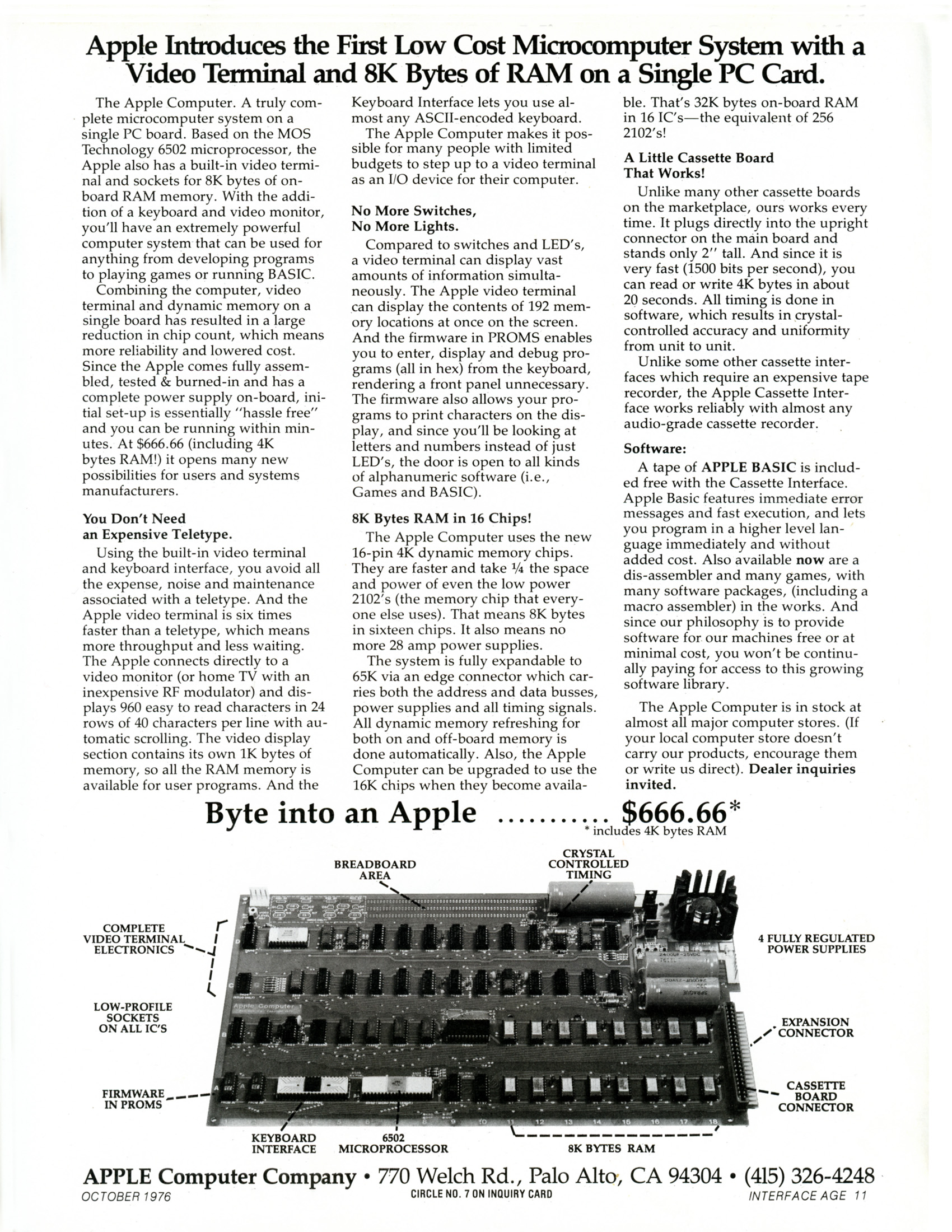
Still the advertisement is filled with details like the number of chips, the number of pins, etc. If you're dealing with chips and pins, it's always going to base-2.