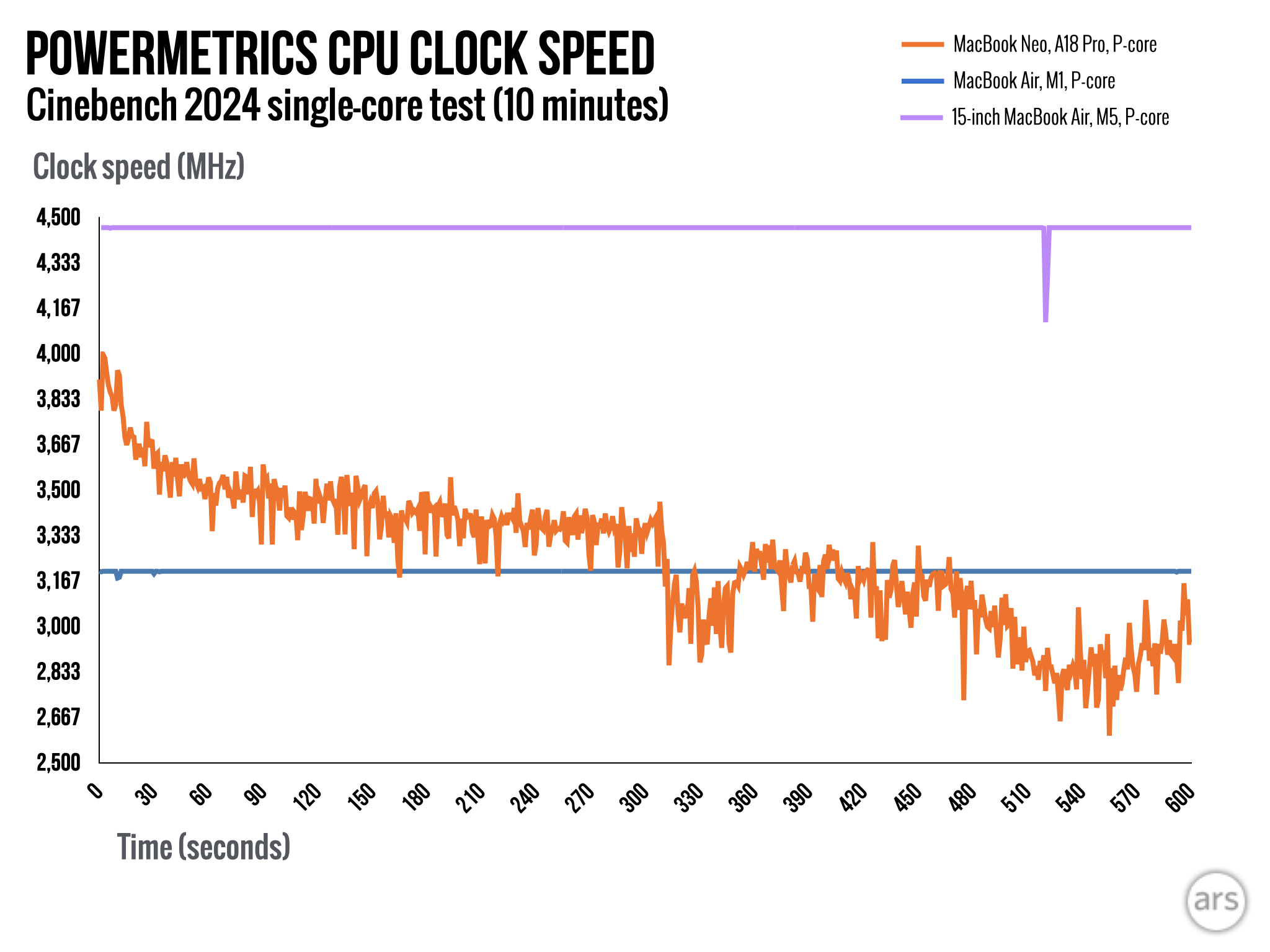
In my personal experience, 13” M1 MacBook Air, 15” M4 Macbook Air, M4 Pro Mac Mini, and MacBook Neo, the Neo is the fastest for single threaded and strictly CPU bound tasks. E.g. calculating 200x200, 1000 max iterations Mandelbrot fractals it does ~785 in ten seconds compared to ~760 on the M4s and somewhere in the 600s for the M1.
Given its RAM size I’m not going to be spinning up VMs, but in terms of general purpose computing it’s more than adequate. And, out of the box, you get a word processor, spreadsheet, presentation, video editing, digital audio, web browser, and a bunch of other things. Xcode is free. This is easily a laptop you can buy and use for years in 90% of settings.
Yes, all the M-series have more cores, they often have better thermal management, and they have more memory bandwidth. (The the Neo still has crazy high bandwidth.) But, for a single threaded, strictly compute task that runs in 10 seconds, it outperforms the M4 cores. I don't know why, I'm just sharing my experience.
Many security cameras have the ability to record audio. Depending on where you are, it might be illegal to use it. All the cams I have purchased have it. That would include ReoLink and a recommended model from the Frigate site.
I don't mind it at all for decorational images, but in this case I would mind. I suppose I would mind the inaccuracy, the worry that the creatures might not look exactly like the real world ones look.
Not that it actually matters but if those images were generated it would feel pointless to me, even if I can't tell the difference.
It can matter to you without it being a grand philosophical, ethical or commercial concern.
That's where I'm at with this stuff, and I think I am in good company.
The image represents a facsimile of seeing the real world with my own eyes, which an AI image does not. That is important to me in this context, that of learning about the real world by literally observing it.
> Not that it actually matters but if those images were generated it would feel pointless to me
I also very much felt like it doesn't really matter, perhaps too much and without considering other potential points of view, that's why the "plenty of worries" seemed so strange to me. How could you experience plenty of worry over an internet site being disingenuous about facts or images? You'd be freaking out all the time. But I can see now that it could be serious for some people in this case.
Yes please, but do it in a way where the government doesn't know what services am I using and the service doesn't know who I am beyond being a unique non-registered human.
I'm not sure this is possible in EU and US. And I'm sure it is not possible worldwide.
As always when this pops up, I'm asking what options are there to prove that a user is human that are more privacy friendly (and as the author puts it, less creepy).
Because the problem World claims to try to solve is real.
I’m glad you asked. I’m working in a competing product named Globe that will offer twice the service at half the cost with a greater emphasis on security and privacy than Sam Altman ever could.
All you need to do is send me your biometrics, and if you don’t feel like doing that willingly I’ll use the billions of dollars of capital that my friends and I have to coerce you into doing so because I’ll leave you with no other choice.
The problem we at Globe are trying to solve is real and necessary to solve.
People who oppose it are obviously the problem, not me and the existence of a problem is sufficient reason for me to coerce people into accepting my solution without government oversight because my friends have been diligently working hard to reduce the ability of governments around the world to do so.
Imagine A system where there's a vending machine outside City Hall, you spend $X on a charity for choice, and you get a one-time, anonymous token. You can "spend" it with a forum to indicate "this is probably a person or close enough to it."
Misuse of the system could be curbed by making it so that the status of a token cannot be tested non-destructively.
I like the idea, but I'm not sure it solves the problem enough. I'm not convinced that there is an $X where the service is not too cost prohibitive for humans and at the same time cost prohibitive enough to discourage bots.
In the specific case of Tinder you might as well just make Tinder paid and skip all of this.
There's a rather rich spectrum of solutions, and too-often often the debate becomes a binary of comprehensively-identified versus uncontrolled-anonymity". By clarifying our requirements, we can get better mixes of cheapness and privacy.
For the average web-forum, you don't really need to know that an account is a human, let alone a unique human. It's enough to know that whatever is on the other end (A) likely cares about what happens to the account if it doesn't follow rules and (B) probably isn't running a hundred sockpuppets, or is at least taking a risk doing so.
I think a key part of the idea is that it's a vending machine you'd have to physically interact with and not an online service. That would filter out bots pretty effectively.
Yubikey type device issued by an authority trusted by the website owner. Same as we have it now with browsers and SSL certificates.
We can even have a key issued by the government as a digital ID card. They can be used to check: is over 18, is real person, for digital signature, etc.
Yes, I agree, but as one of the other comments say, they are not able to read your mind. So even if the structure and style is not clear, you must be able to express what you want.
Certainly. I just think "expressing thoughts in words clearly" might in the end turn out to be something different than what we, humans consider clear.
For example long unstructured rambling might turn out to be a non-issue, while as human I would rank such message low no matter how good it is in other informational aspects.
That's true. I feed Codex some very long .md files that I use as a kind of work diary and that are pain to use into something very much usable. Writing your thoughts is important even if done carelessly.


reply