I have never played bridge so my opinion is of a complete outsider's. You can also see me as the devil's advocate.
What if we just accepted "cheating" to be part of the game? Such that every team is allowed to devise their own way to communicate in subtle manners (barring the use of electronic devices). And so part of the game would be to figure out the opposing team's code. There is really no way to prevent communication when you have physical presence. If you really want to prevent communications, sit them in separate rooms and make them play through computer terminals.
Catcher signals are used in baseball, we don't call that cheating.
And to bring up another analogy. Remember how in the anime Naruto, the kids have to take a paper exam to advance? The questions in that paper were hopelessly difficult for the candidates, and it turned out that the real exam was for them to attempt cheating without being obvious.
And please don't get me wrong. I'm not saying that what Fisher and Schwartz did was ok. They were clearly violating the existing rules. What I'm saying that trying to enforce a rule forbidding communications when you have physical presence is an exercise in futility. It's just that maybe we should consider changing the rules or how the game is played.
I don't know about bridge either, but I think that all rules of sports and games are conventions, which I suspect evolve to optimize enjoyment for players and fans.
In a sport with "offensive" and "defensive" sides, a poorly thought out set of rules could give a compelling advantage to one side or the other, making the sport un-interesting to watch. Rules will evolve over time as new techniques are developed, that give a particular style of play too much of an advantage.
If you don't know what's actually occurring in the game, because it's happening in a trailer next to the arena, then your interest in watching the game may wane.
In some sports, the suspicion of widespread cheating (such as doping and financial shenanigans) at the elite level dampens public enthusiasm, which becomes a marketing issue.
Maybe its hard to get if you're not used to the game, but cheating like that is amazingly offensive.
Screens aren't used very often though - I wasnt a great player, but I played in the youth championships in Sweden a few times, and we didnt use screens, and I never once felt like it was needed - it's just not the done thing to cheat.
If you take that to a logical extreme (and humans do take things to logical extremes... ) it becomes a game more about electronics intelligence (jamming, jam evasion, cryptography, steganography... ) which, don't get me wrong, would be amazingly amusing to watch if you even could watch it, but would devalue the relative contributions of the card players and would put more emphasis on having money for equipment and the salaries of specialists.
You could fix that by making sure every team has the same budget and watching the financials closely to ensure nobody goes even one cent over, which should once again move the competition into the realm of being mind against mind instead of checkbook against checkbook. For added fun, make all purchases and hiring decisions (and make sure all team members are hired and salaried out of the total budget) public information, so each team can fret about what every other team just spent money on and why and how all those things can be used and which are decoys and which decoys are actually useful and we should buy that decoy and...
The problem with this suggestion is that your opponents need to have exactly the same information about your bid as your partner does. In fact, at any point during bidding (when it's your turn to bid) you can ask the partner of the person who made a bid to explain the meaning of the bid and they need to answer to the best of their knowledge (or you can consult their bidding card).
Using any "subtle" ways to communicate provides additional information to your partner that is not available to your opponents, and that's why it's cheating. If this is allowed, then the main effort would go into devising ways to clandestinely pass that information and since knowing your partner's hand gives your huge advantage, it would significantly change the game.


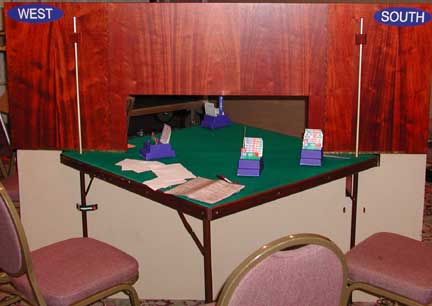
What if we just accepted "cheating" to be part of the game? Such that every team is allowed to devise their own way to communicate in subtle manners (barring the use of electronic devices). And so part of the game would be to figure out the opposing team's code. There is really no way to prevent communication when you have physical presence. If you really want to prevent communications, sit them in separate rooms and make them play through computer terminals.
Catcher signals are used in baseball, we don't call that cheating.
And to bring up another analogy. Remember how in the anime Naruto, the kids have to take a paper exam to advance? The questions in that paper were hopelessly difficult for the candidates, and it turned out that the real exam was for them to attempt cheating without being obvious.
And please don't get me wrong. I'm not saying that what Fisher and Schwartz did was ok. They were clearly violating the existing rules. What I'm saying that trying to enforce a rule forbidding communications when you have physical presence is an exercise in futility. It's just that maybe we should consider changing the rules or how the game is played.