Thanks for this. I'd think a metal would fracture very easily if there existed a well defined boundary inside, which is what a crystal is. Seems like a property you wouldn't want inside of a jet engine, but what do I know.
"Grain" refers to crystal that internally has that crystal structure, but externally has whatever shape it just happens to have. Grain and crystal are almost synonyms. Regular steel has grains inside, which then have atoms inside organized in crystalline way. In between the grains are "grain boundaries" which are not organized in any way. Different grains have different directions.
If a crack starts to grow through steel, it first needs to penetrate a crystal. It can go "easy" by following some plane that doesn't have any atoms laying on it. Then it needs to go through amorphic (=disordered) boundary region, but now the crack can't go easy. The next grain extremely is unlikely to have nice plane continuing right after the first one. In practice the crack will have to follow winding path and this long path will consume more energy than short one.
Here is image of steel grain structure. The white are grains, the black are amorphic boundary regions.
Practically making grain size smaller is one of the best ways to resist crack growth (=fatigue strength). Other possibilities is to have different sized atoms in the crystals, so there are no perfectly straight planes for the crack to grow. And it's also possible to several different crystal structures in different crystals. But also different structures inside single crystal.
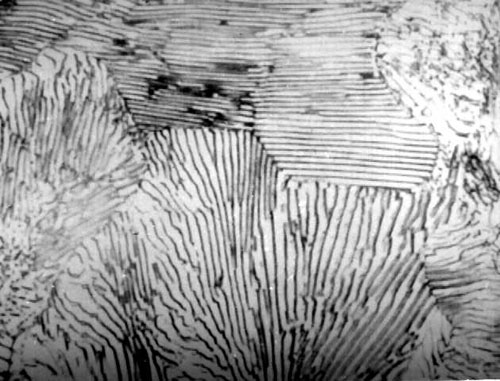
Here is "pearlite" microscopic image. The black stripes are one crystalline structure and the white ones are another. But they are well aligned and therefore don't require any disorganized boundary when they are side by side.
Sometimes you get bullshit like excessive boundary precipitation. Like in some stainless steels in certain heat treatments, the chromium relocates to the grain boundaries. This leaves the base metal chromium free and makes it soft. And also the grain boundary becomes lot more distinct entity. Now the crack can easily travel along the boundary layer, as the pure chromium boundary is not that well attached to the steel grains.
Also normal cast iron suffers from carbon flakes that are easy crack propagating mediums. Metals attach to metals nicely, but carbon is not metallic, so it's automatic weak spot. Broken cast iron can have almost black cracking surfaces. For this reason guys invented "nodular cast iron". The carbon makes little balls inside the iron, so it offers very little ways for cracks. It has almost as good mechanical properties as steel, but is lot easier to cast.
TL;DR Grain boundary is usually not distinct surface inside the material. It's just where one way to organize atoms shifts into another way to organize atoms. But it's still continuous solid.
Okay, it's all coming back to me now. I remember in one physics class we talked about magnetic grains. So this is the same thing.
When someone says "single-crystal", I think of a structure with zero boundary regions, a structure made up of one big grain. This is what was in the title of the article. Does that describe this turbine blade?