Closing nuclear power plants and replacing them with coal power plants is simply criminal. In Europe, coal pollution kills ~20,000 people each year (), nuclear never killed a single person, and no study could ever provide any mortality increase due to nuclear energy (outside the Tchernobyl accident, which killed between 200 and 4000 people depending on estimations, after 20 years of study)
To be clear: nuclear is not the perfect solution, is not a renewable energy, and will have to be replaced by something else in the future. But this is the least deadly energy, even safer than wind or solar power ()
How is the mortality rate of wind and hydro calculated? Is it from engineers being killed during maintenance/construction? It feels like those two would have a mortality rate or something similar to "a house."
Specifically, hydro was the cause of the worst single power generation accident of all time: 171,000 dead when the Banqiao dam failed.
Before anyone assumes that will never happen again: There are fears over multiple large dams, including Mosul, where a failure worst case could kill a million.
If we're lucky Banqiao will be a one-off, but large dams are massive risk factors because they need ongoing maintanenance forever, and are often upstream of some of the densest populated areas. On top of that they're also ecological disasters.
Also when they are properly maintained. You don't want to be the maintenance guy getting killed by the combination of high water pressure and a 1cm wide opening.
In addition to the factors unique to dam failure, large construction projects will statistically result in dead workmen - at least over multiple projects.
Well, really every form of power generation either involves construction or people clambering about on roofs they might fall off of. But this is the reason that forms of power generation with no pollution still kill a certain number of people per trillion Whr.
I'm no expert on Chernobyl or power generation. But I think Chernobyl was the result of under-investment and poor management, whereas many of the deaths from coal are an unavoidable consequence of burning coal. Hence, you can say nuclear is safer as long as it's managed well.
The other major flaw of RBMK reactors is a dangerously high positive void coefficient of reactivity, which self reinforces the nuclear reaction in case of a loss of coolant accident.
Isn't the point that even with the current mixture of managment, it's safer? However, I don't know if these numbers include the long-term risk from storing/processing the spent fuel.
50 years of operation of hundreds of plants. We could have had a repeat of all of the accidents every year and it would still be one of the safest alternatives.
Heck, we could have Chernobyl every year, and even based on the current worst case estimates of reduced life expectancy and counting every one of them as a death, we'd still not compensate for 1 Banqiao failure, or more than 1-2 years worth of coal.
But we're not having a Chernobyl every year. What we are having is vast numbers of preventable deaths due to other types of power generation.
We're talking millions dead over the last 50 years due to other types of plants.
I think you have to be careful here. It's entirely unclear how small dose exposure over long times damage humans. There might be a threshold effect: Some people speculated that low doses actually help, as they trigger the DNA self-repair systems. Slightly more, and that self-repair can't help anymore. So 1 Chernobyl might be fine for people further way, let's say, in the US, 2 or 10 or ... and you suddenly get a lot of Cancer deaths.
If you look at what medicine deemed as safe, the limits were reduced every couple of years.
new design exist that in case of disaster self contains under most conditions, trouble is it's very hard to obtain certifications needed for operation today as opposed to decades ago, so we're mostly stuck with old designs.
I think the important difference is killing people when running as intended, versus killing people when disasters occur. In a way, a Nulcear power plant is similar to dam; when the dam breaks, it's a serious disaster, but as long as it runs as intended, humans aren't really at risk.
That's not true. Coal pollution and deaths are guaranteed mainly by economic disincentives to using clean coal technologies. Even mercury and CO2 emissions could be captured. But then, that would likely make solar the clear choice.
Because solar is intermittent, and isn't practical at all in many parts of the world. The true environmental impact of nuclear is also arguably less, since solar requires a lot of space per watt produced by comparison.
Next-gen nuclear reactor designs from Thorcon Power, Terrestrial and others are very near to perfectly safe, and also produce much less long-term nuclear waste than current designs. There will be an ongoing need for clean, high-density electricity sources.
> Because solar is intermittent, and isn't practical at all in many parts of the world.
The solution to that is simple, use less power at night. I.e. don't make so much aluminum when there is no sun or wind. We could decide as a society to trade a few percent of our wealth for using much less coal and nuclear if we wanted (and if our society were organized in a rational fashion).
Also: don't heat with electricty, but use e.g. solar thermal or geothermal power.
Night isn't the only source of solar intermittency, overcast also has a large effect. Solar also isn't cost effective at higher latitudes. When people are freezing to death, your simplistic approaches won't appeal much.
Efficiency is great and should be encouraged. We still need increasing amounts of reliable, plentiful and cheap energy going forward. You may be willing to accept a diminishing standard of living, most are not.
Because solar is largely unsuitable for base load power stations. Only solar thermal with molten salt storage or a gas pipe nearby to run the turbine during the night counts for base load. Otherwise we are talking 0.2-0.25 capacity factors.
Those nuclear accidents are covered in those numbers. The deaths from nuclear have simply not been very high, and the amount of energy created is massive. The result is a very low mortality per unit of power.
Based on this list, even the summed death toll of these incidences is still massively lower than the single worst incident involving hydroelectricity: https://en.wikipedia.org/wiki/Banqiao_Dam
If every single nuclear plant exploded like Fukushima a productive lifetime like Fukushima had did that would still be only an order of magnitude more deaths from nuclear than from coal.
Nuclear killed a lot of people already and will for the next thousands of generations. There is still no proper prospect of how to get rid of that poison.
That's not comparable to any other technology.
That's why nuclear energy needs to demolished and banned.
We do little to even try to contain that waste, and aren't even thinking of how to 'get rid of it'. The effects of this radioactive waste are totally overshadowed by the 'conventional' pollution caused by coal.
We could take all the current nuclear waste, grind it up, and pump it into the atmosphere and there is still no reason to believe that it would lead to more than a blip in terms of mortality compared to coal.
In addition to the reductions in air quality that kills vast number of people from coal - multiple Chernobyls every year - coal plants also pump vast quantities of radioactive material like uranium particles into the air.
While nuclear waste would pump nastier stuff into the air, we know the consequences from Chernobyl: Most of it gets washed out and end up on the ground quickly. What doesn't tend to be less dangerous particulates like cesium isotopes.
I'm obviously not suggesting that we should, but that pretty much the worst possible scenarios you can think of would still end up killing fewer people than coal.
Right now I feel that nuclear waste would be easier to handle than run-away greenhouse effect. Of course renewable is by far the best energy option in conjuction with using less.
But all things considered I have given up hope that that will actually work in time - thus, by all means, we should build as-safe-as-possible nuclear power plants for the transition and shut down all fossil-based versions immediately.
Soon it will be possible to use most of the waste as fuel:
"...Fast reactors can "burn" long lasting nuclear transuranic waste (TRU) waste components (actinides: reactor-grade plutonium and minor actinides), turning liabilities into assets. Another major waste component, fission products (FP), would stabilize at a lower level of radioactivity than the original natural uranium ore it was attained from in two to four centuries, rather than tens of thousands of years"
The worry people have about nuclear waste is greatly overblown. The amounts generated are small and in a relatively short amount of time we can use most of this "waste" to generate electricity.
As a comparison, how does coal waste compare to that?
"Coal ash – the waste material left after coal is burned – contains arsenic, mercury, lead, and over a dozen other heavy metals, many of them toxic."
How much coal waste is produced per year? Is it small enough to deal with easily?
"According to the American Coal Ash Association's Coal Combustion Product Production & Use Survey Report, nearly 130 million tons of coal ash was generated in 2014."
(And yes, I know the people who oppose nuclear power usually will say they don't like coal and natural gas either, but we are going to need a predictable, reliable form of base load power for a long time. One of these three ways of generating electricity has much fewer health consequences than the other.)
Fukushima has demonstrated that humans aren't great at controlling or predicting the real risk of nuclear. The fact is, even if no one dies from acute radiation poisoning, nuclear disasters are costly and devastating.
Dunno. The Tsunami killed upwards of 15000 people. I don't have figures, but I am sure that a good number of these were not killed by the wave directly, but by technical contraptions that failed, crushed them or what have you.
One of these many technical contraptions that was damaged/destroyed by the Tsunami was the Fukushima Daiichi Nuclear Power Plant. Yet, so far not a single person has been killed as a result of that failure, and so far the predictions are that future deaths will be so low as to disappear into the statistical noise. (And these predictions tend to be on the high side: the WHO created reports every decade after Chernobyl, and each report massively revised those estimates downwards).
In fact, even when your reactor does NOT explode, you still have to manage the waste for 10,000 to 1,000,000 years (see https://en.wikipedia.org/wiki/Nuclear_waste#Long_term_manage...). The radioactive materials are not only deadly due to their radiation; most of them are also highly toxic.
So even without a meltdown, you risk many lives in the future. Just because not many people have died yet does not make it a safe energy choice. Who in their right mind can guarantee safe storage of the waste for 10,000+ years?
You don't need to be able to guarantee safe storage for 10,000+ years. For starters most of it can be reprocessed and reused, resulting in less dangerous waste. But no matter how reckless you decide to be with it, the amounts are small enough that it'll be nothing compared to the devastation caused by coal.
It has been done since the 70's [1]. It has been banned in the US since '76 due to proliferation concerns. There are certainly challenges, but most of those challenges are down to stupid choices that were made in the 60's. Newer plants will continue to bring down the cost of using reprocessed fuel.
>There would be more deaths if Japan and Tepco would not pour billions of dollars into collecting as much waste as possible.
(a) Citation needed.
(b) How many more deaths?
(c) Sure, it's good that we clean these things up. There would be more deaths from cars, airplanes, trains or just about anything if we didn't do something about it.
From the NYTimes article:
"400 tons of water a day"
Sounds bad, right? Except when you compare it to a coal plant, which produces about 350 tons of ash (which is more radioactive) and >500 tons of toxic sludge per day in normal operation.
Oh, and just how bad is that water?
"The authorities are debating whether it might be acceptable, given the relatively low radioactive levels in the water, to dilute the contaminated water and then dump it into the ocean."
And of course that is "low" under the current rules, which follow the linear extrapolation ("no safe dosage") assumption that is almost certainly wrong, and tend to be extremely conservative even within that framework.
"200,400 Cubic Meters of Radioactive Rubble"
Again, there is no context given. For water, 1 cubic meter is exactly 1 ton. Concrete is 2.4 tons per cubic meter, but it isn't clear how dense the rubble is. I am guessing significantly less dense than non-rubble concrete. But let's assume this is about 500 Kilotons of rubble, how does that compare?
"Reports indicate that some coastal areas generated as much as 4.35 million metric tons of waste each from the disaster,"[1] (that's the Tsunami, not the meltdown)
So that's about 10 times that amount, from each of several/many(?) sites. How radioactive is the Fukushima rubble? The New York Times article doesn't say, but the one I found (which also mentions 500 Kilotons) says that they measured "133 Bq/kg, well below the limit of 8000 Bq/kq". So 80 times below the limit, and the limits are conservative, so they are just processing it with the "normal" rubble from elsewhere.
How much is 133 Bq/kg? Well, the Potassium inside the human body means that humans produce around 40-60 Bq/kg[2], or a total 4000 Bq per person. Coffee is 1000 Bq/kg. Coal ash is 2000 Bq/kg. 1 household smoke detector with Americanium is 30000 Bq (not per kg, per unit).[2] Bananas are 31 Bq/g, so significantly more radioactive![2], with a single typical Banana of 175g being equivalent to 40 kilos of that rubble. So the rubble is not really all that radioactive and not all that scary.
And so on and so on...
Anyway, I fully understand where you are coming from. Nuclear is scary and the reporting is so incredibly one-sided and innumerate that it is hard to believe just how slanted it is. It certainly took me a while, because I wasn't suspicious, if anything I suspected the media were under-reporting. They aren't.
Fukushima has demonstrated that relying on 60's technology and refusing to upgrade or invest because of political sensitivities exposes you to disasters 50 years down the line.
It's like if everyone got afraid of airplanes in the 1980's and kept flying the same ones from the 60s through today because people were afraid to build new ones. Would you say air travel was unsafe, or that we made poor technology investments?
Now you understand a tiny part of the Energy business. 'Nuclear' is not only a technical problem, it is a financial problem. Old plants will be run until they collapse - unless a regulator keeps the companies from doing that. But then the regulator comes onto pressure, because there is huge amount of money/corruption involved to keep the plant online. Every single plant is a multi-billion dollar investment, jobs, surrounding industry, ...
Tepco from Fukushima claimed until the day their plants were hit, that everything was totally safe. Politics supported them. Nobody was questioning them.
Right, it will cost only a few hundred billion dollars, maybe a trillion, to clean up the effects from the earthquake on the nuclear power plants.
The country lost most of their nuclear power plants in a single day. It takes years, if not decades to bring them back online - partly. 50 plants. Each worth, say, ten billion dollar (current worth and future earnings - just an estimate). That loss alone goes into the hundreds of billions. Additionally fuel had to be imported, other plants had to be built.
'Currently 42 reactors are operable and potentially able to restart, and 24 of these are in the process of restart approvals. The first two restarted in August and October 2015.' Six years after the earthquake/tsunami.
Only a few ten thousand people, maybe a hundred thousand, will work in Fukushima under extreme circumstances to keep the site stable and clean it up the site for the next five decades. Robots die regularly after a short time inside the reactors. Humans get a year worth radioactive exposure in a few hours. Where to get all the people needed to work there?
We have experience to dismantle functioning reactors. Here we have damaged reactors with damaged fuel...
Very little effects... I don't think so. The effects were much more severe than the industry thought. They were thinking that most of the reactors would operate again, by now.
World-wide reactor projects were seeing delays. Companies have a hard time to survive. All these are effects of a single earthquake/tsunami on the nuclear reactor industry. It's a huge financial catastrophe for the nuclear industry and the countries financing it.
> There was no actual need to shut down the other plants, etc
That's your personal opinion. I think it's naive, because you had actually no idea in what state the other reactors were.
The OFFICIAL REGULATION AUTHORITIES for nuclear safety in Japan had a different opinion. Some plants had damages, were shutdown because of the earthquake, every plant needed inspections and every plant needed full safety reviews. That it takes so long to bring some of the reactors back shows that there are lots of doubts about their safety and the industry will need to do more than just say 'there was no need to shut them down' - nobody believes that.
Here you can find a good overview what the authorities are doing and when reactors might be restarted - if at all:
Japan sits on a seismic very active region and severe earthquakes and tsunamis happen. It's only logical after such damage to question the whole safety architecture. Are the spend fuel pools in similar unfortunate positions? Are they full, too? What happens at complete loss of outside electricity? Are the reactors able to safely shutdown then, unlike Fukushima? Can the spent fuel pools be cooled? Are there instruments in the reactor able to survive massive damage in an earth quake? There are many many questions which have not been asked for a decade, because the consequences would have been costly upgrades and even the shutdown of reactors - for example those sitting near fault lines.
Given that the nuclear industry in Japan is corrupt and runs very old reactors with severe design mistakes, I think it is only justified to shut down the industry for a full review. That would also include the whole network of politicians, research, industry, utilities, ...
"The OFFICIAL REGULATION AUTHORITIES for nuclear safety in Japan had a different opinion"
Citation needed.
I could not find anything supporting that claim in the article you linked to. In fact, there is an article saying the regulator refused to shut down a plant [1]
"Despite attempts by politicians in Tokyo to persuade them to do so, provincial governors and local communities won’t allow them to restart."[2]
"Utilities were unable immediately to restart them due to public opposition."[3]
Also, the regulator that called for tougher standards was a new regulator, politicians having replaced the old one. So very clearly a political move.
So as I wrote, the shutdowns were largely political (or in some cases, routine shutdowns for maintenance happened and the reactors were then not allowed to restart for political reasons. Same difference).
> politicians having replaced the old one. So very clearly a political move.
The old regulator: 'The Nuclear & Industrial Safety Agency (NISA) granted a 10-year licence extension for Fukushima Daiichi 1 in February 2011, after technical review and some modifications in 2010.'
In March 2011, a month later, the reactor was destroyed incl. a fuel meltdown. It will take decades to clean up the mess. It wasn't even this reactor alone, units 2,3 and 4 were also damaged. Units 5 and 6 are given up in 2013.
Yeah, it was definitely a political move to replace the old regulator. The regulator was corrupt, incompetent, without power, ... The experts have failed. They had granted a ten year life extension to a reactor, which only days later was destroyed in a large scale accident.
It took a political move to replace them. Fully justified.
Don't read the torygraph or treehugger. Read the updates from the World Nuclear Association:
> Yeah, it was definitely a political move to replace the old regulator.
> The regulator was corrupt, incompetent, without power, .
And that was a legal decision? A technical decision? Oh wait, no! It was a political decision. Made by politicians.
> It took a political move to replace them.
Exactly. So why are you scoffing at me saying that it was a political move?
> Fully justified.
That's your (political) evaluation of that decision. Hmm...last I checked you scoffed at me for my evaluation.
You keep citing that article, but it proves my point.
"However, following the Fukushima accident, in October 2011 the government sought to greatly reduce the role of nuclear power."
Political decision.
Anyway, you still haven't provided any citations to prove your point, and haven't refuted my quotes that clearly show (a) that shutdowns were often routine maintenance (every 13 months) and (b) that blocking startup was frequently due to local political opposition.
So in essence, you have an opinion and not much else.
> Oh wait, no! It was a political decision. Made by politicians.
I'm not sure where you live, but in the country where I live energy policy is done by elected politicians, not by unelected technocrats.
It's their job. That's why we elect them.
The decision to replace the old regulatory body was made because the old regulatory body failed. Technically. Practically. In every single way. A nuclear reactor which they just granted a 10 year lifetime extension blew up days later and was a total wreck then. A multi-billion-dollar-wreck. Who would have left these people in office?
> Political decision.
You say that in a negative way. Every decision done is political. You live in a fairy tale world if you think unelected technocrats should make the decisions. The job of a politician is to make decisions based on all kinds of influences: technical, economical, social, ... That's exactly their job. If a technology (here nuclear) is not safe, costly, has no acceptance, etc, ... then this technology has to be reduced/removed and has to be replaced by safer technologies.
Politicians decided to invest into nuclear and set up the market, the regulatory bodies, the financing, etc. for it. They can also decide to reduce or completely abandon nuclear - if the voters demand that. That's why we have them.
Energy policy is political. Energy policy decisions are finally made by politicians we can elect. Not by TEPCO, Toshiba, ... There are huge amounts of money involved, paid by the tax payer (there is no other insurance of a nuclear power plant, the tax payer pays this show: the taxpayer finances the research, the infrastructure, the financing of the plants, and it keeps bankrupt companies like TEPCO from collapsing by pouring more money into them) and by electricity consumers. No nuclear power plant would exist without political decisions, public money, and a distorted market. It's no wonder nuclear especially grows in authoritarian states like Russia and China. There unelected technocrats make the decisions in combination with authoritarian politicians.
> quotes that clearly show (a) that shutdowns were often routine maintenance (every 13 months) and (b) that blocking startup was frequently due to local political opposition.
You still have not read the overview of the World Nuclear Association. Japan had literally to invest many billions to upgrade their reactor fleet. Old ones which weren't economic to upgrade were closed. Dangerous ones, for example sitting on top of fault lines, are not being opened again.
Possibly to you sitting on the other side of the world. Not so for the thousands of people displaced who lost their homes and communities through no fault of their own and might be exposed to higher cancer rates in their lifetimes.
Yes, the evacuation zone almost certainly should have been smaller, that's one of the perverse effects of the panic about nuclear, that the mitigation efforts tend to be overblown (not that they should be zero), and therefore the damage from the mitigation much worse than it needs to be.
But you missed the word "comparatively". We have lots of human-/technology-induced deaths and injuries. We allow car traffic in our cities at speeds that kills and maims thousands, often children. These are completely avoidable, just lower speed limits to 5mph or less. The US allows more than ten thousand gun deaths every year, because "reasons". etc. etc.
So yes, the effects were comparatively benign, compared to most of the technology we surround ourselves with, and certainly compared to all power-generating technologies we have (including solar). Not absolutely benign, though it would be interesting to compare the damage even of accidents like Fukushima to the benefits (in lives saved) of the electricity that was produced.
Fukushima Daiichi 1 just go a ten year life extension in feb 2011.
A few days later it was a multi-billion-dollar wreck.
Not at 'end of life' obviously does not mean 'safe to operate'. 'end of life' is also not a fixed date. Once the initial 'end of life' date comes, the owner will see how to get a life extension. Fukushima Daiichi 1 had an inspection, some upgrades, got the life extension. Following month this was one of most costly decisions ever made in industry.
And even with all of these obvious and avoidable mistakes, there were no fatalities.
In fact, it was Fukushima that turned me around on nuclear. I always thought that the risks were just too great, that if you weren't perfect there would be disasters of unimaginable proportions. And humans just aren't perfect.
Actually, none of what you said refutes the parent post, rather proves the point. Humans as a group have demonstrated a lack of maturity handling nuclear power.
And demonstrated maturity by burning coal that as part of normal predictable operations kills thousands a year? Humans' continous insistence on burning coal instead of thorium may well be our Fermi filter.
Of course not. Demonstrated even MORE immaturity by burning coal. Aliens discussing us: "are the earthlings burning coal for fuel? I thought you said they couldn't even handle nuclear fission?"
"Yes dear Sklaar, it's even worse than we thought. Can you believe where they put the exhaust? Straight into the atmosphere!"
And so it happened that Earth was put into another 1000 years of no-contact-policy at the latest board of review, kids...
A lack of maturity by what standard? When we say such things of an individual, we do so by comparison with other individuals. With whom do you compare our entire species?
I can at best give you a circular (or spiral, given that generations pass) argument: nuclear has not demonstrated that it has a great appeal to current stock of humans.
It didn't because humans are not rational and bad press is highly overblown. Mostly because of link to weapons of mass destruction I suppose.
Nobody says anything about the health and ecological disaster that is coal and oil. People do not attribute mining deaths to it and are bad at linking long term chronic health effects to them.
A red herring of solar and wind is proposed that people haven't rejected due to outages thanks to the other technologies covering its major drawbacks.
Likewise hydro disasters are not covered as much as they should.
3) Crippling fire causing loss of power to all control circuitry.
Even with all that, the number of direct radiation casualties was zero. There are about six workers who got more than a lifetime allowed dose of radiation. They may have an increased cancer risk.
1) How many do you suppose would have died had it been a hydroelectric dam of similar capacity? (hint: a lot more than six)
That can be mitigated in the US because the entire country doesn't run along a fault line. Not so Japan. Yes, don't build your nuclear reactor in western California.
So nuclear apologists are simply offering a calculation, where the biggest risk/liability has been left out, because "what number should we put in?".
Also, I'm always fascinated of the "Chernobyl was unsafe, today reactors are safe" argument. The exact same line was fed to us when Chernobyl was state of the art.
There are good reasons to think that it may indeed be so this time. But the nuclear industry has lost all trust and all right to demand anyone ever trusted them again.
Actually we do, technically, and the amount is trivial (and can be reused, though that isn't currently being done). Spent fuel is a political problem. In fact, last time I checked even just the radiation from coal power plants is greater than from nuclear plants.
> The exact same line was fed to us when Chernobyl was state of the art
Chernobyl was never state of the art and western reactors, which are much safer, are also of a design derived from military designs, not optimized for safety. Also, the negative health effects of coal and other energy sources are so much worse than even Chernobyl that it isn't funny.
Consider airliners. Airliners have been around for 80 years, and get substantially safer every decade. This is a statistical fact. Every crash is used as a learning experience and designs, procedures, and training is adjusted as a result.
There's no reason to believe that such does not apply to nuclear power stations.
Outside of submarines and aircraft carriers, that is. We seem to have those pretty figured out.
You'd think that nuclear propulsion would be a natural choice for the biggest of the enormous cargo container ships that are currently burning millions of gallons of dirty, dirty bunker fuel instead.
Of course we do. You need to update your ken on nuclear and stop being willfully ignorant. Spent fuel is fuel for breeder reactors, at the end you sit with material that is less radioactive than Guarapari beach.
You blame the nuclear industry, I blame my own party, the Greens, and their relentless demonising of the one thing that could have reversed doubling of atmospheric CO2, and I forgot how many times sea C02 levels. And you and your anti-nuclear agitpop is pulling us further into this mess. Please educate yourself and stop being part of the problem.
Yes we do, we can reprocess most of it and then just store what's left - which is such a small amount it could just be buried and essentially forgotten about.
Throw the "spent" fuel in a breeder reactor, reduce it by >90%, store the rest (it's really not much, volume wise, and decays a lot faster after it's been through a breeder).
Large proportions of coal plants spew uranium particles into the atmosphere. That's the radioactivity I worry about.
> Also, I'm always fascinated of the "Chernobyl was unsafe, today reactors are safe" argument. The exact same line was fed to us when Chernobyl was state of the art.
And yet the death toll of Chernobyl turned out to be a tiny fraction of what was feared, and a blib compared to the death tolls from coal and other types.
Two of the reactors kept being operated for years. That's how small of a problem it turned out to be.
> There are good reasons to think that it may indeed be so this time. But the nuclear industry has lost all trust and all right to demand anyone ever trusted them again.
On the contrary they have demonstrated that the plants are safe enough that even in face of utter incompetency and criminal levels of negligence, nuclear disasters are manageable.
Unlike, say, collapsing damns, or coal plants that kill during normal operation.
In his posthumously published memoirs, Valeri Legasov, the First Deputy Director of the Kurchatov Institute of Atomic Energy, revealed that the Institute's scientists had long known that the RBMK reactor had significant design flaws.[16][17] Legasov's death from suicide, apparently as a result of becoming bitterly disillusioned with the failure of the authorities to confront the flaws, caused shockwaves throughout the Soviet nuclear industry and the problems with the RBMK design were rapidly accepted.[18][19]
- Wikipedia
The design of the RBMK and the lack of criticism were due to political reasons. Similar to how today we can't update or replace reactors.
>...To be clear: nuclear is not the perfect solution, is not a renewable energy, and will have to be replaced by something else in the future.
While we may want to replace nuclear with a different power source in the future, there is enough uranium and thorium to last hundreds of thousands (or more likely millions) of years.
On the other hand coal, wind and solar never poisoned our food (wild boars in Germany thousands of km away still often are too radioactive to be eaten ). Coal, wind and solar never led to emergency evacuations. Coal, wind and solar cannot be used to make atomic bombs.
> If coal plants had the same radiation rules as nuclear plants, they couldn't run.
I think you mean if nuclear plants had the same radiation output as coal plants, they would be required to shut down.
Edit: thanks for the downvotes, I realise now that I'm basically stating the same thing as OP.
Quite the double standard that coal plants are allowed to spew so much radiation when all other forms of power generation are held to a higher standard.
What @wbl wrote also makes sense. Nuclear power has a closed fuel cycle: what goes in comes out and is stored.
There's no way we could hope to capture all the radioactive particles from a coal plant exhaust, not in the foreseeable future with any reasonable efficiency.
Lesson learned: Don't trust Stalin and Beria with a nuclear plant. Or anything else, of course, but fortunately for everyone both men are safely dead and their danger thus permanently curtailed.
Just being closed cycle isn't enough. A couple of the early British reactors apparently exposed the public to low levels of neutron and gamma radiation in normal operation because part of the cooling loop was outside the radiation shield for cost-saving reasons.
A lot of early reactors did a lot of things we now recognize as members of the "pants on head" category of activities. We know better now because back then they didn't, and had to discover what not to do the hard way. We are fortunate to have such examples, and would be foolish to squander such hardly learned knowledge.
Burning coal for electricity generation has released in to the environment more radiation, heavy metals, and other pollutants than civil nuclear power could ever hope to.
Yep. What really astounds me is that, when I was younger I used to associated with a lot of self-proclaimed environmentalists, the sort of people who would go to anti-<whatever> protests. They were strongly against nuclear.
Ah the irony! It is the environmentalists themselves who are directly to blame for the situation we find ourselves in now. We could have relatively-carbon-free electricity today if they had supported nuclear power.
But, putting my tin-foil hat on for a minute, I am lead to believe that the anti-nuclear movement is actually perpetuated by the fossil-fuel industry. Or maybe my B12 dependant psychosis is playing up again.
Absolutely. We Greens (I am a loyal Australian Greens voter) scoff and roll our collective superior eyes at the stupid Libs and their proven boken models and then we demonise the one solution we have and have had for 60 years, and I wonder if we are so different from those we despise.
As a sibling comment pointed out, you may have selected a poor example there.
However, you raise a good point with the Fukushima and Chernobyl examples. It's not hard to imagine that if we had, globally, built nuclear power plants as enthusiastically as we have coal power plants, there would likely have been a lot more serious incidents. It's a sobering thought for my usually rose-tinted view of nuclear.
While I could probably have found a more dramatic reference, this one[1] is a bit more calm saying that the risks of adverse health affects from radiation exposure from coal vs nuclear are, in both cases, very slim. It would seem, then, that coal would have other negative health affects before the radiation exposure aspect became a problem. You have to live extraordinarily close to either a coal or nuclear plant to have higher than background radiation exposure from either, under normal operating conditions.
Coal have unavoidable casualties in human health and environmental degradation built into normal operations. Nuclear much less so, so while I also wear those specs, I still believe the argument for Nuclear is sound.
Another thing I like to point out is how much of a wildlife haven Chernobyl is compared to any moderate city. The fear that keeps the humans away, has transformed a "safe" dump into a paradise.
It's good that you don't mention hydroelectric energy, because based on your criteria this is the most dangerous way to produce electric power, killing 170,000 people in a single incident: https://en.wikipedia.org/wiki/Banqiao_Dam
Except that Banqaio Dam was required anyway for flood control purposes, so the choice wasn't between killing 170,000 people and using some other form of power. All that not using hydroelectric power would've achieved is to ensure that nuclear proponents could no longer blame those deaths on hydroelectric power. Not only that, nuclear power didn't exist yet when it was built. Which is probably a good thing - Banqaiao Dam was build significantly under the specs recommended by its engineer for cost reasons, then operated unsafely; can you imagine what would happen if China built a nuclear power plant with the same approach?
Couldn't you use the same reasoning for Chernobyl? A requirement to build an electric power plant, sloppy construction, sloppy operation, resulting in a catastrophic accident.
Exactly. Chernobyl was an unsafe design, when safe(r) designs were well known. Its operation was not just sloppy, the operation that was performed was a crazy experiment that was well beyond the operating specs of the reactor, clearly illegal and unsafe even in the best of times.
Coal releases proportional amounts of carbon dioxide when used to generate power. On the other hand, wind and solar release fixed amounts of carbon dioxide (during construction and transport) then generate energy C02 free.
..except for maintenance.
Does anybody have up-to-date numbers how long hydro/solar/wind have to run to recoup the energy used in production? For a while, Solar was essentially "let's import energy from Asia in the form of pretty sand", but I think this has changed.
> For a while, Solar was essentially "let's import energy from Asia in the form of pretty sand", but I think this has changed.
Considering the fact that efficient pv panels need less than 4% of their lifetime output for production (if in service 25 years (most panels last up to 40 years)), that must have been the late 70s or so.
You were probably remembering that 2010 study talking about the rapidly growing solar industry as a whole becoming net producers of energy, e.g. current industry energy input is now lower than current running PV output (http://news.stanford.edu/news/2013/april/pv-net-energy-04021...). But that doesn't say much about net energy production per panel over the panel's lifetime, e.g. if the PV industry would disappear this very moment, existing PV installations would still produce energy for decades.
The numbers I heard had a 50% replacement/failure rate or so after 10 years. However, that might have been related to the roof installations in Germany.
The Fukushima plant had a wall to protect it from tsunami and the motors to keep the pumps working when there the electricity fails. The whole design however didn't cover that particular wave:
This is research from the 1980s. It is undoubtedly correct, but it does not not apply to today.
Today, renewables are competing favorably against coal and nuclear power on price, and they are improving rapidly still. It takes easily 15 years to plan and build a nuclear power plant, while a solar plant can be planned and built in months.
The issue of what happens when the wind doesn't blow and the sun doesn't shine can be addressed through larger HVDC grids with a good energy mix and through storage technology, which is also improving rapidly. Meanwhile, nuclear has its own issues with the elements nowadays. Nuclear relies on huge amounts of freshwater. I've heard of nuclear plants that need to shut down in the summers now because of drought. It will become harder and harder to find locations where they can be built.
Finally, new fossil fuel plants built today are mostly gas, not coal. Gas also has its problems, but it has been a reasonable transition technology that is also losing ground now as energy storage technology is improving.
That is just semantics. I am arguing that a nuclear shutdown event would have different long-term effects today. In the short term of course, fossil fuel plants would still be able to pick up the slack, but there would be a larger share of natural gas than in the 1980s and were the shutdown to last longer it would be less costly to set up renewable energy plants. People in this thread are also using the article to argue about new nuclear development rather than only unplanned shutdowns. I am countering that failing to develop new nuclear energy no longer automatically means more coal pollution.
Yes, it emphatically is semantics. Semantics: the meaning of things, particularly words. That's important.
You probably meant "nit-picking", and I would suggest it was you who was engaging in nit-picking (though incorrectly) that this is outdated/irrelevant because it is from the past. So I see your incorrect nit-pick and raise you a correct nit-pick.
> I am arguing that...
Yes you are. Arguing, that is. And back then, you probably would have argued that shutting down that nuclear plant would have been a boon to health, because "evil/bad nuclear".
The thing is that this article is not about arguing about what you believe will/should happen, however strongly you believe that, but about what actually did happen.
> no longer automatically means more coal pollution.
It wasn't automatic back then either, just as it isn't automatic now. However, then and now the actual replacement is largely with coal, no matter what your preferences might be.
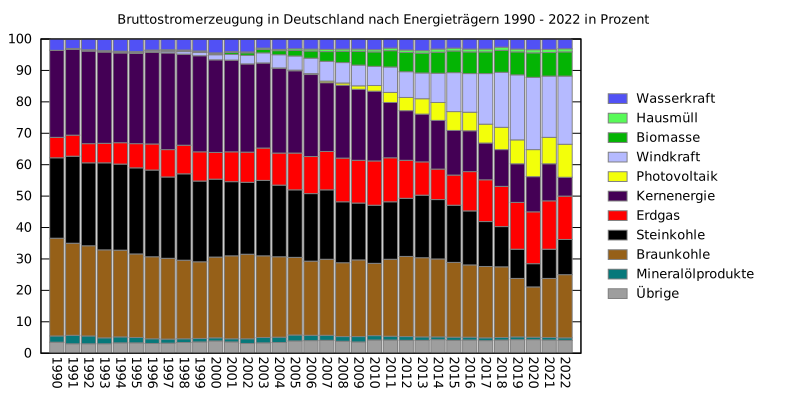
Germany: missing nuclear largely replaced with "new coal"
> Yes you are. Arguing, that is. And back then, you probably would have argued that shutting down that nuclear plant would have been a boon to health, because "evil/bad nuclear".
You're not only nit-picking over semantics, you're also making incorrect assumptions.
A 2014 article with projections for 2013 based on the author's own calculations on a site run by a mysterious owner with no credentials. The projections were completely wrong, by the way, as you can see here: https://www.energy-charts.de/power_inst.htm
Another shady source. I give you that if you shut down all reactors in a country with a large proportion of nuclear energy generation you will still be in a conundrum. Still, Japan made up for the gap almost entirely with natural gas, not coal.
"In 2000, Japan's coal demand was only slightly bigger than LNG consumption, around 60 million tonnes a year versus some 55 million tonnes for LNG, but gas use has now stalled while coal imports have nearly doubled since then."
Usually the sun not shining means higher wind speeds, not necessarily at the same location. In general a larger grid means less overhead is required. HVDC is tested and proven, UHVDC links are also being constructed now https://en.wikipedia.org/wiki/High-voltage_direct_current
electricity transmission powers aren't that trivial, even discounting the large saltwater ocean you'd have to cross to power the other side of the world (and the security implications for that infrastructure)
it's more of a storage problem. you can get quite efficient batteries using pressure/gravity chambers, but not all places are apt to host them.
The sun not shining at night can also be addressed with variable pricing. Electricity usage is elastic, and a lot of consumption patterns can be time-shifted.
The idea that electricity should have a fixed rate 24/7 is obsolete.
A very weird way to study the outcome of coal air pollution. It seems like this is not really about air pollution but trying to push nuclear energy. Luckily shutting down nuclear plants does not necessarily mean turning on coal power (e.g. in Germany they were replaced by renewables).
Some questions arise though: Which coal power air pollutant is to blame for the birth weight decrease. Which coal pollution mitigation techniques[1] (which are probably now more common) were used by the coal plants?
Do you have a reference for this? Germany has a very aggressive (and highly commendable) plan to move to renewables, but my understanding was that the closing of nuclear plants post-Fukushima was covered by coal. Wikipedia seems to agree (https://en.wikipedia.org/wiki/Nuclear_power_in_Germany):
At the same time, Germany continues to rely heavily on coal power, with usage increasing to offset the phase-out of nuclear energy.
> but my understanding was that the closing of nuclear plants post-Fukushima was covered by coal.
There was a minor uptick in coal usage for a few years, however even that wasn't necessary, but due to bad policy (gas plants were standing still at the same time). By now coal usage is going down again.
There were a couple of new constructions of coal plants, but all of them were started before the nuclear phaseout. And by now most of their operators recognize that their investments were failures and will probably never pay out.
It isn't all ideal in Germany, but overall it's going into the right direction (and the success of solar in many countries these days wouldn't have been possible without the early investments in Germany that brought the prices down).
And without the decommissioning, vast amounts of money spent on the decommissioning could have been spent on renewables to replace coal instead, and far less coal would have still been necessary in order to compensate for the decommissioned capacity.
It also meant less capacity available for export to countries whose fallback is fossil fuels from elsewhere.
The German decommissioning alone is likely to have been a far greater public health disaster than all nuclear incidents in human history combined many times over.
Pretty remarkable growth in PV! I do remember that Germany already had quite a bit of wind generators in the early 2000s, yet they seemed to have generated around the same amount of energy as the PV capacity of today. And that's been mostly build during this decade.
What's missing from this graph, however, are imports. I believe Germany imports quite a bit of nuclear power from France and coal power from Poland.
> I believe Germany imports quite a bit of nuclear power from France and coal power from Poland.
No, that is totally wrong.
While in an open net and marked there are always small exports and imports going on, overall Germany is an electricity exporter and imports are very small overall and not very relevant.
That might be true for net flows, but it seems that German production does not meet demand at nights very often, as per these statistics: https://www.energy-charts.de/power.htm . I do think that situation will get worse with increased PV installations, as they don't produce during nights. Grid storage is going to be needed.
Of course it's an open market and the German expensive production such as gas turbines will not produce if cheaper power can be imported.
There is another form of import which is much harder to judge. Germany imports a lot of stuff from e.g. China, so in some sense the energy production should offset what energy is used in other countries for the imported stuff.
That is true, but it's true for all countries. And it's a major failure of practically all existing climate and environmental regulations that they don't take this into account.
It's quite possible to import energy and still be a net exporter. As far as I can tell, Germany does both, although I would like to see a source for the grandparent comment's claim.
I think there was a post on HN about a year ago saying that Germany has a weird law or policy that says it can only produce renewable power for internal use, and for export it uses coal. I think this is only a political issue, because no one wants to tackle it when elections are this year.
Otherwise, the phasing-out of coal in Europe is looking pretty good, I'd say - they're looking to close the most polluting plants in Europe by 2031:
Yes they could equally say increased use of solar results in increased birth weights.
Really the take away here is simply "coal is bad" - there's correlation between coal plants and lowered birth weights.
Anything that supplants coal (nuclear, solar, wind, hydro, tidal, etc) will result in increased birth weights. Replacing them with coal will result in lowered birth weights.
It's a bit weird their pushing nuclear this way right now, didn't Westinghouse just go belly up?
This is a recurrent topic on HN. Somebody posts an article about "coal is bad". Then somebody mentions that nuclear is safer/better than coal. A third person then claims Germany is evil because they are replacing nuclear with coal. The next person shows evidence that this is not the case. Then a discussion about energy imports & exports of Germany starts.
Literally every fucking topic about renewables/nuclear/coal ends up with the same content.
Similar to the "EVs use coal powered electricity, therefore EVs are bad" argument. A weird distraction from the fundamental "Coal is bad, pretty much everything is better than coal, let's use much less coal" argument that you'd think everyone (but Trump) could agree on together.
  ...the difference in birth weights between the two time
  periods is roughly the difference in birth weights between
  a baby born to a mother with a disadvantaged background
  who received supplemental nutrition during pregnancy and a
  baby born to a similar mother who didn't get that help.
I think a map correlating power plant pollution plume estimates with the reporting hospitals or physicians that provided infant data, and their areas served would be helpful in representing the relationship between these two events.
Here seems to be an older version of the source, with power plant maps:
I suspect the drop in infant birth weights is caused by the economic disruption of closing a major local employer, rather than by the increased pollution from the coal-fired power plants.
While I don't doubt that coal pollution is harmful, I do have to wonder how much the study controlled for other conditions that could cause these changes (like economic factors).
I can't help but wonder if this is confusing correlation with causation even if just a little.
You don't need to convince me of the dangers of coal pollution. I grew up in Farmington, New Mexico with two massive coal-fired power plants right outside of town.
But this article ignores the consequences, and apparently the very existence, of nuclear waste. This is a problem we'll be dealing with for tens of thousands of years.
It's unlikely that today's pollution from coal-fired power plants will endanger the lives of people thousands of years from now, but you can bet your bacon that the pollution from nuclear power plants will.
Can't wait for the results of Thorcon Power's first plant in Indonesia [1]. Too bad that they could not get past the regulatory innovation kill that's preventing the US from taking a lead on next generation nuclear power plants.
An irony I've noticed recently is fans of nuclear saying: "Coal is killing people, if you say anything bad about Nuclear then you are killing people" and then turning round and attacking other, non-coal alternatives like wind, solar or even natural gas.
Initially I assumed these were actually coal supporters doing some devious concern trolling to delay the roll out of alternatives that are viable in the short term but I've come to accept that it's just another weird nerd-war like Emacs Vs Vi, except with deadlier real life consequences.
The world will need base load power for a long time. Yes, there is a lot of research into grid storage, but except for pumped hydro we are a long way away from that being a major component of the power system. (For example, Gates is investing in startups that are working on innovative nuclear plant designs and startups that are working on storage - maybe they all succeed, maybe none of them will.)
We are going to need a predictable, reliable form of base load power for a long time. When you compare nuclear, coal and natural gas, one of these three ways of generating electricity has much fewer health consequences than the others. Lives depend on having reliable, affordable electricity and as we transition the vehicle fleet to electric, we will need more electricity, not less.
That paper basically says "coal is bad" but again, kind of throws natural gas under the bus in a sneaky way.
"almost certainly would have been supplied by fossil fuels instead (overwhelmingly coal)"
So they've established, coal is really bad. That would be a really powerful argument for nuclear if people didn't already know that. How about running the numbers for nuclear plus as much natural gas as necessary to follow load, vs renewables plus natural gas? That seems like the real question. (Numbers here being cost, time, C02, health impacts, deaths etc. because deaths are acceptable if we could have saved enough money to save many more lives elsewhere).
>...That would be a really powerful argument for nuclear if people didn't already know that.
Yes some people know that, but obviously many people don't or politicians wouldn't shut down all their nuclear power plants while continuing to run coal. Burning coal when there are alternatives is a danger not just to the thousands who will die that year, but to future generations who have to deal with the CO2.
>...How about running the numbers for nuclear plus as much natural gas as necessary to follow load, vs renewables plus natural gas? That seems like the real question. (Numbers here being cost, time, C02, health impacts, deaths etc. because deaths are acceptable if we could have saved enough money to save many more lives elsewhere).
Solar/wind have such low capacity factors that without grid storage at best they can be used as a supplement to a load following base load power source. The people who are afraid of nuclear power suggest to use natural gas as the base load. The CO2 from burning natural gas is less than coal and it doesn't emit mercury or the other particulates and doesn't have a waste issue like coal does. Unfortunately for those who care about climate change, there are inevitable methane releases from fracking and from distribution of natural gas and those are now known to be worse than previously thought:
>...Back in August, a NOAA-led study measured a stunning 6% to 12% methane leakage over one of the country’s largest gas fields — which would gut the climate benefits of switching from coal to gas.
We’ve known for a long time that methane is a far more potent greenhouse gas than carbon dioxide (CO2), which is released when any hydrocarbon, like natural gas, is burned.
But the IPCC’s latest report, released Monday (big PDF here), reports that methane is 34 times stronger a heat-trapping gas than CO2 over a 100-year time scale, so its global-warming potential (GWP) is 34. That is a nearly 40% increase from the IPCC’s previous estimate of 25.
The death rate from natural gas accidents is also much higher than from nuclear energy. There is no defense in depth or a slow progression of accident - one unexpected spark and natural gas is an explosive.
In the San Bruno natural gas explosion 8 members of the general public died and eyewitnesses reported the initial blast "had a wall of fire more than 1,000 feet high". Can you imagine the media coverage if this had been a nuclear accident?? Just because the media finds such stories uninteresting, doesn't mean we should ignore these deaths - that was 8 more people that died in Fukushima. No one can claim that natural gas is safer than nuclear power and unfortunately using natural gas may be as bad for the climate as burning coal.
From a previous comment someone made, here are the death totals for generating power:
Energy Source Mortality Rate (deaths/trillionkWhr)
Coal – U.S. 10,000 (32% U.S. electricity)
Natural Gas 4,000 (22% global electricity)
Solar (rooftop) 440 (< 1% global electricity)
Wind 150 (2% global electricity)
Nuclear – U.S. 0.1 (19% U.S. electricity)
While the death rate for solar farms should be much less than rooftop and the price of solar cells continues to drop, the costs for land do not:
>...To build the equivalent of a 1,000-Mw nuclear plant, a solar park would require 11,000
acres of PV solar panels and a wind farm would need 50,000 acres of wind turbines. By contrast, Diablo Canyon is able to produce twice as much power (2300 Mw) in a footprint of approximately 545 acres.
The usual response I have heard is to say that we should put all the solar farms in the southwest and rebuild our grid system to handle have the power source thousands of miles away. Unclear how many billions of dollars this would cost (and how feasible this could ever be and the terrorist potential of having so many people dependent on such long distance power lines) but this cost should be added to the cost of solar if this is what people think should be done.
And as far as using natural gas to be the base load for solar/wind, nuclear in France is load following, there isn't a reason it can't be in other places.
What is it with "capacity factors" that seems to confuse people? It's a relatively simple concept, but all over the net I see people turn it into big mystical numerological nonsense.
It's not the capacity factors of solar and wind that make them not able to follow flexible demand. Just like it's not the capacity factor of nuclear that also makes it unable to follow flexible demand.
Is it really just because it's a lower number than the alternatives, people just latch onto that and won't let go?
Some nuclear plants have some level of load following capability (though the cost are fixed so this can be less economic than a nuclear plant that runs 100%) but still not enough to precisely match demand, so what are you going to fill the rest in with? You've just explained how natural gas is horrible and causes explosions so I guess it won't be that.
"Base load" is another weird chimera, but that's not what I was suggesting natural gas be used for except in the short term to help phase out coal as quickly as possible. It has a medium term role in rapidly responding to demand to fill the gaps and has a similar potential role in a nuclear dominated grid. France appears to use natural gas and hydro in this role, both of which are regularly demonised by nuclear fans, which seems a bit self-contradictory to me.
>"What is it with "capacity factors" that seems to confuse people? It's a relatively simple concept, but all over the net I see people turn it into big mystical numerological nonsense."
Of course people are interested in the capacity factor of any power source - a utility planner would be crazy not to take that into consideration. In an interview, Bill Gates pointed out a real world implications of this: "..It’s kind of ironic: Germany, by installing so much rooftop solar, has it that both their coal plants and their rooftop solar are available in the summer, and the price of power during the day actually goes negative—they pay people to take it. Then at night the only source is the coal, and because the energy companies have to recover their capital costs, they either raise the price because they’re not getting any return for the day, or they slowly go bankrupt." He adds that clean energy advocates: "…They have this statement that the cost of solar photovoltaic is the same as hydrocarbon’s. And that’s one of those misleadingly meaningless statements. What they mean is that at noon in Arizona, the cost of that kilowatt-hour is the same as a hydrocarbon kilowatt-hour. But it doesn’t come at night, it doesn’t come after the sun hasn’t shone, so the fact that in that one moment you reach parity, so what? The reading public, when they see things like that, they underestimate how hard this thing is. So false solutions like divestment or “Oh, it’s easy to do” hurt our ability to fix the problems. Distinguishing a real solution from a false solution is actually very complicated."
>…You've just explained how natural gas is horrible and causes explosions so I guess it won't be that.
That comes off as a rather flippant comment. Are you saying that you think natural gas is safer and has less effects on the climate than nuclear power or are you trying to say that the safety and the effects on climate change by using natural gas don't matter?
>…France appears to use natural gas and hydro in this role, both of which are regularly demonised by nuclear fans, which seems a bit self-contradictory to me.
I haven't noticed anyone here "demonizing" hydro or natural gas - please give an example of someone spreading false information.
While wind and solar are great and we need more, there is not enough of it unless major international cooperation for building huge plants in good locations is involved.
An aside from the article: What are the best ways to get access to journals? Is there some sort of subscription program like Spotify / Netflix but for journals?
TVA nuclear vs TVA coal wasn't a binary choice. TVA coal was likely the least-expensive offset, but TVA could have purchased hydro or gas-turbine power. Also, I suspect that the coal plants used were among the oldest and most-polluting.
I worked at a massive coal plant years back as a student. Once spent a afternoon crawling through a ESP during maintenance. The dust made my hair feel like sand, weird gritty sticky eyeballs.
Now this was before health and safety became fashionable. I recall tales of the poor bastard that they forgot about when they tested the plate voltage. The test failed: 64kv was 40kv for some reason, and kept arching, they were still tracing the issue when his wife phoned to ask where John was, he was a few hours late picking up his kid at kindergarten...



To be clear: nuclear is not the perfect solution, is not a renewable energy, and will have to be replaced by something else in the future. But this is the least deadly energy, even safer than wind or solar power ()
() https://www.theguardian.com/environment/2013/jun/12/european... () http://www.nextbigfuture.com/2016/06/update-of-death-per-ter...