Indeed Warren Buffet made a similar point: if you buy a farm, you're buying the land, the potential to grow crops that people actually consume, etc. whereas cryptocurrency doesn't really have a purpose except as a store of value. It's not a productive asset; it doesn't produce anything. It is a bit like buying gold.
It’s nothing like buying gold. Gold is widely considered to be beautiful, and was considered a store of very high value in many cultures that were completely isolated from each other, and human desire for it has remained consistent for literally thousands of years.
Golds value comes entirely from the fact that we as a society give it value.
The beauty line doesnt work, because then platinum shouldnt have any serious value despite its rarity (it just looks like silver basically)
The industrial value is laughable, but read comments below/above to debate that more at length.
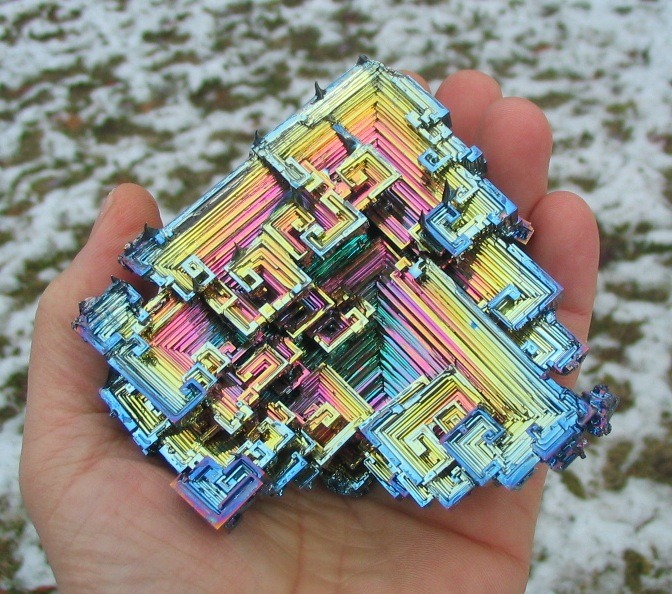
The scarcity line doesn't work, because you have elements like bismuth which are also (Arguably) more beautiful than gold https://66.media.tumblr.com/61ce390242a79a767772d4b2027eb902... but command prices far less despite being .025 vs .0031 on the PPM abundance on earth.
Or even look at ruthenium which has a similar look to platinum and is even rarer than gold. Did I mention it also goes for about 400 an ounce? Quite a savings over gold.
The only thing that makes sense is that we as a collective have decided gold has value of X.
Platinum is valuable because it's an unbelievably good reaction catalyst and is unbelievably rare. Look at Palladium (also used in catalytic applications, and still quite rare) price charts for confirmation.
Bismuth's attractiveness is subjective, but what is not subjective is that it's found in ore in mineral form, not in pure form like gold. It's also brittle, and not easily worked to jewelry by primitive methods like gold.
Anyway, agree that gold is largely assigned it's value based on social reasons. Also would say that, in spite of its many faults, it's a much, much better investment than cryptocurrencies.
> it's a much, much better investment than cryptocurrencies
I'm not going to argue that, on the basis that crypto is super volatile and has potential to outperfrom etc etc.
Gold is a far safer store of value, a much better hedge against market turmoil, and generally easier to "own" at low risk of having it nabbed.
> "Golds value comes entirely from the fact that we as a society give it value."
thats true for anything. that includes currencies, what you get paid, the value of a hockey card, the value of a car, the value of a banana, etc. sure, if society doesn't want to pay you anything for 'it', you can do with it what you want, like eat the banana (before it becomes worthless to anyone).
I am not a gold bug, i personally dont think its a great investment. its not a hedge against a declining market, and its difficult to own in large quantities. however; statements like 'its only valued because people give it value' are not very informative. everything is valued that way. everything.
also, the industrial value of gold is not laughable. its negligible because we have plenty of gold to meet industrial needs. but its not laughable, its in your smart phone, its in your desktop / laptop, etc.
Currencies have value because entities with monopolies on force (countries) give them special legal status to be used conveniently as means of exchange. This is one of the hurdles for Bitcoin, and was a big source of debate in 2016-2018. Every time you spend Bitcoin you have to keep track of the avg. acquisition cost and resulting realized capital gains for every transaction to be able to declare the appropriate gains or losses on your taxes at year-end. A heavy burden for a "currency".
> statements like 'its only valued because people give it value' are not very informative
If you go to first principles, sure, everything is an illusion. But gold, crypto, and other "stores of value" derive their value in fundamentally different ways than everything else. Our existing models and body of knowledge do not apply to them. This is worth investigating. All other things are consumed in some way or another, and the rate at which they are consumed, relative to their supply, determines their price. The consumption of gold relative to its supply is much too low to justify its price using the same models.
Perhaps a better way to frame the argument is that Gold is useful only because society has agreed that it is a store of value.
Things like cars and bananas are useful outside of being a medium of exchange. You can use a car to get around, and you can eat a banana if you are hungry.
Dollar bills and Gold are useful as long as society agree that you can exchange them for cars and bananas. When society stops agreeing that currency is worth anything (i.e. hyperinflation), money becomes worthless and people throw it away or burn it.
Typically, printing excess currency is what causes it to lose value. Gold avoids that because you cannot just "print" it - you have to physically mine it from the earth by exerting effort.
Those qualities are part of it, but not the whole story, gold is also:
- divisible (including literally soft to divide)
- fungible
- identifiable
- verifiable
- scarcity tested (people have been looking for, and trying to create, gold for so long without success that supply estimates can be trusted)
And the big one: branding.
Money is only useful when everyone uses it. It has one of the most powerful network effect of any system. The fact that it was successfully used as money for thousands of years, and everyone knows it, making it the default non-fiat money in terms of mind-share - has enormous value. Are you really going to try to convince everyone to exchange bismuth instead when fiat collapses?
Gold has embedded demand via governments, a global jewelry industry, and yes industrial demand. Bitcoin demand is speculators (mostly) and a handful of people who use it as a transactional value store. Comparing the two is a waste of time - they are nothing alike - but ignoring that the supply and demand picture for gold is way more stable -- global demand for gold does not halve over a few months, which is likely what drove the price shock with Bitcoins.
Gold's value comes from two main things - it's nice for jewellery and it's expensive to mine. The price has for many centuries approximated (within 3x or so) the mining cost and it doesn't drop to zero because it made nice jewellery from Varnian jewellery 6000 years ago (http://www.ancientfacts.net/7-oldest-pieces-jewelry-world/) to modern wedding rings and that's not changing in a hurry. Both mining costs and market price are about $1200/oz at the moment. Financial uses are a secondary effect that has kind of come and gone.
Supply and demand determine the value of everything and they are both additive. Each piece of supply tips the price scale lower, each piece of demand tips it higher. You have taken several key pieces off the scale, argued (unconvincingly) that each one individually cannot explain the scale's reading, and then (even more unconvincingly) claimed that the scale's reading is therefore completely arbitrary.
It isn't. You just don't seem to understand how it works.
the combination of malleability and resistance to corrosion and acid makes gold a very useful material beyond its value as a currency. there are things you can do with gold that you just can't do with other metals, especially in the field of art and jewelry.
Gold's value does not come from its beauty. It comes from its verifiability. If someone presents you a sample of gold you can very quickly verify its authenticity and approximate purity with very little technology.
While funny, it's actually not easy to verify the quality of manure.
> Animal manures are a valuable source of nutrients for crop growth. But, since every farm operation is different, each manure will have unique characteristics. Make regular laboratory manure analysis an important step in your manure and nutrient management planning. Understand that the total nutrient content in manure is not available the first year and that some nutrients may be lost depending on management practices.
let's not be so down on cow manure. Sure in small quantities cow manure is an inconvenience you wipe off your shoe. But in very, very large quantities it's an extremely useful argricultural material you can build a business around. (fertilizer)
I mean, I think Bitcoin is really beautiful. I'm not sure it's as multipurpose as gold is (it certainly doesn't seem to have many uses.) But the basic idea really is a beautiful algorithm. I'm just not sure it has serious applications. Which is definitely unlike gold.
Bitcoin is really ugly. The utterly ugly algorithm requires storing of enormous amounts of waste data and requires extremely unefficient computational work of "mining". It's just a showcase of human greediness and stupidity.
I’d say the point is that one can appreciate the beauty of bitcoin design without owning any, whereas appreciation of gold is much more tightly connected to physical interaction with a gold artifact. At least in sane people.
Gold enjoys a lot of fashionable demand. Which is very much why you shouldn't use it to store your money - because not enough is actually propping up that demand. It just has a longer historical inertia - if you want to see a future problem, depending on the mineralogical analysis of near earth asteroids we could be in for a long slow decline if it's abundant up there.
I'm talking about industrial usage - like the contacts on your CPU. Gold offers a unique combination of very high electrical conductivity and near-immunity to corrosion.
Gold has been more stable in real value that pretty much anything else over the last 6000 years. Land being the only comparable asset I can think of. Way more stable than paper or crypto money. You shouldn't store your wealth in it because it's kind of stable while income producing assets make money.
There are comparisons being made that 1 gold coin used to provide 1 Roman toga, a good pair of leather shoes, and a good belt. And the comparison suggests looking at the cost of today's fine suite, with good leather shoes and said belt.
If true, gold's value has not risen, the currency's value it is being measured with has gone down.
The current gold price is a combination of industrial usage value (price higher than coal as it's more rare) and perceived value, but the difference is not that huge compared to other metals, so I would say the goldbugs are not completely wrong.
Coming from the investing world, I won’t say this is entirely true. If an ICO token is a genuine utility token, then it could have true value in the distributed network as far as I understand. If some company takes off where this utility token/security works, it could be a preferable form to a more common IPO/listed equity. I don’t think many companies fall under this domain, but for a few types of circumstances, the ICO model makes a lot of sense.
Can you provide any examples? I literally cannot think of a single company that needed to do an ICO for reasons other than to make quick money. I’m actually far more skeptical orf ICOs and adding blockchains to a company for no reason than bitcoin as a mere currency solution. We don’t need an ICO and a blockchain to track bananas in Laos.
I think the hard part is we haven't seen anything take off in reality yet.
I've thought about one from a conceptual standpoint. In finance, many buy-side firms are collecting the same alternative data. This might be anything from consumer reviews to executive flight traffic data. So, could the buyside band together to create "Bloomberg"?
More buyside firms now have data science teams, and with the explosion of alternative data, you could make the argument that the DIY is too taxing for one firm and the vendor is too slow at incorporating new datasets, and merely is the middleman. I don't think a hedge fund would give away its secret sauce, but much of this data eventually becomes table stakes.
I've thought about whether a token could be created to provide an incentive for firms to build and share datasets. Tokens could be rewarded if a large number of other firms use/read from a particular dataset, or another firm could fork a dataset to clean dirty data and potentially tokens would flow to multiple firms in this instance. More firms using the network should lead to more data and a more valuable network/token.
Maybe the closest real-world example I've heard so far is the Catalonian government using IPFS during an election, and how Filecoin could be used on top of IPFS to pay people to store data:
Human civilization is at least tens of thousands of years old(just considering what modern man believes) and always valued gold more than anything for both store and exchange of value. I don't see why modern civilization(which were ahead of us in all domains) would feel any different from their ancestors for gold.
Gold as metal has something more than what makes it scarce and valuable, something we have yet to discover. There's a good reason why all central banks of all economies(US,Chine,Russia) are holding on to gold as much as they can and buy/steal more of it as the opportunity arises.
Even if you live out in the middle of nowhere, you have to pay property taxes. If you barter, you have to pay taxes on that stuff too, so you need to make the fiat bucks somehow. That's why fiat being required for taxes is the big one that makes it the defacto standard. After all, you have to have it, or its electronic equivalent or people with guns will come and get you, imprison you and take all your stuff away.
Not that paying taxes is bad. It helps keep inflation down vs the government just borrowing all the fiat it needs from the fed. However, if you try and run your whole life in gold or bitcoin or whatever you just can't do it legally.
Beyond that the government only accepts fiat for tax payments, tax payments are denominated in it. It’s a small distinction but an important one, as swings in the value of the bartering asset you’ve been trading with as we see today can put you massively behind on your tax payments.
In my opinion it’s likely that they are holding the $130B of cash equivalents because they’re expecting a downturn in the economy and want to buy up assets on the cheap. It’s not that they are investing in the cash, they sold some assets at what they perceive to be at the top of the market and are holding for the next downturn so they can get back in on some discounted equities. This is large-scale buy low sell high. It’s not a productive asset but a short term store of buying power.
I think it can be rational for an investor to forgo productive assets, even if they have no opinions about market timing. They might look at a company, estimate its lifespan, estimate its total inflation-adjusted earnings over that period, and find that it's less than the current market cap. In that case it's just not a good investment opportunity, irrespective of market timing.
Historically there has always been a shortage of capital, and plenty of productive enterprises competing for that capital, so investors have received a discount on expected future earnings. But I think the case can be made that in the current economy, there is no such discount. That appears to be Buffet's stance, judging from his public comments. He says that he doesn't practice market timing, but simply can't find many worthwhile investments.
Not all cryptocurrency has no purpose. To me the “store of value” has always been a copout due to Proof of Work based ledgers painting themselves into a corner and being unable to scale to support enough transactions to support real payments. So all people can so with eg bitcoin and ethereum tokens is speculate.
That is changing with the next breed of cryptocurrencies like Stellar and EOS. Take for example https://intercoin.org (disclaimer: working on it). It is explicitly designed to solve real problems, and the applications are listed in the video.
I consider Bitcoin and Ethereum to be the myspace and friendster of the industry.
This is why people dislike the crypto space. Someone is always shilling their project. I'm not saying intercoin is a scam but it certainly looks like one and it's ridiculous for you to be calling Bitcoin and Ethereum "the myspace and friendster of the industry" when your project has literally no advantages over it, lots of disadvantasges, and no public code. When projects like this get burnt out of the space from the bear market, we can finally start realizing the potential of decentralization.
Nothing in your message is backed up by any arguments. I would love to know for example:
Why Intercoin looks like a scam
Why it’s ridiculous to be calling Bitcoin and Ethereum the myspace and friendster of the industry when they are literally the first movers and have been around for 10 years but painted themselves into a corner and are unable to scale - no one uses bitcoin for real world transactions and projects building a token on ethereum who needs it to be actually used regularly says they’ll get off ethereum right in their whitepaper (Kik Messenger for instance).
How can you say Intercoin (or EOS or SAFE network or Stellar) has no advantages over Bitcoin and Ethereum, what planet are you on?
We have half a million lines of public code written over 7 years. We have been trying to fix decentralization for longer than you knew about crypto. And MAidSAFE has been doing this for 12 years!
Why would “projects like this” be “burnt out of the space” in the bear market, when I just said they are the future of the space, which has stagnated?
The promise was utility tokens and ICOs, where the tokens would be presold and the network would be owned by the participants instead of extracting rents. Tht was the dream. That was chilled by regulators, in favor of security tokens.
This reaction is what’s ridiculous. Imagine me saying this about MySQL for instance, or Wordpress. It looks like a scam guys. It has no advantages over current first-gen database systems or CMS, and there can never be anything better
Do you really, honestly think that a system burning more electricity than most countries to do 7 transactions per second, where each full node needs an ever growing amount of memory to even join the network, is the best BFT database and distributed ledger that can ever exist?
Look at other projects like Holochain and Maidsafe. Look at the evolving EOS ecosystem. “People” who dislike cryptocurrency hardly know what’s going on it. “People” also disliked the Internet, the Web, social networking, and thought it was a fad. At the very least, answer my questions point by point and bring some substance. Other people are working for years on free open source software, instead of cushy jobs at some cushy VC funded startup, which is likely to fail, and you are calling THEM scammers because...?
You do realize that these projects produce open source software AND are looking to build a decentralized ecosystem where you no longer have to extract rents and have middlemen like Facebook which can be hacked, influence elections etc. And meanwhile you say once these projects are burned out and we go back to ethereum THEN finally we can get back to the business of decentralization? Ha ha ha.
Agreed. I do some EOS smart contract work on the side (personal tinker projects) and its incredibly impressive.
If you haven't played around with EOS and are interested in blockchain computing you should check it out. Being able to write C++ code and deploy it on chain is pretty dope.
Yeah, but what can you actually do with it? The killer use case for smart contracts so far has been Ponzi schemes and gambling games. I have yet to see a smart contract actually do anything useful/legal.


https://www.youtube.com/watch?v=LtITDtZPYEw