>Imprisoned for decades for a crime he committed as a juvenile
So, for a single, first time, first degree murder, Pennsylvania gives "a mandatory life sentence without the possibility of parole, including for juveniles"?
What kind of medieval backwater has such laws?
And how is that working out for them? [1]
Compared to e.g. countries which have much smaller sentences for the same type of crimes (especially for juveniles), in much more humane prisons, and achieve much lower crime rates...
For comparison, the guy who methodically mass shoot and killed 77 people in Norway, only got 21 years in prison (and in a vastly more humane prison, more like a Motel 8 than the hell-holes in the US, at that). Perhaps that's another extreme, and I'd be OK if he went in for life, but the Pennsylvania extreme is medieval, inhumane, and depraved too. Too much Old-Testament inspired morals...
The Norway example is misleading for people who are primarily familiar with US sentencing. Twenty one years is the maximum sentence one can be given initially, but it can be extended five years at a time at the end of the sentence. There are no limits on the number of five year extensions, so a twenty one year sentence can effectively be a life sentence.
It's basically equivalent to a US sentence of life in prison with the possibility of parole after 21 years, though the default is that you're released after 21 years, as opposed to the US default of you continuing to stay in prison unless you can convince a parole board to release you.
Recent changes means the new max is 30, with a possible mandatory 20 years served. The 5 year indefinite extension remains (but as far as I understand extensions are not intended as punishment - rather as a way to protect society in the face of a real risk of the prisoner committing new, serious crimes on release).
As I recall there is some newfangled stuff about "terrorism" on the books - but the change was apparently mostly motivated by the NOKAS-robbers possibly being released earlier under the new "forvaring" (containment?) system than under the previous 21 year "life sentencing". (they'd be given a max of 10 year mandatory imprisonment even with a 21 year sentence).
Yes, but it will also be far more common to be actually released at the default (or close). Heck, "real" life sentences in the US are handed out as peanuts...
Also no death penalty.
Plus much much nicer prison terms (very human hotel-like prisons, permission to study, no solitary crap as punishment, very low recidivism rates, prisoners can take leaves -like "vacations" and come back, etc).
If the system in Norway releases based on someone being a continued threat to society, which is the case if I understand it correctly, the government will probably have to make an argument to that effect, and it strikes me as very possible they might lose that argument at some point.
For the Norway example, that offender is being held in solitary confinement in very harsh conditions, and it's very likely his sentence will be extended indefinitely. It's not a good example of a more human criminal justice outcome, considering how harmful we know the effects of solitary confinement to be on mental health of those held.
I can’t tell if your post was being sarcastic or sincere.
It’s a first degree murder. Putting him away for life is what he deserves and others (law-abiding free citizens) should not have to bear the risk that he would commit more extreme crimes given the extreme nature of the crime here. That’s not medieval or inhumane, it’s appropriate and common sense.
The relation you imply between laws, sentencing, and crime rates between different locations and demographics is not causal and doesn’t account for various other factors, and is therefore irrelevant.
>It’s a first degree murder. Putting him away for life is what he deserves and others (law-abiding free citizens) should not have to bear the risk that he would commit more extreme crimes given the extreme nature of the crime here
Well, not all cultures on Earth, especially western ones, share the above revenge-motivated old-testament-style viewpoint on the law. Perhaps that's why they manage to have less crime, less recidivism, less mass shootings, and far lower murder rates, with far-far lower incarceration rates and no death penalty.
In the end, a society gets what they deserve, and those revengeful reap what they sow. Like those clinging to guns for "protection", and dying from gun crime (or from their own gun-owning family members).
>The relation you imply between laws, sentencing, and crime rates between different locations and demographics is not causal and doesn’t account for various other factors, and is therefore irrelevant.
Well, it's not the only factor, but it's a telling part of the belief systems, structures, and overall culture a society operates. It's not just lost in the noise of other factors, as it's irrelevant. Culturally, and in terms of recidivism etc, it's very relevant (like the long history of racism inspired incarceration is). Besides, the proof in the pudding is in the eating.
As they say, "so, how does that work out for you"?
> In the end, a society gets what they deserve, and those revengeful reap what they sow.
I bet you apply this very selectively.
> Like those clinging to guns for "protection", and dying from gun crime (or from their own gun-owning family members).
You would not want mandatory monitoring collars, sacrificing privacy to massively reduce the homicide rate, would you? We are willing to bear substantial risks to preserve our rights - I would argue it comes from an intuitive understanding of how dangerous it is to be powerless. So why not apply that same logic to gun rights?
There is more to the question than 'Would fewer people die' - after all, if that is all you consider, then monitoring collars would get an unreserved 'Yes!'.
This same logic could get that kid a milder sentence - give him a punishment more just considering his age and role in the crime (subjective, I know I know), despite the risk to "law-abiding free citizens" that he kills again.
If you're not willing to risk death, your own and that of others, to protect your rights, then you will have none.
> In the end, a society gets what they deserve, and those revengeful reap what they sow. Like those clinging to guns for "protection", and dying from gun crime (or from their own gun-owning family members).
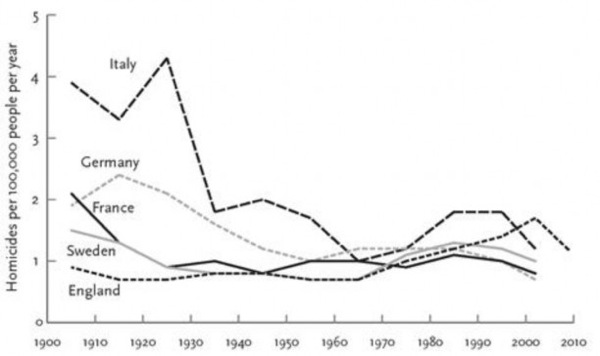
During the 20th century the US homicide rate fluctuated from 5-10 per 100,000. In Germany, France, Sweden, and England, it was below 2.5 the entire century.
Focus on France and the UK (since Germany and Italy were unstable states during part of that time). In France, the first gun laws date to 1938. By that time, France’s homicide rate was about 1 per 100k, about what it is today. The first UK gun laws started in 1920. The UK murder rate has gone up since that time. (Handguns, which are responsible for most US gun homicides, weren’t banned in England until 1997.)
How did gun control cause low homicide rates in those countries when homicide rates were already very low (at current levels or even lower) before gun control? That’s an “umbrellas cause rain” argument.
Likewise, the death penalty wasn’t eliminated in the UK until the 1950s. Criminal justice reform in Europe generally happened in the 1960s and 1970s.
How did criminal justice reform cause European homicide rates to be lower when they were already very low?
The idea that gun control and lenient criminal laws caused lower homicide rates in Europe contradicts all the available data. The only supportable conclusion is the opposite: that Americans remain resistant to lenient criminal justice laws or disarmament because America is a much more violent society.
It was much worse in the past -- and even before the abolishment of the death penalty the drop are related to a more lenient system (e.g. check France during Les Miserables times, or England and Dickensian conditions), plus increased prosperity of course.
Now go to the "Global long run perspective" and click to add United States. Historically worse than Europe (measurements start from 1900 but not so complete then).
I don’t see how that helps your argument. Gun control and leniency on criminal issues are a 20th century reform in Europe. England imposed the death penalty for pickpocketing until 1808. And prior to 1920, you could buy guns at the store with cash in the UK. Gun control didn’t exist in France until 1938. Yet the homicide rate of the UK was lower than it is today, and 1/7 of what it was in the US at the time. By 1800, it was basically at modern levels, at a time when 220 different crimes carried the death penalty, including theft or forgery. How can leniency on criminal issues be responsible for low homicide rates that were low before they were implemented?
>And prior to 1920, you could buy guns at the store with cash in the UK. Gun control didn’t exist in France until 1938. Yet the homicide rate of the UK was lower than it is today
According to the graph it wasn't. It was 0.8 and higher between 1900 and 1960, 0.7 in 1962, had a rise in the 70s and 80s, and is historically smaller than 1900-1960 today at 0.5 (since 2012 or so) while still not having the death penalty.
Which chart are you looking at? The fifth chart in the page shows the homicide rate of England at under 1 per 100k in 1900, and over that from 1990-2010. World Bank data says 1 per 100k in 2017, and there has been a spike in the UK last couple of years. 0.5 in this decade is almost certainly incorrect.
If your point now is that the murder rate didn’t go up after getting rid of the death penalty, that’s probably true, but a different argument than you made previously. (We should keep the death penalty because some people deserve to be executed for their crimes. But death penalty versus life in prison probably doesn’t serve as a deterrent effect that would lower the homicide rate. It’s a moral rather than utilitarian policy.)
Europe had much lower homicide rates before criminal justice reforms. Arguably, the causation runs the other way. Europeans were willing to have more lenient sentences because homicides were less of a pervasive problem.
>Right. Homicide rate in the UK went up significantly after hangings were abolished
Only slowly (following a trend that was there before 1964 - heck, 1053 with the death penalty is higher than 1965 to 1968 without it), then had a sudden jump around mid-90s and a peak in 2002 (35 to 40 years after the abolishment for that to be a factor).
Note also, as the article itself notes, that the measurements were diluted, for example after 1972 "the crimes of murder, manslaughter and infanticide" where lumped into homicides, and that before 1998 they counted multiple murder cases as a single homicide incident.
On top of that, the rate is low enough to be diluted by cases like "58 Chinese nationals who suffocated in a lorry en route into the UK" in 2001, "173 victims of Dr Harold Shipman" in 2013, "52 victims of the 7 July London bombings" in 2006, and so on.
Even with such over-reporting, meanwhile, the whole time, the rate was so far below the US (who had the death penalty the whole time) even at its peak, that it hardly makes the case:
You are assuming that having killed once he is more likely to kill again. Depending on the person this may not be true. A psychopath will likely kill again and so should be locked for good. OTOH someone who was not a psychopath and took this chance to rethink his life choices might be about as harmless as the next guy.
Before you say "we can't tell one form the other" let me say this: we cannot tell if we never look. Northern European countries have gathered a lot of expertise in this area, the least we can do is look at it, then maybe look to expend our own understanding of psychology.
Someone else in this equation didn't get to think their life choices, maybe for no fault of their own, because they're dead.
So, how long should you be in for a murder? 30 years? 20? 10? 5? If punishment really got nothing to do with it at all, and the perpetrator is really, really ashamed from just the trial and conviction, why not let them go after that?
>People die all the time, it's a tragedy. But I would not want the laws of my society to be built on the idea of revenge.
Why have punishments for breaking the law at all ? According to you it's built on the idea of 'revenge', right ?
OR maybe it is good for society if people who murder someone are locked away so that they can't kill someone else, AND maybe it's a good thing that people who have no qualms of killing someone at the very least find the idea of spending a large if not their whole life behind bars a strong deterrent.
But hey, 'people die all the time, so let's just forgive those who take the life of someone else, we don't want to come across as a vengeful society'.
I am happy I don't live in your society, it sounds like a paradise for sociopaths.
I was asking what's the motive for the punishment. Is it to revenge the victim or is it to prevent future victims. I'm not advocating for no punishment at all. The parent was asking what's enough (30,15,10,5 years?). I'd choose a number of years sufficient to deter effectively.
Sociopaths are another matter entirely. It's not a question of deterance or revenge anymore. We may be forced to lock them away indefinitely.
But i see it's getting political and words are turned in my mouth. have a nice day
Every seemingly irrational law or socioeconomic convention that you may find in the US can ultimately be tied causally to the bleeding of contempt for people of color into the design process. It short circuits our logical faculties and results in policy that is as cruel as possible, limited only by the extent to which it is perceived that such policy may affect white Americans and the mandate that said policies be at least nominally race-neutral (though this is only a recent development, itself only predicated on the obvious and embarrassing effects its absence has had on our economic well-being, both internally and globally).
I understand that HN's demographic is likely to be skeptical of this, but I submit as proof the changes to these laws and conventions that happen when they begin to effect white communities. The most infamous of late is, of course, the War on Drugs and the response following the onset of the crack and opioid epidemics, respectively. Cruelty, in the name of deterrence, was 100% the name of the game, until the face of the crisis changed, and suddenly compassion was a more efficacious strategy.
Likewise, gun control is now a serious topic, where for much of the past two decades it was not, even for the left. This change is due mostly to an increased perception of susceptibility to gun violence, which was largely isolated to the black community for years.



So, for a single, first time, first degree murder, Pennsylvania gives "a mandatory life sentence without the possibility of parole, including for juveniles"?
What kind of medieval backwater has such laws?
And how is that working out for them? [1]
Compared to e.g. countries which have much smaller sentences for the same type of crimes (especially for juveniles), in much more humane prisons, and achieve much lower crime rates...
For comparison, the guy who methodically mass shoot and killed 77 people in Norway, only got 21 years in prison (and in a vastly more humane prison, more like a Motel 8 than the hell-holes in the US, at that). Perhaps that's another extreme, and I'd be OK if he went in for life, but the Pennsylvania extreme is medieval, inhumane, and depraved too. Too much Old-Testament inspired morals...
[1] Rhetorical question, I've checked the Pennsylvania homicide rate: https://patch.com/pennsylvania/abington/crime-falls-u-s-here...