But that international market must rely mostly on something else than wind power, otherwise you don't have anything to buy (there is not so much independent wind regions in Europe). So in practice, a country running 100% renewable (on wind, not talking about Costa Rica running on hydro) ends up running on something like 60% renewable in the best case and the remaining is fossil or nuclear.
So you want to prepare against a scenario where wind everywhere stops for a week? Usually (in Europe at least) there is always wind somewhere and if it stops for a week at your place it might be going even stronger 1000km down south. In times with strong wind you store what you can and export the rest and if there is the very rare event of weeks without wind you use what you stored and then import. And if you have the once a century event of there not beeing wind anywhere (and we assume there is not much hydro, sun, etc as well) then you will have to ration power or fire up these old gas plants of yours.
It is not as if people running a grid don't think about these things in depth. In fact anyone I know in that field constantly plays with scenarios like these and certain plants are only connected to the grid to perform functions like these.
When you talk with a certain type of people about renewables they usually have the undertone of: "They are ideological and really want renewables, but don't really plan it out and it will have all kinds of consequences on our good old grid".
I can't speak for the scots in particular, but my perception is rather different. People in the enrrgy sector usually overanalyze instead of doing too little thinking.
I honestly don’t even understand this argument. These arguments are based on the idea that we will be 100% renewable. I mean, maybe when the world reaches 30-40% renewable may be the time to even start thinking about the problems of a 100% renewable future.
The fact that it’s used to discourage us from solving the current, and very real problems of our majority FF present makes it even more ridiculous.
Finally, there is absolutely no reason we necessarily need to be 100% renewable. There may be a 20% fossil fuel generation future, with a bit of tree planting and other sequestration options that may be good enough. Nuclear may get cheaper by then and we could use nuclear for baseload power. Storage tech could get better and we could use that.
Literally, the last thing we need to be worrying about right now is a 100% renewable future, yet, that’s what dominates renewable energy discussions.
I agree with you on most point (even though you miss another key point: consumption reduction), my argument about the issue with 100% renewable isn't a criticism of renewable as a whole: it's a criticism of this particular article which explicitly talks about going 100% renewable!
What I dislike of criticism like this is, that it always operates on the underlying assumption that they have no idea what they are doing. Implying only the critics know how to calculate things and everybody who does renewable energy is fueled by blind ideology and therefore doesn't even bother.
Unless one knows the scottish plans this kind of criticism only brings one closer to becoming an armchair expert. So instead of actually pointing out a meaningful risk someone didn't calculate for in service of society, ones criticism becomes pure agitation and propaganda to the detrement of it.
And over time what started from a honest doubt can be quite dangerous, as can be observed in alternative medicine, where people first formulated their unease about aspects of the modern medical practise and moved quite rapidely to disregarding it completely and selling people sugar as medicine with real consequences.
It never relied on the assumption that they don't know what they are doing: they know it pretty well it has an economic cost in exchange for a political edge, and they know it only works if they are doing it first. And the criticism stays valid.
> this kind of criticism only brings one closer to becoming an armchair expert. So instead of actually pointing out a meaningful risk someone didn't calculate for in service of society, ones criticism becomes pure agitation and propaganda to the detrement of it.
I know the energy sector pretty well for multiple reasons and two years ago, I spent two weeks aggregating data and modelling the outcome of a full transition to renewable in the case of France[1] so I don't think I deserve your personal attack here.
There's just about zero chance of no wind even if you only consider the East and West coasts of Britain and Ireland. Both of which have colossal wind generation potential. Chances of the whole of Europe from Portugal to Romania, Malta to Finland being becalmed? Slim. :)
> There's just about zero chance of no wind even if you only consider the East and West coasts of Britain and Ireland.
Almost zero chance, and yet it happens every year!
> Chances of the whole of Europe from Portugal to Romania, Malta to Finland being becalmed? Slim. :)
That's more true, byty that doesn't matter actually:
1- you can't expect one third of Europe to provide power for the whole continent when they are the only one with wind or you need to massively overdimension every country's power generation, to a point which is far from profitable.
2- the European grid don't work this way, you can't pump hundreds of gigawatts from one side of the grid to the other. Each link is only capable of transferring a few gigawatt at best from a country to another.
For the odd day. It never happens for lengthy periods. Most of the time wind will be the right answer for significant generation in Britain and Ireland, with great interconnect export potential, so we'll use proportionally less solar and more wind in the mix than Italy will. :p
I simply don't understand why just about everyone on HN who argues against renewables presumes 100% solar, 100% wind, 100% whatever. Every nation will have an appropriate mix for their differing conditions -- isn't that obvious? Apparently it's really not. Interconnecting to nearby nations to move mainly westerly wind power eastwards, and mainly southerly solar northwards. Yet it's still worthwhile for Romania to be adding wind generation. It's still worthwhile for England and Scotland to add solar.
No one is expecting one nation to actually supply the whole of Europe -- grids are becoming more localised and far smarter within the European super-grid that's aiming for continent wide management. The UK is already seeing moves to demand shifting, and localised demand. We'll see far more of that fine level demand shifting, managing in-home batteries and grids managing ever more generating sources to keep to the best mix of sources at any given moment. Right now they do a fine job as you basically never realise the grid is even there, yet the mix of sources varies across every day throughout the year. How Orkney power companies manage it gives an idea where we're heading.
There's a lot of new interconnects in the pipeline across all of Europe too -- UK has 5 or 6 new ones coming soon. Scotland is progressing to new pumped storage of similar size to Dinorwig, though I'm not sure where in the approval process that currently is, or if it'll ultimately be rejected.
We'll all keep some generation of last resort -- right now, in the UK that's coal. It comes in as less economic than interconnects most of the time. There's a few (three or four IIRC) remaining coal plants, all of which are spending 99% of the time idling. Doing absolutely nothing but being ready for spin up. In five years all the coal will be closed, and it'll be the gas plants at the bottom of the heap. It's already uneconomic to build new gas.
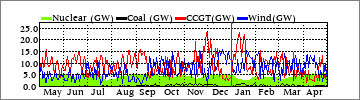
I analysed the Templar website grid watch records for I think 2017 and they showed a period of five days with no wind and overall, wind generation was about 30% of the rated maximum over the year. Also don't forget that turbines close down if the winds are too strong as well as too weak.
Sure, and that's not ever in dispute. That's what the grid manage on a daily basis, and the reason we have a mix of sources, and need to always have a mix of renewables. We're also only using a tiny amount of the renewable potential. Not forgetting offshore alone is even less variable.
The only thing that matters is getting the right mix for the local conditions, and a grid capable of managing the rising amount of generating sources properly, and smartly. So far the grid's side of things is being done pretty well, and is pushing and promoting faster renewable adoption. The Westminster political part not so much.
Wind can provide the bulk of regional need, but clearly can't ever be 100%. The resulting mix also has to allow for keeping the lights on in once in a century conditions as well as normality -- an increasing challenge with changing climate.