I think the question is wrong. It assumes that the problem is to find a "replacement" for oil, in other words, that all we need to do is replace the oil and everything else will work "the same."
For whatever reason, Americans are locked in to thinking that cities should be designed for cars and that every errand should involve driving somewhere (with the expectation that your destination should furnish your car with a free place to park).
It doesn't have to be that way, although I can understand why a country that burns up 20% of global output of petroleum commuting to work everyday might feel that we need to "replace" oil and that will "solve" the looming
crisis.
There are OTHER ways of thinking about a solution that does not involve simply replacing oil. These would include:
* Go back to human-scale cities by increasing density and diversity of housing, businesses and facilities.
* Invest in public transit infrastructure, alternative transportation modes. Mandate walkable metro-centers.
Of course, people won't change unless there's a reason to do so. What I am saying is that "market forces" will push us towards those kinds of solutions INSTEAD of towards an oil replacement. People will be better off if they can adapt to this reality rather than hang on until the bitter end to the idea that the future will involve "happy motoring" forever.
Americans don't want "human scale" cities or public transit, or else we would already have them.
I realize this is not politically correct, but I like the isolation of the suburbs. I don't want to hear my neighbors or have a grocery within walking distance. I'm happy to need to drive to reach anything, because it means that the hustle and bustle of commerce stays far the hell away from my home.
I hate using public transit. I spent a lot of time and money to purchase and maintain my car, and for good reason. I enjoy the convenience of private, personal transport that departs and arrives on my schedule. I don't have to see, hear, or smell any fellow travelers.
Don't get me wrong: I'm happy to subsidize public transit with my tax dollars. The hard truth is that it is primarily for the benefit of the poor. I don't intend to use it. You couldn't pay me enough to spend two hours on a bus in lieu of my 30 minute commute.
We won't see an end to car culture until it is forced upon us. You will have to tear middle-class Americans kicking and screaming from their suburbs. We have chosen to live this way. The escape from the cities was hard-won, and most people won't give it up just because gas gets expensive.
You've clearly never been to Europe - where quiet residential neighborhoods coexist perfectly well with a public transit system that works.
The only reason we don't have a public transit system that works any more is that GM was smart enough to realize there was even more money in it for them if they bought, and scrapped, all the public transit systems in America's smaller towns and cities. And it worked. Don't wallow in it; it's embarrassing.
I have been to some European countries, and that's patently untrue. Residential neighborhoods tend to contain lots of shared housing -- apartments/rowhouses with shared walls between units -- and all attendant noise and unpleasantness.
The only residential neighborhood I ever enjoyed was when I stayed with a family who lived as I do: four vehicles for four people, in a freestanding home, driving to the grocery daily. The major difference in our lifestyles is that, ignoring exchange rates, they paid easily five times as much to achieve my standard of living. I don't think they would willingly trade places with their middle class employees, living in the crowded row housing.
To put it another way, I reject your underlying argument. Yes, hundreds millions of Europeans have become accustomed to a lower standard of living than mine. No, that does not mean I will happily acclimate myself to the same standard.
"Standard of living" means different things to different people. One could say that you've acclimated yourself to a lower standard of living by burning up lots of time and money commuting and taking care of a car and large house.
I'll take a 900 sq ft walk-up with marble flooring and 12 foot ceilings in the middle of Paris IN A SECOND over any sopranos-style 4000 sq ft mcMansion made of plywood and tyvek and located 40 minutes from the nearest depressing strip mall.
I've been to some American cities where it's patently untrue as well. There are other places in Europe, where I repeat that you have obviously never been, and I'm talking about suburban Germany here, where it is not patently untrue - where, in fact, it is patently true.
So feel free to reject my underlying argument if you like. Just don't think that makes you right.
Closer to the US, Toronto and Vancouver manage to run effective public transport systems in American style cities. It's essentially a myth that you need high densities to support rail/bus services.
Having been to Vancouver and living in Europe[1], I have to agree that public transport can work very very well. My uncle, for example, lives in a small country town in Germany and it is serviced by a very regular train with which you can pretty much go anywhere (obviously the distant destinations require you to go to the closest city and transfer from there, but any local towns and villages are quickly and easily reached).
[1] Sadly, in Ireland, public transport is not so great. I have family in mainland Europe though and public transport is (generally) quite good there.
Any proper discussion on the topic of energy dependence, car and city planning must acknowledge that many Americans have this point of view. Americans like driving around everywhere and not living in dense cities. It's an inconvenient truth for policy makers trying to push for green and pro-urban policies in America.
I don't know if "Americans don't like living in dense cities" can be called a truism though. Wouldn't that assume that in America, there are no dense cities? Wouldn't the existence of dense cities along side suburbs indicate that there is a wide range of preference?
Of course there is a range of preference -- it's not an absolute statement. Hell, I used to live in NYC and now I live in a rural area surrounded by horses and cornfields.
But the fact that so many people choose to live in the suburbs (and now an increasing number of those are moving out to the country!) indicates that city life is unsuitable for many. Honestly, the only thing that keeps me tied to a certain distance from the city is the availability of DSL.
So all of those massively expensive condos that are built in the middle of dense cities are for poor people? People complaining about how expensive real estate is 'downtown' are just extremely poor people because they can't even afford what regular poor people can?
In any case, living in suburbs doesn't account for the preference of wanting to drive everywhere. It's perfectly possible to build suburbs that are walking distance from most local stores that you would need (i.e. grocery, hardware, etc).
"Human scale" commerce failed. Supermarkets obliterated tiny, expensive grocers everywhere that real estate prices afforded their existence. Inner cities are now "food deserts" because running a limited-selection, high-price grocery isn't practical.
It didn't have to be that way, but that's how it turned out. Low prices and wide selection are more important to the average consumer than "human scale."
It wasn't until the 1960's through 1970's, the car-ownership prompted massive shifts from cities to suburbs.
Many baby boomers and those who preceded them (the "Ward Cleever" generation), can still remember the concept of having a main street. Even suburbs back then had central business districts and these are now known as "streetcar suburbs" or "inner-ring suburbs".
This way-of-life where everything so spread out so much that it necessitates driving for every little trip is a relatively new phenomena.
>For whatever reason, Americans are locked in to thinking that cities should be designed for cars
I think it's the abundance of ground. The last time I was in the states I realized that the entire shopping street in my city could fit in an american mall parking lot. What a tremendous waste of space, but it's cheaper than going up like is done in Europe.
>Invest in public transit infrastructure
Personally I think public transit is a stepping stone. It's not a workable final solution. It doesn't go anywhere anyone wants to go, it goes close to where a lot of people want to go. It doesn't know when we want to go so it just picks times and forces us into buckets.
A proper solution would be that "public transport" consisted of a network of self-driving cars that you can schedule on the internet to come pick you up and drop you where you need to go. We wouldn't need parking places because the cars never stop. We'd have the convenience of not having to drive.
> It doesn't go anywhere anyone wants to go, it goes close to where a lot of people want to go. It doesn't know when we want to go so it just picks times and forces us into buckets.
That's why you run a network of high frequency services (every 10 minutes or better). You turn up at a stop and wait on average 5 minutes, I think most people can tolerate that. If it doesn't go where you're going then you transfer, again waiting an average time of 5 minutes. That's convenient and you don't have to drive either.
> A proper solution would be that "public transport" consisted of a network of self-driving cars that you can schedule on the internet to come pick you up and drop you where you need to go.
Would still create congestion on busy routes and I suspect a huge number of these cars would be needed purely to cater for demand for about 2 hours of the day.
>That's why you run a network of high frequency services (every 10 minutes or better). You turn up at a stop and wait on average 5 minutes
Except that isn't realistic for everywhere. Even in a pretty densely populated country there will be areas that just can't justify that high frequency.
>again waiting an average time of 5 minutes. That's convenient and you don't have to drive either.
I'm living in a country that has, imo, the best public transport in the world. Even in remote areas a bus or train will be there once an hour. Normally it's 30 minutes in smaller towns and 10-15 or less as you go up. The issue is the connections. 5 minutes here, 15 minutes there. You don't have to travel very far before public transit is taking double the time it takes to go by car. I really hate driving, I feel like it's throwing my time in the trash. The issue is, as a programmer, I'm more productive in 2 solid hours than I am in four 1 hour periods.
>Would still create congestion on busy routes
Congestion shouldn't be any issue at all if everything is computer controlled. When you try to schedule at a certain time the computer can already say that you'll be picked up 10 minutes later and arrive 10 minutes later. Most congestion is caused by stupid things human drivers are doing. Get rid of human drivers and driving suddenly becomes vastly safer.
>and I suspect a huge number of these cars would be needed purely to cater for demand for about 2 hours of the day.
This could be but that would mean that, say, 80% of all public pool cars would be sitting in a central parking lot most of the day. How is that worse than now with 100% of cars sitting idle most of the day? Plus in many places every family will have 2 or more cars.
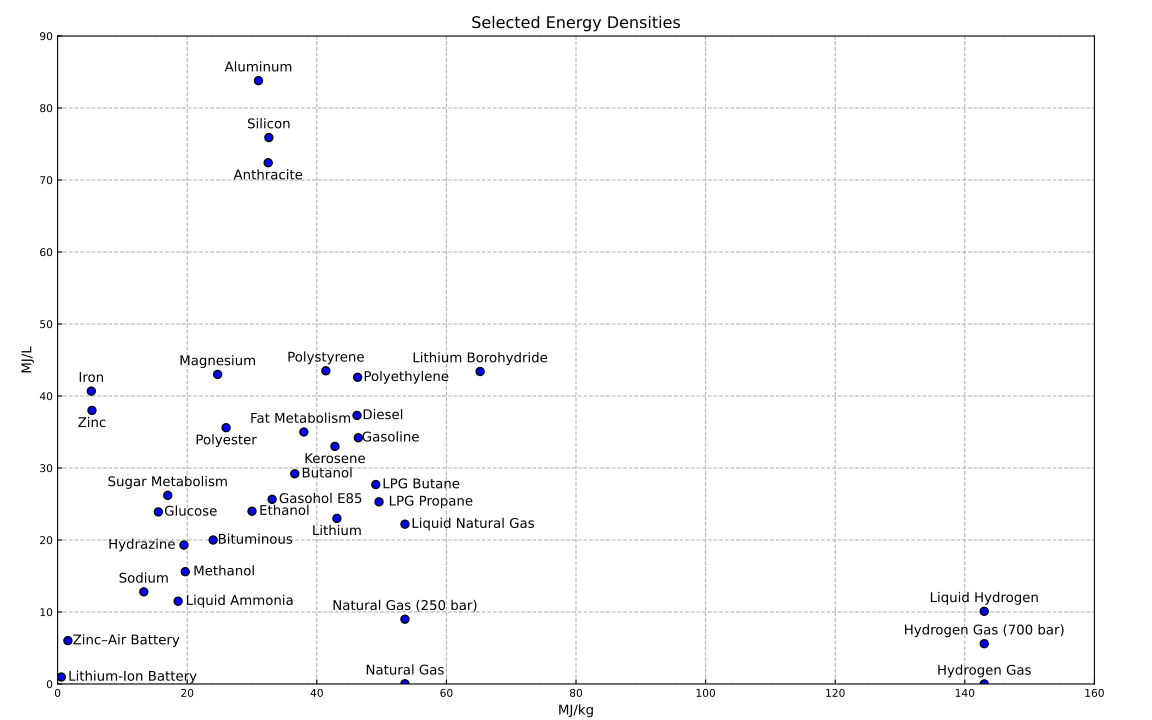
That's pretty much it. Our infrastructure and assumptions are built on the existence of oil. Its ease of transport, its energy density, its relatively low costs. And there is no alternative with all those features.
So you need to address those assumptions before you can see where it's going.
Which is why we should probably stop spending 10x as much subsidizing commuting over transit. Because most of those suburbs are probably not going to recover from this housing crash. Growth economics allowed us to waste money building, zoning and living that way. But it's not going to work anymore. Not for nearly as many people.
It's attractive to propose "let's build a new kind of city" or if you prefer, a new sort of living style, but this is one of the classic boil-the-ocean sort of problems that any ground-up engineering solution faces. How do we migrate people from a solution they know, like, inhabit, and own today to one that they don't know, will likely have to be educated to like, don't currently inhabit, and don't currently own? It's a tall order.
>For whatever reason, Americans are locked in to thinking that cities should be designed for cars and that every errand should involve driving somewhere (with the expectation that your destination should furnish your car with a free place to park).
A major reason is the massive amount of explosive growth directed through central planning by government. This has literally made most cities designed around travel by car.
>Of course, people won't change unless there's a reason to do so. What I am saying is that "market forces" will push us towards those kinds of solutions INSTEAD of towards an oil replacement. People will be better off if they can adapt to this reality rather than hang on until the bitter end to the idea that the future will involve "happy motoring" forever.
Getting rid of government subsidy to oil through lobby, tax breaks, and the military-industrial complex would go a long way toward this goal. We are bearing the full brunt of the "moral hazard" experiment.
shows that gasoline has both of these, along with good resistance to premature ignition, and other favourable ignition characteristics. The solution will not be in finding something new, which is superior in every aspect to oil, but instead to be willing to sacrifice in some areas, (maybe volumetric energy density and total thermal efficiency,) in order to find an achievable solution. Using a plentiful energy source (nuclear?) to perform hydrolysis, and distributing the hydrogen as a fuel seems like the most likely endgame to me, but the material properties of hydrogen are not favourable to storage and small scale use.
I think a switch to electric makes the most sense. It can piggyback off our existing infrastructure, and in an engineering sense, it is only "loosely coupled" to whatever manner we use to create the electricity.
Are you saying that the electricity flowing into Volts and Leafs hitting the market doesn't really come from a polluting source or merely that it doesn't have to?
It is possible to change the type of generation without having to change the way electricity is taken out of the grid to power things. This makes it easier to make changes in the type of generation. Changing from coal to solar to nuclear just involves making a new connection between the power plant and the grid. Everything else then just works as normal.
By contrast, if we converted energy into "Dragon Tears" instead of electricity we would need to lay down a whole new Dragon Tear distribution network so that people could use that energy. Then, a scientific break through occurs and we are able to use the much more efficient "Unicorn Blood". But now we have to rip out the Dragon Tear distribution network and install a new Unicorn Blood network.
The problem with switching to electricity is that the electricity distribution network has a limited capacity. Increasing the capacity of the connection to every single dwelling would be enormously expensive (and energy consuming!), so there are limits to how much demand can easily be switched to the electrical network.
Easy. Oil is an awesome fuel for energy generation, especially distributed generation. In the 19th century, it was awesome enough for people to go to sea for months at a time slaughtering whales and rendering their fat to provide light to homes.
As someone who grew up in the country and got to spend lots of my childhood quality time splitting logs and hauling wood around, I have to tell you that the day the oil-fired boiler was installed in my house was a happy day.
That said, I think people take advantage of a good thing. I work in a downtown city center and live about 5 miles away. $5/gallon gas means about $60/month to me in direct costs. My co-workers live an average of 20 miles away, with a 15% living over 75 miles away. That's insane!
"The same legislation passed in the 1970s to force increased fuel efficiency, for instance, has brought no new innovation to U.S. vehicle fuel consumption in two decades"
I disagree with this. We've seen hybrids, pure electric and much more efficient normal engines created in the past 20 years with things like cylinder shut-off, etc. If someone from 1970 saw a Toyota Prius it would seem like something straight out of the Jetsons.
The multi-thousand dollar tax credits that made purchasing one cost-effective certainly drove its initial popularity (it's the only reason my sister bought one).
Even after the credits shrank to a level where a prius is no longer a cost-effective purchase, there are still U.S. laws (state and federal) which incentivise purchase of a prius (or other hybrid).
For example, a disproportionate number of hybrids are driven in the greater DC area. A big reason for this is because the state of Virginia allows hybrids to drive in carpool lanes with only one person (this may have changed--last I read there were lawsuits underway to challenge this policy). For people who live in the DC area, deciding where to live can involve some serious number crunching: the farther you get from the beltway, the less you will need to pay for housing, but the more you will need to pay (in time and money) for your commute. Buying a hybrid gave you a free pass to cut your commute time almost in half, allowing you to live farther away and save on housing.
Innovation didn't create oil in the first place, at least not human innovation. You might as well ask why innovation hasn't replaced the Sun or water or air.
We (the people involved in making decisions on behalf of politicians and the people who buy IP for tech that greatly improves energy efficiency so they can prevent everyone from using it) would rather keep using oil.
It has, biofuel companies are even hotter than startups which huge amounts of money getting pumped into them. As the price of biofuels drop and the price of oil rises it's inevitable they'll cross-over and people will start buying biofuels because they're cheaper.
How are biofuels viable as a replacement for oil in the quantities our current lifestyle demands? They can't be produced in the same quantities that oil can be, and producing them requires farmland, so food prices go up.
Simple Answer: We can't produce oil (we discover it), we can produce crops. We're pretty good at it.
Complex answer: If demand for crops goes up then farmers can grow more crops. Although it's hard to see if that's happening right now as corn ethanol subsidies and corn import taxes completely distort that market. If you want to produce corn ethanol you buy domestic corn as you can get US gov subsidies for it, you don't get those subsidies if you use imported corn, so naturally US produced corn ends up disproportionately in fuel production. Also it's worth noting that DDG is a byproduct of corn ethanol production, and DDG is used as animal feed. So it's misleading to think that corn used for fuel production is pulling it completely out of the food chain.
By hoping that algae based biodiesels and cellulosic ethanol production get figured out.
Airliners and aircraft manufacturers are throwing more hope behind biodiseals now, since once you can get algae producing that, it's just one step away from them making jet fuel. And there -really- isn't a replacement for jet fuel. Ethanol just doesn't cut it.
I mean oil is insanely, massively profitable, nothing else can touch it, so why would big industry bother until they actually run out of it?
BP alone made nearly $2 BILLION the same quarter they had to pay for the deephorizon cleanup That's AFTER paying for it. Normally they make close to $10 billion per quarter.
Instead they can just run commercials before PBS shows telling us how they will "keep researching alternatives". Much cheaper.
Because the market prefers oil, is why. And it's easy to see why: oil packs an awful lot of kilojoules of energy into a given volume. That matters whether you are a motorbike or a cargo ship. And its price per KJ is pretty low too - remember that most "electric" solutions simply burn fuel in power stations instead of in engines, and use that to charge batteries, losing energy at every step of the conversion.
We will go battery/fuel cell/whatever - but the cold hard fact is, that technology just isn't ready yet.
Oil is like finding an underground vault full of batteries of vastly superior energy density to any electric battery you can make. How are you going to compete with that?!
That would be coal; oil adds the property that they vanish completely (from the user's perspective anyway) when they're flat, so you've got zero disposal issues.
The market prefers it because there is a 100-year head start on distribution networks and standards to the consumer for gasoline.
The only thing that could compete with that is the ability to plug it into the wall yourself. But battery technology has not improved much in that same 100 years and there's no universal battery standard to swap out for a new one during roadtrips.
In a half-dozen generations there will be complaints from gas station owners as they go the way of slide-rule manufacturers and have to get government subsidies to stay open.
Not to mention the convenience of refuelling in minutes rather than hours.
If there's any sense in the world, one would hope that the existing infrastructure will complement any new energy source; we'll still need rest breaks and the odd sandwich at least, it would make sense if they could also recharge the fuel source, economies of scale and all that jazz.
Yes and no. In the medium term, we can expect hybrids to play a bigger role, whilst we wait for battery technology to cover the energy density gap. In less than 20 years, simple economics are going to force us to a solution of full electric cars for urban use, and hybrids for longer trips, with the hybrid normally being charged from the wall, but using oil-based fuels for longer trips (or when the owner forgot to charge the car overnight). That should reduce oil consumption enough to make alternate sources, such as algae-derived diesel, a viable alternative.
Hmm, the thing is tho', there isn't much upside to shifting burning fossil fuels from the engine to the power station. Sure the power station is more efficient in burning the fuel - but then you have to charge batteries too, so that efficiency goes away again. There's really not much point to electric vehicles until you can run them all on batteries charged by nuclear power.
I agree, but the article was specifically talking about oil, not fossil fuels. But I don't think we're dead in the water on the electrical utility front - fusion research is finally starting to enter the final stretch before commercialisation - ITER is expected to get us to the point where we can construct the first commercial-break-even reactor:
http://www.iter.org/proj/iterandbeyond
Actually, I find ITER as a pretty good indicator that governments around the world don't feel like they won't be hurting too much on the energy front for quite some time. If they wanted to, they could up the (in context) risible investment in fusion to get a working reactor up and running by the mid-2020s. I mean they're talking about investing about $1billion per year for the next 30 years, from the entire planet. Up that to $5billion, and you can halve the development time. They really aren't terribly concerned at the moment.
And of course nanotech may yet allow us to produce the cheap, efficient solar panels that would be needed to use solar as a baseline energy source. So no, I don't think it as being much of a risk to move car energy over to electricity, starting today.
1 short ton (907kg) of coal costs $71.25 as of October 2010 coal has an energy density around ~32.5 (MJ/kg). 907kg * (32.5MJ / kg ) / $71.25 = 413 MJ per $.
Compared to gas at ~3$ / gallon. So, 121 MJ / gallon / (3$ / gallon = 40 MJ per $.
Oh, and whilst we are on the subject, Does anyone here have their favourite theory for where the next big advance in energy tech is going to come from? Personally I'm surprised by the lack of government investing in nano-tech. Battery tech, fuel cells and solar panels all seem like prime candidates to benefit from a better understanding of how to construct materials at the molecular scale.
Well, I've noticed that solar panel design is starting to head that way - most of the latest and greatest stuff coming out of that corner of research is about using exotic nanotech to produce better panels.
Battery technology can also stand to benefit, allowing for higher energy density batteries, and potentially reducing our dependence on lithium.
Or how about a space elevator, that makes space-base solar cells a viable solution for base energy generation?
These are just a few guesses about how nanotech is likely to help, based on current research results, but there are no doubt other avenues of use of nanotech that I haven't thought of / aren't aware of that are relevant in this context.
What we really need is a better capacity to model the properties of materials designed at nano-scale. Sadly it's the sort of research that has trouble attracting investment because it's too far away from an actual product. But if we ever get to the point where we can use genetic algorithms to search for materials having specific properties, that would turn the world on it's head.
A lot of our nanotech is still in the micro domain or dealing purely with chemicals. A CPU's fundamental organization is too small to be seen without a really, really good microscope, nanomedicines currently only deal with germs and minor changes to their environment, and so on. We have yet to touch the macro domain. For example, nobody has built a car body out of carbon nanotubes so far, and just imagine what would happen if someone found a way to make photovoltaic cells self-assemble on boards dipped in a vat.
And arguably, as it gets less scarce, it gets more profitable, so the economic incentives for the big players all go the wrong way.
The problem with hoping that little players will change that is that oil has a massive, massive distribution infrastructure already in place that no energy startup could hope to match.


For whatever reason, Americans are locked in to thinking that cities should be designed for cars and that every errand should involve driving somewhere (with the expectation that your destination should furnish your car with a free place to park).
It doesn't have to be that way, although I can understand why a country that burns up 20% of global output of petroleum commuting to work everyday might feel that we need to "replace" oil and that will "solve" the looming crisis.
There are OTHER ways of thinking about a solution that does not involve simply replacing oil. These would include:
* Go back to human-scale cities by increasing density and diversity of housing, businesses and facilities.
* Invest in public transit infrastructure, alternative transportation modes. Mandate walkable metro-centers.
Of course, people won't change unless there's a reason to do so. What I am saying is that "market forces" will push us towards those kinds of solutions INSTEAD of towards an oil replacement. People will be better off if they can adapt to this reality rather than hang on until the bitter end to the idea that the future will involve "happy motoring" forever.