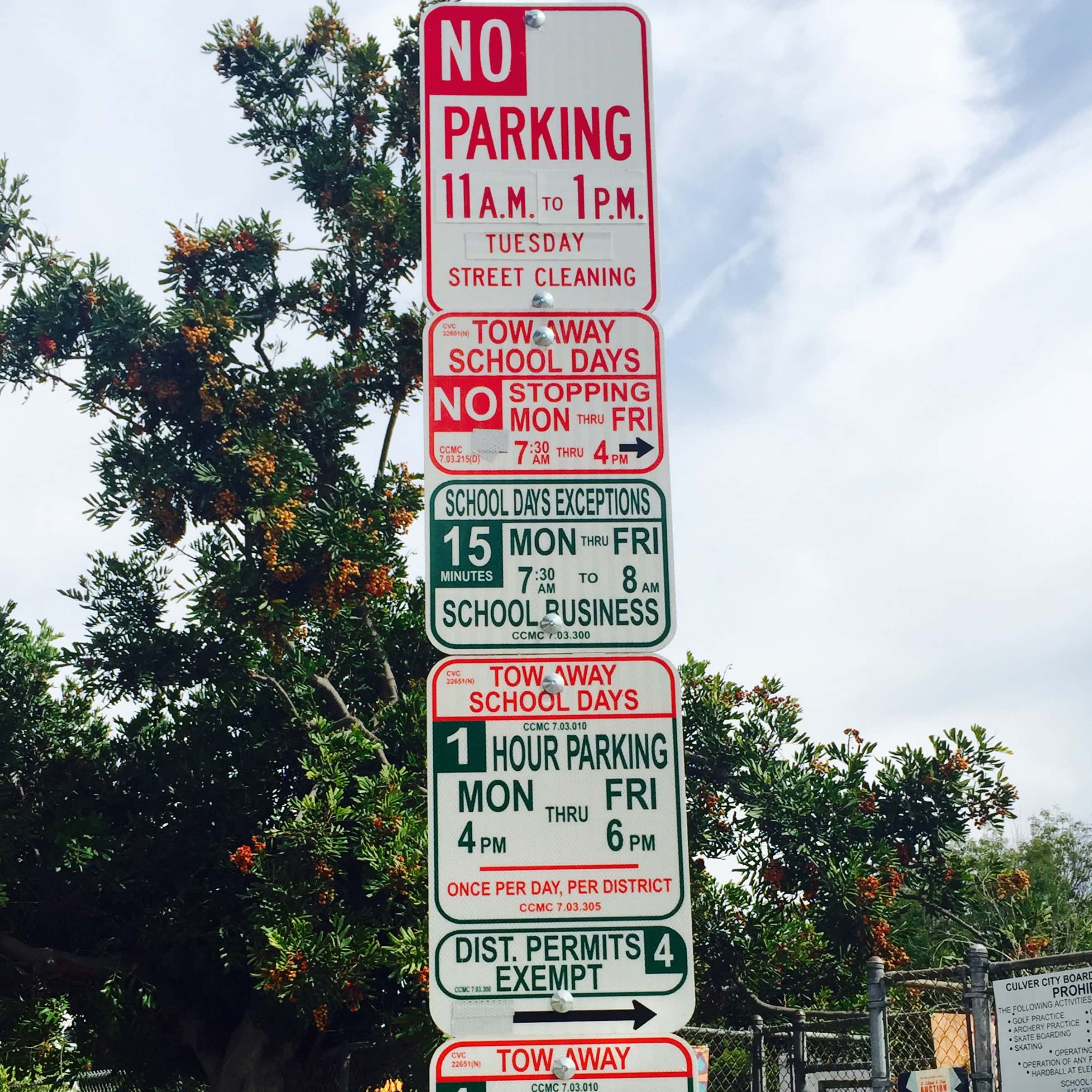
I'm not American, and I agree there is a lot of information there, but it seems reasonably sane if you read through it.
I don't see any obvious contradictions. You can't park 11-1 tuesday due to street cleaning. You can't stop there mon-fri 7:30-16:00 with the exception of 7:30-8 for school business (dropping the kids off). You can park mon-fri between 4 and 6, once per day, per district (to pick up your kids after school), district permits (people who live there, not sure what the 4 means) are exempt.
Oh I absolutely agree. I'm not defending it, just pointing out that it's not totally insane. Here in the UK I've never seen anything that nuts however.
It doesn't matter if it seems sane that way. How many seconds does a driver have to read through that all when he's driving near the speed limit? Do we expect drivers to still keep an eye on the road while trying to decipher it? Do we expect every driver to slam on the brakes, and stand still until they've parsed it all?
I think the idea is you stop, read the sign (probably need to get out of the car), then either stay or go after parsing. Or if you're a regular you learn the rules that apply to you.
I assume the 4 means parking district four. They give people some limited room to hunt for street parking near their home by breaking the city into small districts.
I am American, and it confuses me, which perhaps proves the point.
In particular, why is it necessary to point out that parking is prohibited from 11 to 1 on Tuesday, when stopping of any kind is already prohibited on a superset of that time (7:30-4 M-F)?
Look at the bottom bolt on the "No Parking" sign: It's partially covered by the later-added "No Stopping" sign.
Also, because this is apparently in a school zone, you have to think about how stopping is different from parking: You don't have to pull into a parking zone to drop off your kid, you can just stop momentarily in the middle of the street. During the non-overlap hours, you can pull over and park, just not stop in the street.
That said, it’s not too bad. It’s long and the organization is bad but the policy is reasonableish.
There’s street cleaning one day a week (year round) 11am-1pm, and you can’t ever park then.
It’s a school zone as well; when school is in session you can park for 15 minutes in the afternoon to drop a kid off or for 1 hour to pick the kid up. When school is out you just need to avoid the street cleaning.
I rented a car there and I was amazed at how much text there was, instead of symbols. Eg they have signs in turning lanes that say "Right lane must turn right". By the time you've read that, you've turned right.
As an American cyclist who frequented SF… this gave me a good chuckle, thank you.
True story: Had a driver who swerved from the left-hand lane, across a lane of traffic, across the bike lane, and into a drive way, after I yelled at him (while rapidly braking) tell me "I didn't see you." I've got 3 reflectors (from his PoV), I'm wearing long sleeves reflective highlighter safety orange, and it's daylight…
Cyclists ride. They do not drive. Drive implies you aren't the prime mover in the mechanism (i.e., an engine is doing the work, and you're merely performing the task of executive signaling and control to that set of movers and systems carrying you along do so. The inflection point is actually legal in nature; in that once you slap a motor on it, you require licensure, because you're driving now. This is also why I disagree with driving being a privilege granted by the State; I'm not big on large edifi telling me I can only utilize mechanical devices at their whim, but such is life, yes, I've had the argument before, no I'm not going into it now).
A cyclist, however is the mechanism. You can make the argument that it's silly, but I'll bet you more people will look at you funny for saying cyclists drive than for saying the operator of a motor vehicle rides especially given the legal baggage that comes with driving.
Aside from that, they're quite easy to identify. They're usually the ones either breaking traffic laws, or being ignored/cursed at because their mere existance increases the volatility of motor vehicle traffic patterns in urban environments.
First of all, they've self identified as non-American and presumably not a native English speaker. You could have presented the difference between drive and ride with less pedantry.
Secondly, cities with large numbers of cyclists tend to have better, not worse traffic. It's obvious why: fewer people driving plus infrastructure for bikes is developed and separated from car infrastructure. You should wish for more cyclists, not fewer.
Unfortunately, you can't escape the need for pedantry as a native speaker, and as a non-native (which I sssumed they were), I generally find they appreciate th clarification.
Arguably, what makes motor traffic "flow better" is increased predictability, and decreased demand on shared infrastructure. I'm not condemning all cyclists or saying it isn't worthwhil; merely that the arrangements we've got with them being sometimes pedestrians/sometimes road users leads to a cultural clash that leaves everyone frustrated.
The entire urban network architecture leaves quite a lot to be desired.
I'm not one of those who ignores them. Quite to the contrary. I've been known to roll down the window and ask someone to please pull ahead of my A-pillar.
"Identify which country calls them vasistas because Germans used to ask "was ist das?" from a smaller aperture on the door before opening the actual door"
Depends on the part of the USA. We have tons of roundabouts in the part of the USA I live in. Everything from tiny ones on neighborhoods up to huge multi lane ones (though nothing as crazy as some of the ones I’ve seen in Britain).
Have driven all over the US, and while roundabouts (aka traffic circles) are more common in the northeast, they’re common enough all over that I doubt anyone would struggle with that captcha. /Maybe/ some people would trip over the wording (expecting traffic circle and unfamiliar with “roundabout”).
Tangentially, we've been having fun with this recently. "Why haven't you completed Active Shooter Training?" "I'm busy, prioritising my time, and this training is irrelevant to me." "But what if there's an Active Shooter in the office?" "I've been working at home since April, and I've already been told to expect 6 months more." "It could still happen at home!" "What country do you think we're in?"
Head Office seems to be really struggling to grasp that this training might be less relevant to other countries, other offices, let alone remote workers.
"Although training is currently optional, businesses and organizations are beginning to face citations due to non-compliance with OSHA's guidelines regarding Workplace Violence.[3][4]"
I'm supposed to take it every 6 months. Though they've got it whittled down to 15 depressing minutes of "don't help anyone and try not to be seen by the cops"
I used to have an english boss who used this retort frequently.
That was until I asked him how he pronounced the name of his quintessential made-in-England roadster. You know, his Caterham.
For those not in the know, it is pronounced Kate-rum. The second syllable is normally pronounced as if it should not exist, you move as quickly from the t sound to the m sound as you can. Same thing as Leicester (phonetically leh-str)
To be fair, the “h” was silent in UK English when the English colonized America, and then the English began pronouncing the “h” at a later point. UK English deviates from the common ancestor surprisingly frequently.
I remember a flame war between US-English and UK-English speakers, where one of the former said “if it weren't for us, you'd be speaking German now” and one of the latter ones said “if it weren't for the French, you'd still speak English now”.
Like random3821 commented, it's about American English not being “proper” English (while supposedly if the US of A were a British colony, it would be “proper”.)
Apparently Europeans are bad at this too. Or do you think the French “socialist” party whose members have done things like lead the IMF is really socialist?
Depending on context, the word "socialism" is polysemic in practice in a lot of places in Europe. As long as people are aware that the S for "Socialista" in Spanish governing party PSOE is used in the sense of "social-democrat", and not in the same sense as the 2nd S in USSR standing for "Socialist", it's fine.
Indeed, you’re right. But isn’t this just restating my point?
Americans don’t reliably distinguish between various left-of-center ideologies in their language, but that’s not uniquely American, because neither do Europeans.
I've heard lots of Trump supporters saying Biden is Communist; he seems just right of center to me. But it's about "othering", and USA have had a decades long programme making Communists into evil bogey men, so it's understandable from that perspective.
The fraction of people in the US who genuinely believe that Biden is a communist must be in the single digit percent. The fraction that understand he isn’t but use that as an exaggeration for rhetorical effect is higher, but still not the majority. However, jokes like “let’s ask ‘Americans’ to distinguish these” implies that conflating Biden-ism and communism is a mainstream consensus opinion, which is absolutely wrong.
I see a lot of stuff about Reichsbürger and similar movements in German media; should we conclude anything from that about “what Germans believe” ?