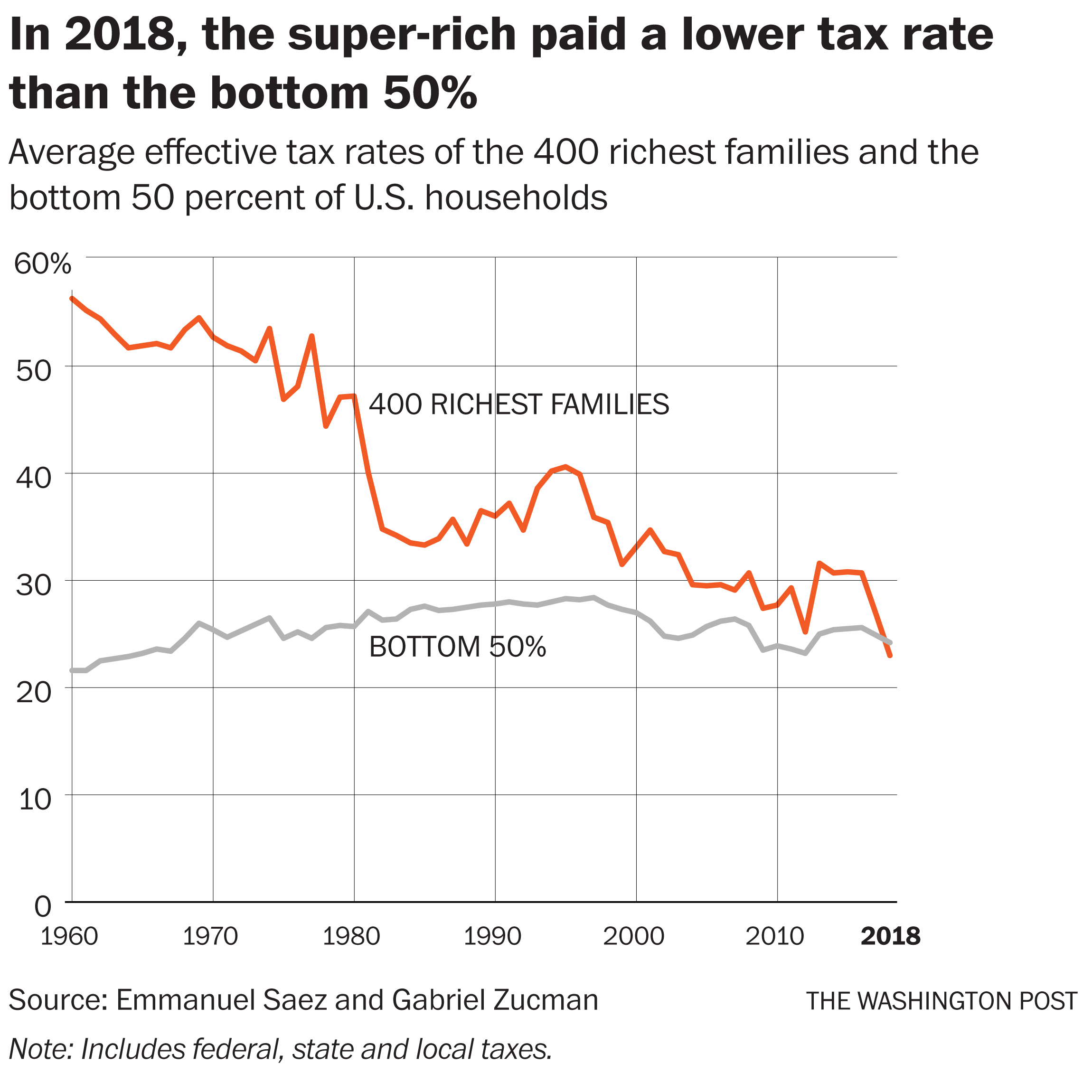
This is meaningless without more detailed numbers. If it's held steady or gone up by a few percent while, say, the percent of wealth and income received by them has gone up far more, then... whoops. They're better off.
Well the percent of the GDP that is taxed is pretty steady at 20%, which infers that spending/taxes grows at the same rate as income. Thus the rich are paying the same percent or more of their annual income over time.
This does not follow at all from those numbers (and reality). Tax pressure has moved towards the middle and lower class, to ease the “burden” of the rich and wealthy.
Look, if the top 1% of people used to share 10% of a country's earnings, but now share 20% of a country's earnings, their relative contribution to total tax revenue will grow without any change to the tax regime.
So you need to consider the change in income distribution alongside any change in relative tax contributions. Otherwise the stats you cite are pretty meaningless
Looking at 2007 was a peak in both income earned and taxes paid. Comparing it to today, income earned (as a %) decreased, yet taxes paid (as a % of total) is about the same.
So we can at least say from 2007 to now, tax burden increased.
The tax burden for the top 1% _income_ earners can totally increase while the tax burden for the top 1% wealthy decreases (they earn from dividends, not work)
Keep in mind that not everyone pays taxes on capital gains. People with a lot of appreciated stock can simply borrow using the stock as collateral, and not pay a single penny in capital gains. Depending on the entity that owns the stock, the interest on the loan might even be deductible.
I hear a lot about that, but in reality it makes no sense. At some point in time the loan needs to be repaid and equity sold which carries a tax burden.
You could "step up" the basis when you die, but I find it hard to believe some billionaire would roll over debt for 30+ years, pay 200-300% in interest, just to avoid 20% long-term capital gains?
I read a lot of conjecture about how this happens and many people said Musk did this, yet he paid $500M in taxes last year?!?
> I find it hard to believe some billionaire would roll over debt
Plenty of rich individuals do exactly that, though. Hang out in any retirement/investing forum and you see people doing the cold hard math and deciding not to sell the stock and pay taxes if the step-up basis is enough.
You don't even need a significant return on capital for the strategy to pay off, it just has to slightly beat the interest on the loan over a very long time horizon. Consider these numbers: $100 million subject to capital gains, $10 million in cash needed for expenses, a 2% interest rate, a 2.5% return on investment, a 20% capital gains tax, and a 10 year timeframe.
The borrowing strategy starts with $100 million and a $10 million loan, and ends up with $128 million and a $12.2 million loan, so net $115.6 million (and the interest is likely tax deductible).
The taxpaying strategy starts with $88 million and ends up with $112.65 million.