People in other countries probably don't understand just how powerful - and depended upon - the big telecoms are here in Canada.
They have no presence outside the country - they are so bloated and inefficient they couldn't compete - but they are omnipresent here.
There are lots of people who depend on Rogers for home Internet, home phone, mobile phone, TV, and home security, not to mention business services that consumers also depend on, like the payment networks that are down.
Plus their media properties, which probably come in useful when the government starts to think about allowing more competition or decreasing the taxpayer money being funneled to them.
I work in telecom and tell this to nearly everyone who asks me about Canada, and its ISP/telecom market and competition...
"Canada is an endangered species protection wildlife reserve park for dinosaur telecoms"
It's a travesty that the government is actually going to let Shaw and Rogers merge to even further concentrate power in the hands of a few families and reduce market competition.
In the article, it mentions that the Canadian government blocked this merger. I believe it said that was in April though. Has that changed, or did I misread what the reporting said? Just want to clarify in case I missed something.
The Canadian government have put up a mild roadblock that will be addressed with non-substantive changes to the structure of the merger, enforced by a little known, toothless regulatory agency who will be instructed to look the other way.
The regulatory environment Canadian telcos operate in is completely captured.
I would bet $100 they'll ultimately let it go through anyways due to the absurdly outsized political influence and lobbying of the equity shareholders of Shaw. One of the wealthiest families in the country.
Practical experience working with Telus has been astounding. I have never met a set of system admins so incredibly ignorant of and incapable of using any of the systems they ostensibly run.
I think people in the USA understand bloated telecoms with monopoly power that means they don't need to compete.
In my neighborhood, I have one effective ISP, that is the cable company (who offers phone+internet+cable), the other is an old-school phone company who offers DSL (with bonded DSL, up to 12mbit). I thought that I could get a slow DSL connection to back up my cable, but no, there's some neighborhood line concentrator that means I can't get DSL at any speed.
So I really have only one ISP to "choose" from. (well, in theory I could get Starlink, but my area is still waitlisted, as is Verizon 5G home internet)
I have a lot of experience in both places. Americans may think think they do, but I don’t think so. As bad as Comcast and others are in the USA, I have found them to be far more efficient and competitive than Rogers or Bell in Canada.
Same for banks in Canada. It’s unbelievable what they do and get away with.
And airlines. Rather, Airline.
I believe there’s a cultural element here: Canadians are more risk adverse and place a higher value on “established” companies and brands. This influences consumer behavior and legislation (Canadians don’t seem to care about laws that make it hard or impossible for market entrants).
If you asked 100 Canadians if they’d prefer more competition to the telcos, 97 would say yes (1 works for Bell, 1 works for Rogers, 1 now works for the CRTC). We’re not risk adverse. It’s just that our government / regulator is captured.
I wonder how many of them would actually buy them though. There's been attempts at mobile providers, sometimes offering prices that the big telcos won't try to match even to flood them out, and they tend to wither away.
Very few of them have offered decent service at good prices. Usually outside of ~5 major metros you have effectively no coverage and speeds are often subpar compared to the incumbents.
Mobile providers have to make huge investments in infrastructure to provide reasonable coverage in Canada. It happens on a small scale but it's like an entirely different market from the main players.
Now I have little doubt that if foreign providers were allowed in Canada that Verizon or AT&T would be able to setup reasonable competition in short order.
This happened: Wind Mobile. They couldn't immediately build infrastructure across the entire country, so IIRC you were "roaming" outside a few major urban centers. However, I believe they also had unlimited US roaming (much better than the big three).
I expected more uptake since it would have been a better deal for most Canadians in those urban centers, but I think there's a subtle bias against taking these kinds of risks.
The Egyptian billionaire CEO had some choice words about the Canadian business climate as he was in the process of divesting of wind mobile: https://www.cbc.ca/amp/1.1013522
They never really expanded close to enough. People didn't want to be roaming when they went to the cottage or camping or whatever and even then the urban areas served were still too concentrated and small.
I think had they focused on southern Ontario or BC and expanded from there rather than aiming to hit the all the big metros first they might have done better.
Decisions are made at the margins. It’s always possible to look back and say “they should have done X, and they would have succeed.” It possible that there were many factors, but in my mind no minor change to the strategy would have helped. Had they done what you suggest, I’m sure the respond would have been that they targeted too small a market, or they didn’t cater to folks traveling between major cities frequently.
IIRC Wind was offering unlimited plans at 50% the price of a mediocre plan on major providers. You could have hours of roaming calls and still come out ahead (and this is in the edge case, where you happen to go camping that month). Most things being equal, Canadians broadly prefer to pay more to have a sure thing. It’s not a bad instinct, but it has consequences to how industry is shaped in the long term.
Most of the smaller providers have either been acquired (e.g. Public Mobile) or downright always been run by the larger telcos (e.g. Virgin Mobile). For both mobile and ISPs, very few companies actually own the infrastructure, most are just leasing bandwidth.
And since you can't count on them to stick around, it's not worth it for many of us to go through the hassle of switching only to have to switch again a year or three later when the company goes under. Plus the risk of poor service compared to the known mediocre service you get from the major telcos.
The poor service often has to do with the fact they don't own the infrastructure, and rely on the parent's technicians. I'd be genuinely surprised if those service calls were put on the same level of priority as their own customers.
Mobile data in NZ is pretty good nowadays, for NZD $60/mo we had unlimited/unthrottled 4G broadband good enough to play FPS games on. In Canada the best we can get is CAD $169/mo for average to middling speeds with pings over 180.
Interesting you'd say that in a thread about ISPs, considering we have regulation-enforced separation between the owners of our government-funded nation-wide FTTH network and the actual service providers. This means I have over a dozen ISPs to choose from, and they all over gigabit fibre and compete on price, customer service, and things like IPv6 or CG-NAT.
I would dispute this one, only because in addition to Air Canada (fleet size 312), Westjet does exist (fleet size 162). And the other regional airlines offer (-ed, prepandemic) some price/service competition. Comparisons to the US aren't as useful with airlines as with some other industries due to population differences.
Yeah, I thought about Westjet and decided that I wouldn’t quite call them a national competitor. I hope they continue to grow, both because I like Westjet and competition helps everyone. There’s a reason Air Canada’s unofficial slogan “we’re not happy until you’re not happy” is widely known.
I mean WestJet hits destinations in every province and two of the three territories (though Whitehorse is apparently going to be cut come September). I think that's a pretty solid national competitor. What reason is there to exclude them?
While I used to love Porter both for location and better service at comparable price, it's not much good if you're flying to Vancouver or Toronto, and the one time I took it to St John's was miserable
Edit: and the union Pearson Express made the main airport a lot more accessible
> Same for banks in Canada. It’s unbelievable what they do and get away with.
Canadian banks are so bad that they actually make the service and fees with a USD checking account with all the normal features at Wells Fargo look good.
I think it has to do with the fact that historically much of Canada's lands/provinces were literally just land owned by very massive British crown corporations. Massive corporations are baked into the history of Canada as a political entity.
No. "Crown Land" in Canada is owned by the provinces.
There is no such thing as a "British Crown Corporation."
Crown Corporations are a Canadian thing.
I lived in Canada for 30 years and now live in the Scotland. CalMac and Scottish Water are not "Crown Corporations," but are nevertheless owned and controlled by the Scottish Ministers. This is contrast to BC Ferries, ICBC, and BC Hydro which are Crown Corporations.
In the UK there is something called the Crown Estate, which is somethint again different.
>> No. "Crown Land" in Canada is owned by the provinces.
Crown land is owned by the Canadian Crown; the monarchy owns all crown land officially. It's administered by a split across federal and provincial jurisdictions.
>> Crown land is owned by the Canadian Crown; the monarchy owns all crown land officially. It's administered by a split across federal and provincial jurisdictions.
No, Crown Land is controlled by the provinces. No, the Canadian monarchy does not own crown land. The Crown owns crown land. Essentially The Crown in Canada is its own legal entity and instrument for the purposes of administration of public lands. The Crown Estates of England and Scotland are something different again, and the Crown Estate owns things like tidal lands and actual real property.
There is Federal Crown Land, but that is almost completely in the northern territories. This is down to Canada's constitutional makeup because provinces control resources.
The Federal government can expropriate land from the provinces when it has a reason to do so like for military bases.
Here is a link that shows Canada Lands. The white area are Provincial Lands.
I suspect that was a reference to the Hudson's Bay Company. I would have to brush up on my history, but they effectively controlled a huge tract of land pre-Confederation and continued to serve many smaller towns until well into the 20th century. I don't think the Hudson's Bay Company was considered a crown corporation, but they were granted a royal charter.
I think they're referring to the fact that the Hudson's Bay Company used to be the legal owner of vast swaths of what is now Canada before selling/surrendering the land to the Canadian government.
National Parks are not Crown Land. National Parks are reserves of land owned and managed by the Federal Parks Department and development is not allowed on that land whatsoever.
Crown Land is land owned and administered by the provinces. Crown Land can be licenced for many uses and sometimes it can be purchased.
We also have national and provincial parks, Crown land is different. A national park is maintained for visitors and for nature, crown land is closer to unused or unclaimed land, generally nothing is done with it unless it's sold off. You are free to camp on crown land, but it's nothing like going to a park, it's full on wilderness camping with no amenities, sites, or anything else.
My point is, Canadians think of government land philosophically as something that is not theirs, but rather, owned by the crown -- the Queen. While Americans see public land as their shared land. This mentality penetrates into many of the differences between the two countries in how they govern.
"Crown" (or "Royal", "Regina", etc.) is used pretty extensively in the Canadian governmental or legal system, and any association in Canadian's minds with the Monarch are pretty much nil.
If you talked about "crown corporations", or "Regina vs." (for criminal cases) no one would associate that with Elizabeth II. "Crown" and anything like that basically just means government.
No, Canadians do not see Crown Land as owned by the Canadian Monarchy, they see Crown Land and owned and controlled by the government as a public asset.
Canadians see the Canadian Royal Family as nothing more than a figurehead of the state.
I am a Canadian and I have studied British and North American History extensively.
I somewhat agree with your main point, but I don't think most Canadians associate the "Crown" as in Crown Land or Crown Corporations with the literal monarchy. Rather it's just a synonym for the (Canadian Federal) government. Most Canadians don't tend to think about the monarchy much at all. (Certainly the Canadian Governor General, theoretically the Queen's representative as head of state, would never be expected to actually take instruction from the Queen.)
TD Bank (and Scotiabank in Latin America) operate as independent entities outside of Canada -- those American TD Bank branches are branches for a different bank (TD Bank USA). In fact, I believe that TD Bank (Canada) simply acquired a US bank rebranded it. I believe they have basically nothing in common operationally.
But it’s also true that over the years, TD has had to merge systems and make changes. They’ve been operating in the US for about two decades now. So they’ve had time to merge and continue growing by merging companies in the US.
It’s true though. They aren’t entirely integrated across borders the way other companies might be. The plans and cards they offer in the US are a much better value than those in Canada, too.
They are becoming more integrated than they used to be. I just opened a TD Bank account linked to my TD Canada Trust account that I can (theoretically, still getting it set up) manage through my Canadian login.
It's kind of funny that Telus, which at it's core is a merger of British Columbia Telephone Company and Alberta Government Telephones (tough to get more entrenched and bureaucratic than that) is actually a pretty innovative and diversified company... outside of their core telecom business where they're just as bad as the others.
Not really. Most Canadians live near the US border and concentrated in high density. There's no correlation to what you are proposing. Income levels are good. Looking at developing countries, they have cheaper and better plans than Canada.
Having lived in Canada and the US, with telecom plans with providers in both countries, I think Canada’s telecoms take it to a new level. To give you a sense of how distorted the market is, it was cheaper for me to keep my US Verizon wireless plan than to use Rogers, Fido, etc. when I lived in Canada!
Unlimited (international!) roaming and everything isn't that expensive (Only about 100$) compared to whatever insane amount I'd be paying if I had some ripoff, under 5 gigabyte or whatever pittance data capped Canadian phone plan for no reason. I also maintain a Central American phone plan that doesn't cost me very much either (2$ every 3 months just to keep the number outside of the country and receive SMS/use chat apps basically, but I don't do roaming when out of that region - When in the region, I spend maybe 20$ a month).
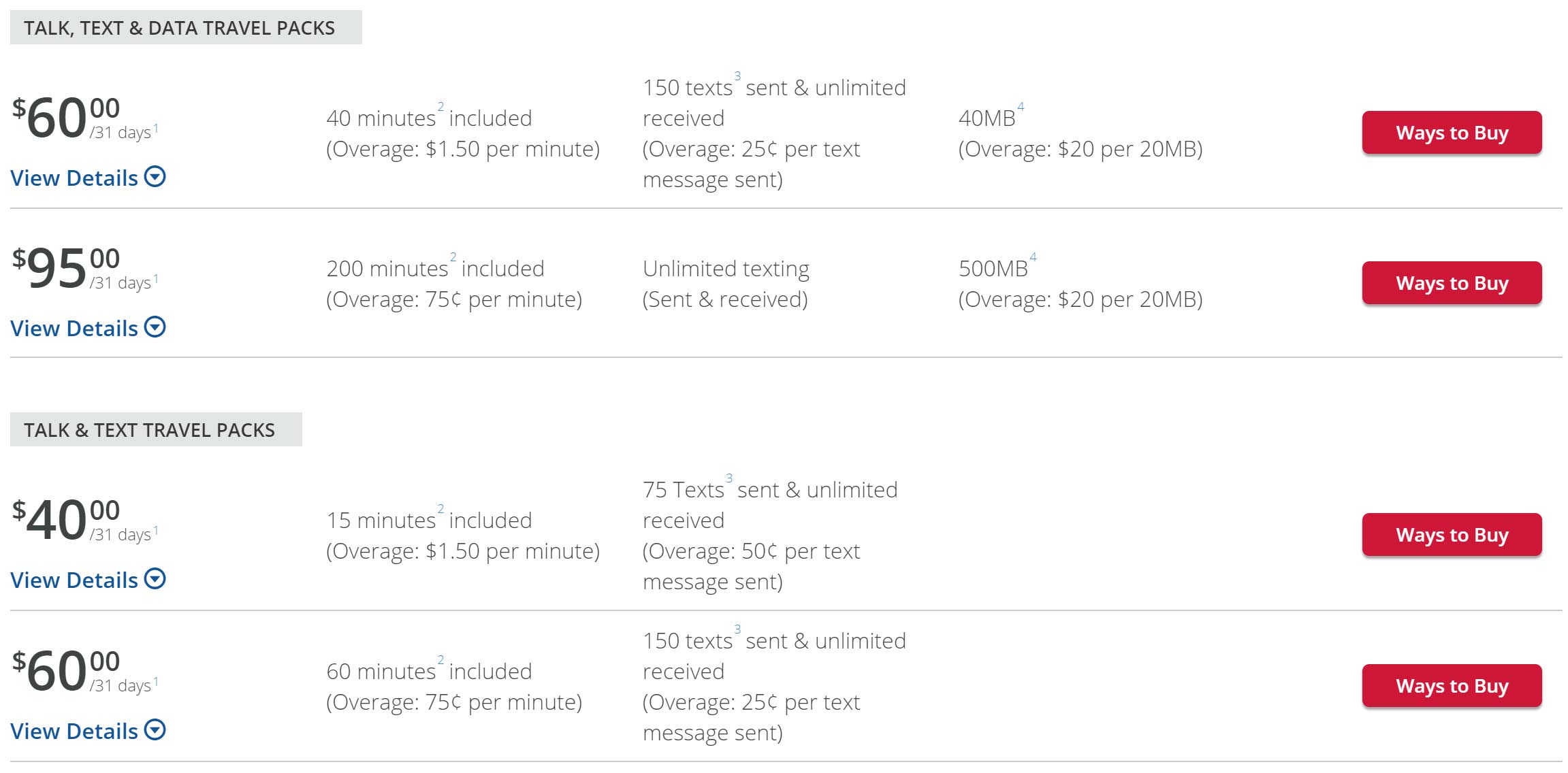
Since the Rogers website is down (Great sales strategy!) I can refer anyone curious to a portion of their menu from some image I found; [1] 95$CAD (500MB until you hit overage) + 60$ for 'roam like home' (no mention of data, canadians still use SMS way too widely), and then probably more to up that data cap with no guarantee that applies to roaming? Yeah, no thanks! Oh yeah, the cops just install malware on your shit with reckless abandon, too. [2] I see no reason to consider Canadian nationality as anything but a nice passport at this point.
Wow, that's incredibly rude. I've never experienced something like that outside of Canada before.
Like what are you even paying roaming for if they pull stuff like that? Is there any acknowledgement that some of us are actually abroad most of the time?
Telecoms routinely sell people services based on the assumption people won't use them. This gigabit link? The user isn't ever going to saturate it, right? They are pretty much immediately proven wrong and get angry because their infrastructure is over capacity.
That they can get away with this false advertising astounds me to this day.
My Rogers plan is $90 for 65 GB of data, it is unnecessary (average use for me is 4 GB/month), but better than going over or throttled. When I was supporting an MPLS Rogers fibre connection, we had zero downtime in 2.5 years.
I bet you could twist their arm into a better deal if you spend a while complaining on the phone about today.
I do a lot of my work off of a mobile hotspot so I'm not tied to an office or home. I try to make the most of what's paid for and it goes very far.
I think that if you're getting a decent price it's probably just customer retention at that price point. If they're ripping anyone off widely at the prices I saw, it's new customers... Immigrants etc, pretty nasty.
I (america) also have only one internet provider to choose from (Spectrum TV, formerly Time Warner Cable). It's really annoying as just barely a mile away, my neighbor has a choice to use Verizon DSL (and does). -.-
I dropped TV and a landline a long time ago, and use cell (google-fi/t-mobile).
The annoying thing is all the spam mail I get from spectrum to bundle all the above for much lower than I'm paying now for an introductory rate. I don't want to play that game but it kills me what I could be saving for at least 6 months to a year.
Most people also don't realize telcos rake in more revenue than the entire tech sector. And that it is no where close to enough to maintain or upgrade the pipes. Cloud has been built on lot of assumptions that are close to breaking point.
Deploying infrastructure is not easy or cheap. But is clearly profitable if you can find investors to finance the capital spend.
Google have tried to enter the FTTH market thinking there must be opportunities to innovate and reduce the cost to consumers. But even they have struggled due to the complexities of deploying fiber in the existing built environment...
The model of separating the fiber network from the telcos that offer service on it can work of the incentives are well aligned. Many Asian countries, eg Singapore, do this.
Or you could put the fox in charge of the hen house and end up in Australia's situation, where local monopolist Telstra owns the phone network and is supposed to play nicely with its competitors.
for last mile ISP options, there are some very fortunate US counties in WA state that have
a) last mile dark fiber network operated by local public utility district which is also the electrical grid operator, and rents access to the fiber to 3rd party ISPs
b) local cable tv operator, legacy coax operator, often docsis3 cablemodem
c) local ILEC/POTS phone company that may or may not have overbuilt its last mile copper/DSL service with its own singlemode fiber and 1Gbps GPON service.
for primarily mobile phone carriers like rogers, there's an effective RF planning limit of around four major LTE/3GPP technology based operators in any given geographical area.
USA used to have 4 with sprint until the tmobile/sprint acquisition.
no but i think theres similar zombie giants that is essentially a hybrid state run enterprise but Canada has explicitly designated industries where you simply cannot execute because they are anti-competitive.
and its not clear how individuals are being handed out rights to say run a casino in canada.
if you took a look at canada's corruption, you will be shocked. we don't quite live in a first world even though we like to tell ourselves all of the government officials/servants are honest.
after all the canadian embassy staff in Hong Kong happily handed out PR residency to hardcore organized criminal groups in exchange for various luxuries and perks. when a staff tried to expose it, he was quickly removed and media began to attack him.
its not only that but you see NGO's championing for racist white supremacy linked groups who vandalize Chinatown in Vancouver and with a large chunk of locals who feel that they are "being overrun by a certain ethnic group" eat that up and the same populist individuals get elected again and again. then my tax goes towards those interest while none for me because i'm 'privileged'
in the long run, I see this system breaking down, if not already. Canada no longer feels like a country but some feudalistic interest group driven, poorly run corportation.
so glad i dont have to pay taxes here. the savings and currency difference allowed me to create jobs in another part of the world. there was a time where I hoped things would get better and I could be creating jobs locally.
i just regret wasting my youth in canada and west coast. canada is a bubble and lot of us are moving capital/jobs out of it.
why contribute to a country that just sees you as an ATM to transfer payments to others who blame everyone but themselves and constantly wanting hand outs?
im done with canada and im warning anybody who still attach romantic outlooks, especially in heavily marketed cities like vancouver.
Singapore does a decent job. I was paying $10/month for a 10GB mobile plan.
There are 5 different mobile providers in Singapore: Singtel, Starhub, M1, MyRepublic, ViewQwest and WhizComms.
Many of them also do fiber broadband. Some government body owns the infrastructure and the providers provide the connection to the internet. There are 5 providers as well.
I was paying $50/month for 1GB fiber and I paid more since I did a shorter term plan. If you buy in for 2 years, it's can be $35/month.
Mountain West state, middle of nowhere town. I have the option of choosing between a 1Gb+ fiber provider, a 1Gb fiber provider, a 100Mb fiber provider, multiple wireless line of site providers in the 30Mb range(more targeted to the people outside town but have line of site to the mountain), or T-Mobile home internet in the 30-180Mb. Small towns are super friendly and responsive to the 'work remote' crowd.
Completely not comparable. Openreach has significant marketshare but is also extremely tightly regulated. It has to allow other providers access to basically every element of its offering, now including its physical ducts and poles.
Hence you have a very competitive market landscape in the UK. There are at least 5 major national retail players using various wholesale products (BT, VM, TalkTalk, Sky, Vodafone), plus dozens of altnets offering FTTH on totally seperate fibre infrastructure have started (Hyperoptic, Cityfibre, GNetworks, Community Fibre).
In my flat in London I have access to 4 seperate FTTH networks (with completely different infrastructure) - Openreach FTTH, VM DOCSIS, Hyperoptic FTTB and Community Fibre FTTH. The market works here, prices are low and there are very few data caps.
Yip, things in London are quite different than the rest of the UK.
While Openreach has to allow access to other providers to its infrastructure, most infrastructure is owned and controlled by BT.
If you want FTTP, the underlying service is still BT Openreach. Openreach is very profitable.
At my previous employer it cost us £30K to have BT put in 3000m of fibre that took them 1 afternoon, then it cost £1K a month for a 30Mbs service.
BT owns provides the vast majority of broadband service in the UK and it is somewhat disingenuous to claim BT is on an equal footing as Hyperoptic, VM, or Community Fibre.
TT and Sky use BT OR infra, and EE, Plusnet, and BT Retail are all owned by the BT Group.
The telecom market in the UK is very consolidated and controlled by BT.
You don't even have to leave London to see a night and day difference. I currently live in a new-build flat and have multiple choices for fibre (Hyperoptic are great). I am hopefully soon to be moving less than a mile down the road into a house where my choice is either an offensively slow BT-backed service or an offensively unreliable (so I have heard) Virgin Media service.
If you have a new-build flat in a major UK city you probably have a similar decent choice but the rest of the housing stock (the majority by far) is stuck with BT/Virgin.
You'll almost certainly be getting BT FTTH in the next year or two if you have access to VM. The program is running quickly, something like 6 million premises a year and ramping.
VM can be ok or can be congested depending on the area. BT FTTH doesn't suffer from congestion issues (nor does the FTTC).
Check https://bidb.uk/ for more information. It collates all the altnets and planned roadworks into one dashboard.
>> BT FTTH doesn't suffer from congestion issues (nor does the FTTC).
That is just not true. BT consumer FTTC is contended up to 40 to 1--that is you are sharing your backhaul with upto 40 of your neighbours. I am assuming that their FTTH services are the same.
> If you want FTTP, the underlying service is still BT Openreach. Openreach is very profitable.
Not always. There are many altnets now (cityfibre etc).
> TT and Sky use BT OR infra, and EE, Plusnet, and BT Retail are all owned by the BT Group.
TalkTalk also use cityfibre.
> The telecom market in the UK is very consolidated and controlled by BT.
If you mean physical infrastrure, yes it is (though changing rapidly). Consumer level pricing is competitive though and the services are reliable in the large. It is a different planet compared to the US and especially Canada.


They have no presence outside the country - they are so bloated and inefficient they couldn't compete - but they are omnipresent here.
There are lots of people who depend on Rogers for home Internet, home phone, mobile phone, TV, and home security, not to mention business services that consumers also depend on, like the payment networks that are down.
Plus their media properties, which probably come in useful when the government starts to think about allowing more competition or decreasing the taxpayer money being funneled to them.