This is great news, and most people knew that Chrome could close a lot of the gap and saw asm.js as a competitive push. The main goal seems to have worked.
There is still a ways to go though before they are fully on par with Firefox. Note that one of the benchmarks is still far slower on Chrome, and there are still probably edge cases here and there that trigger slow JS in Chrome. The guarantee of asm.js that your code is ~2x slower than native is nice. Additionally, loading in massive amounts of asm.js in Firefox will be much faster in Firefox in the future when they optimize the parser for asm.js.
All in all, these are very happy times. There are pros and cons to both approaches, but it's exciting to see how far it's going.
>The guarantee of asm.js that your code is ~2x slower than native is nice
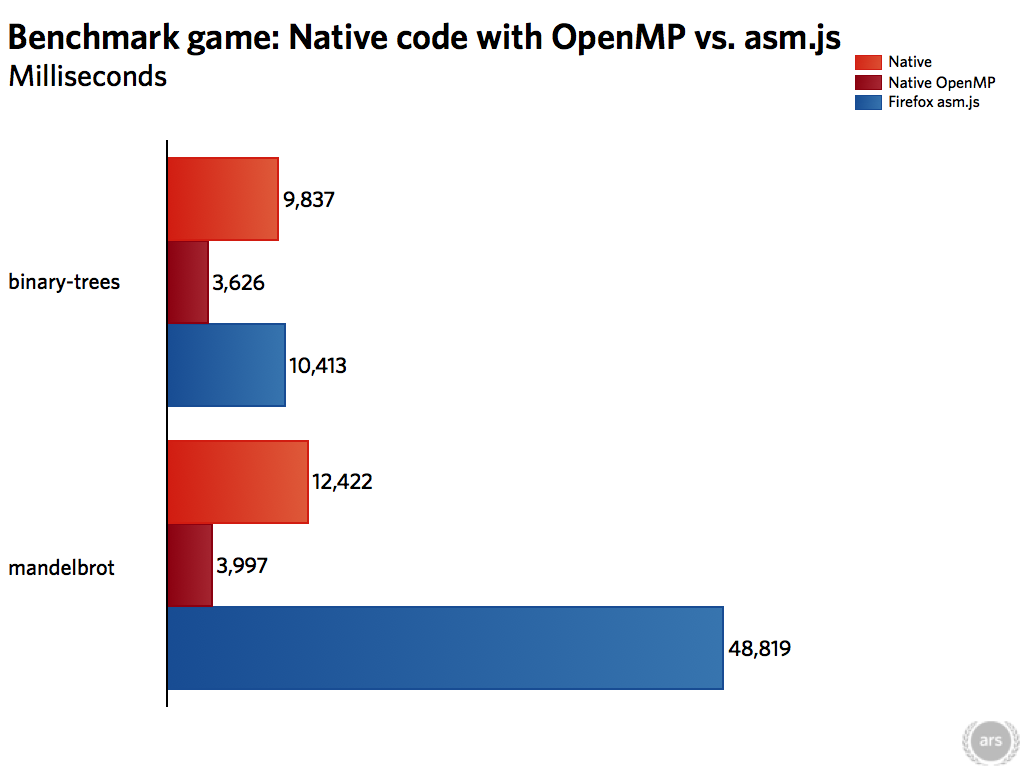
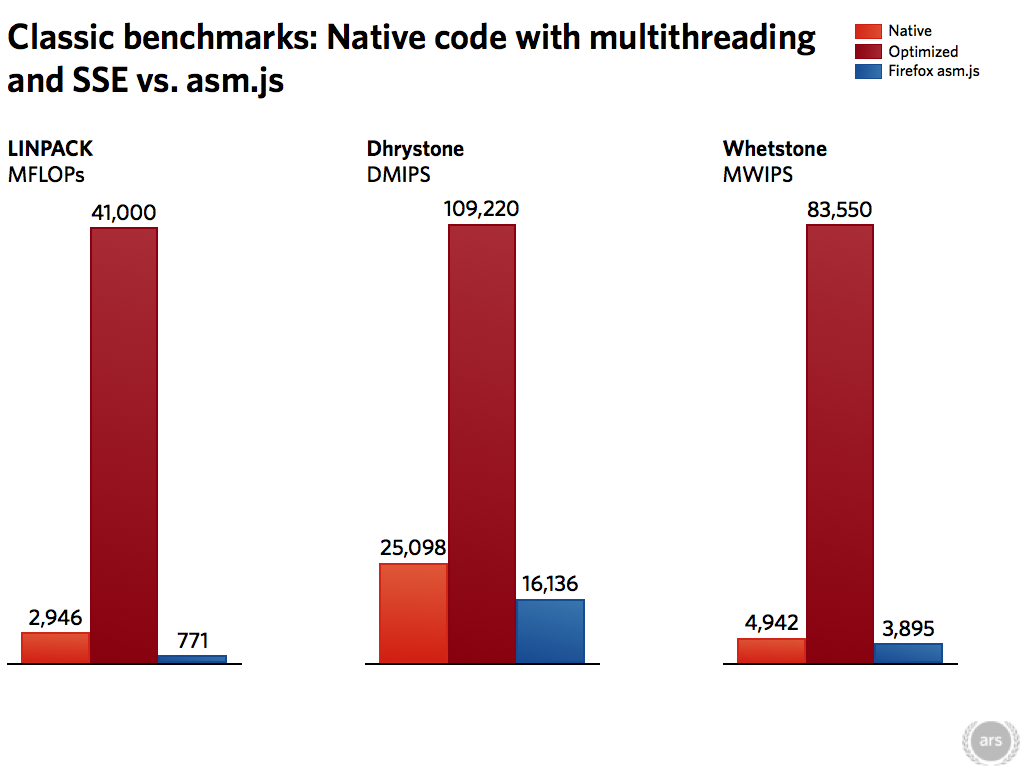
What? How did a couple of benchmarks that showed ~2x performance for a few tasks become a 'guarantee'? In some situations asm.js only takes twice as long to run your code, in others it takes 12 times as long[1] or even more[2].
Those are examples of native code using multiple processes or threads. The asm.js code compared to them did not use multiple processes (but it could have, using web workers), nor did it use threads (which are not available on the web).
It's fair to say that for single-threaded code, asm.js has a very good chance of running at half the speed of native, or better. For multicore code, it depends on whether web workers make sense for that use case - if they do, it can still maintain the same performance compared to native. Otherwise, the web platform would need to consider adding some more low-level parallelism to JS. Such proposals exist and there is some discussion about them.


There is still a ways to go though before they are fully on par with Firefox. Note that one of the benchmarks is still far slower on Chrome, and there are still probably edge cases here and there that trigger slow JS in Chrome. The guarantee of asm.js that your code is ~2x slower than native is nice. Additionally, loading in massive amounts of asm.js in Firefox will be much faster in Firefox in the future when they optimize the parser for asm.js.
All in all, these are very happy times. There are pros and cons to both approaches, but it's exciting to see how far it's going.