Well, indeed. I'm far from convinced there are easy solutions to the problem, and in my more conservative moments I can entertain the idea of abolishing even pretences at welfare aimed redistribution on this basis, but ultimately it's very hard to stomach. Credit should probably be harder to obtain, regardless of the position I'm feeling in at the time!
Ironically the better approach may be fairly close to what's in the games, and that is to expand the scope of food stamps (or similar) to create a sort of two tiered currency setup, where one currency is only legally usable for basic needs. Unfortunately that's likely to have exactly the same consequences as exists in the games.
Give it a year or so, and credit will be much harder to obtain. Problem will solve itself, with massive consequences for the rest of us.
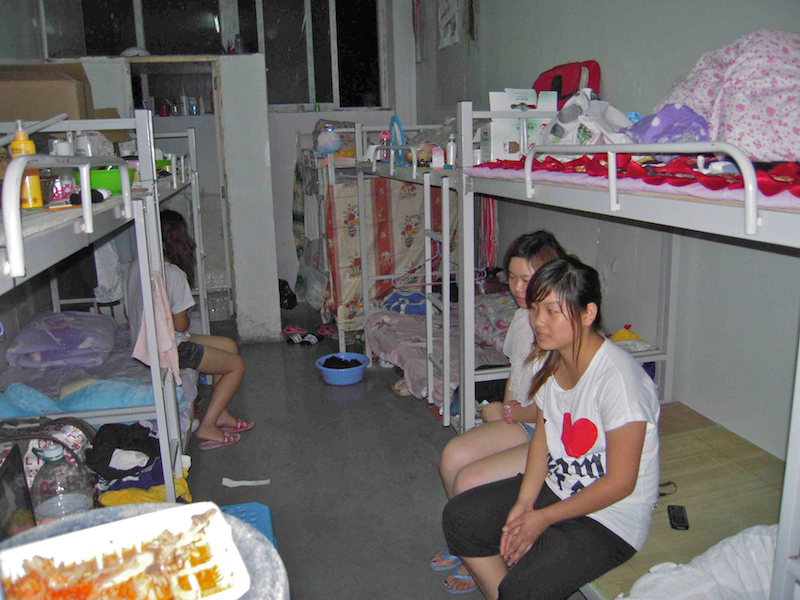
Problem is that we simply don't have economically useful things for people to do. This problem is hitting China. Unemployment is hitting people who are willing to tolerate this quality of life :
It's being caused partially by the energy crunch (even with the US shale boom, net oil available to the world to use has been declining since 2005) and the lack of solutions (note that solar panels need ... a lot of oil to get produced, wind turbines need massive amounts of oil for their production, so so far the whole "renewable" energy thing has increased, not decreased, our reliance on oil. Hopefully that'll reverse in a decade or so, question is will it still matter by then ? Also global warming policies have basically moved a lot of factories which were in the west (where they were powered by mostly oil, some nuclear, little bit of gas), to China (where they are powered by coal). Coal is about 10x worse for the environment than coal).
But fixing the oil problem (e.g. there are massive methane deposits along continental edges that could replace natural gas. They're big enough that they put the total amount of oil available in 1950 to shame. We don't currently know how to extract them, but loads (as in dozens) of research programs are in progress to fix that) would not bring a permanent solution.
What we need is something useful for unskilled workers to do that is reasonably well-paid, can use any amount of unskilled workers, is spread about the country, and ideally cheaper than bailing out banks. Maybe we ought to take a page out of the Roman empire's book and start building cathedrals in every city in America ? Worked for Europe for several hundred years ...
It figures it will be paid by 2020 at the latest (it also figures that current solar pv energy production matches or exceeds energy consumption by panel producers).
That still means that the energy balance is negative until that time.
Also : There's caveats in this study. They are calculating the point where PV electricity production starts exceeding energy use in PV production, assuming no rise from current production levels. This is not a good guide to use to decide whether a specific installation of PV is a net-energy-negative or not. Any small-scale installation north of, say, Detroit, will never be energy positive, and is just a loss. This includes most of the German installed base.
I was putting forth a credible resource that pretty much exactly addressed the topic, not trying to argue with what you said.
I guess a useful government regulation would be to require estimates of the energy consumed to make certain energy products available. It would be pretty much impossible to do at the point of sale for things like retail gasoline, but a given fuel distributor shouldn't have too much trouble calculating their average for some period of time (especially if they are getting reasonable numbers from upstream providers).
I talk about gasoline because I think it would be interesting to have numbers for more than just solar panels and liquid fuels are probably one of the more complicated places to do such a calculation. It should be relatively easy for pv manufacturers.
Why do you think that people should have to do 'economically useful' things?
Surely it is one of the goals of technology and progress that we free people from the need to work. As such, any step towards this 'leisure economy' should be celebrated, rather than thinking up pointless labour for people to do.
I suspect that, without some sort of direction, many people would go mad. It would be nice if people used their leisure time to create art or pursue research of some sort and so on, but people generally don't. You see it all the time, lottery winners who are miserable, some of them even going back to their ordinary jobs, because they miss them. For every JK Rowling who spent a period of unemployment writing a book, there are a million who won't even read a book. There's no easy way around this, it needs a fairly basic shift in human nature.
I'd be just fine. The natural state of man isn't a 40-hour workweek, and it wasn't even common until the industrial revolution. Hunter-gatherers worked less than we do.
If people still feel too idle and can't come up with something to do on their own, they can share a 40hr job with 4 or 5 other people. I am fully confident, though, that everyone will find something they like to do to occupy their time.
Quote:life expectancy at age 15 is 48 years for Aborigines, 52 and 51 for settled Ache and !Kung, yet 31 and 36 for peas-
ant and transitional Agta.
Survival to age 45 varies between 19 and 54 percent, and those aged 45 live an average of 12–24 additional years
The modal age of mortality in hunter-gatherers can range from 68 in the Hiwi to 78 in the Tsimane.
The "natural state of man" is to work from sunrise to sunset to find enough to eat, and still sometimes going to sleep hungry. The hunter-gatherer lifestyle wore people out so they died at 30! The natural state of humans is to be active. The question in the modern world is what activity.
Incidentally, my experience of job sharing is that it doesn't scale. You get 2 or 3 people, they arrange the job share among themselves, everyone is blissfully happy. Then one leaves and how do you fill the position, when it was tailored for one specific individual's lifestyle? The other sharers then find themselves having to adapt again, and maybe that's incompatible with the other commitments they've picked up thanks to the arrangement. 9-5 is actually the least-worst option all things considered.
Work is of two kinds: first, altering the position of matter at or near the earth's surface relatively to other such matter; second, telling other people to do so
Well for a start that isn't true... And JK Rowling is a perfect example of it.


Ironically the better approach may be fairly close to what's in the games, and that is to expand the scope of food stamps (or similar) to create a sort of two tiered currency setup, where one currency is only legally usable for basic needs. Unfortunately that's likely to have exactly the same consequences as exists in the games.