I'm a religious guy who loves science and technology, and I greatly appreciated this article.
Men of faith need not be anti-science, indeed, many great men of science were men of faith. And not by an incidental flaw in their minds, as the article puts it, but as a driver and strengthener of their science.
In the last 100 years especially, religious people have grown anti-science, largely because we see science growing increasingly atheistic. Others feel threatened by evolution, as if natural selection undermines the existence of God.
I am working in my own religious circles to counteract that and to bring back a love of science and a love of knowledge back to my own Christian circles.
In the meantime, articles like this one are helpful to dispel the modern notion that one cannot be religious and still love knowledge and science.
> In the last 100 years especially, religious people have grown anti-science, largely because we see science growing increasingly atheistic.
If I may have a moment? I want to discuss this comment. For a very long time, many people rooted their faith in mystery. Nobody knows how the weather works, therefore God does it. That sort of thinking was very commonplace.
Science has always been "atheistic" in that God has never been a coherent part of any scientific system. It's difficult to account for an uncontrollable and omnipotent force, after all. Nothing there has changed in centuries. What has changed in that science has advanced enough to pull away the mysteries that used to be attributed to God.
Ever hear the phrase "God of the gaps"? For a lot of people, that was - and is - how they understand God. Anything they didn't understand, that was God. Science was just something those rich eggheads did.
Over time, it became possible to see the material world in which we live as comprised of matter and energy that are governed by natural laws. It was no longer necessary to see God in everything you didn't understand. The human body wasn't divinely created in its current form, we're the product of millennia of evolution.
To a great many people, whose primary understanding of divinity is that of a God of the gaps, knowledge and faith are fundamentally incompatible. If they acquired knowledge, the unknowns on which their faith rests will vanish and their faith be shaken.
I suppose this is a very long-winded way of saying that I don't perceive science as becoming more atheistic over time. I perceive religion as being in a slow, painful retreat from territory it never should have occupied.
“Men think epilepsy divine, merely because they do not understand it. But if they called everything divine which they do not understand, why, there would be no end to divine things.” - Hippocrates.
I appreciate the clarity with which you've articulated your understanding of religion, but I disagree with almost everything you've said. Since the disagreement is not really about facts, but rather attitude or orientation, it might be pretty hard for me get you to see it from my perspective, but I'll try.
Here's the main idea: you see a fundamental gap between science and religion that in the past simply did not exist.
> Ever hear the phrase "God of the gaps"? For a lot of people, that was - and is - how they understand God.
This may be true of many people today, but it is an essentially modern understanding of God that cannot have been held by anyone before the Renaissance. Before the scientific worldview existed, there simply were no gaps for God to reside in. What did God mean to people then?
Richard Tarnas's The Passion of the Western Mind[1] is a wonderful intellectual history of the West starting from the Greeks. You would probably find it interesting. It traces some of the philosophical roots of Christianity back into Greek thought, and it traces the philosophical roots of your modern worldview back into Christian thought.
And before you dismiss me as a religious weirdo, I am a lifelong atheist who has studied a lot of math and physics.
You say, "religion was the only available mental framework"
He says, "philosophical roots of Christianity back into Greek thought" ... and ... "philosophical roots of your modern worldview back into Christian thought."
My understanding was that he sought to explain the lack of a perceived gap in the past by stating that there were not multiple worldviews that could have come into conflict. Further, there was commentary on the history of relevant worldviews.
Then what is Godel's argument, and why is it so perfect?
Once you've answered that, what kind of god does this argument "prove", and why should I believe in it, especially if it's not going to give me eternal life? How does a perfect argument conjure a god into being but not the perfect ice cream sundae and the universal pizza I can imagine?
In my opinion the difference between then and now is that now you have a contingent of scientists that actively promote the position that you cannot simultaneously be both religious and a scientist. I understand the positive goals they are trying to achieve, but I don't think they are considering the ways it can be counterproductive to their cause. I don't think you can do anything about fundamentalist Christians, but I wonder how many people were pushed into fundamentalism because something less extreme was still treated with utter contempt.
The people you refer to would cite the ineffectualness of the moderate positions to which you appeal. Their position is based in part on the notion that the less extreme approaches have failed utterly.
What's fascinating about the progress of science is the discovery of hidden laws that govern our universe. Discovering how the weather works doesn't mean it arrived by accident. We both know that laws don't and have never had creatorial powers. Governing laws are defined by a creator before/during creation, and are discovered through observation. So the laws of the weather, among others, were waiting to be discovered. But they must have been set by someone.
That... is a religious position, rather than a scientific one. There's ample evidence of complexity emerging from simplicity without a governing intelligence.
> There's ample evidence of complexity emerging from simplicity without a governing intelligence.
I wouldn't be so quick to say classify the evidence as supporting complexity emerging from simplicity without a governing intelligence; because we know so little about our universe and how it works. Our best scientists are still at work. But, there's orders of magnitude ample evidence of complexity emerging from simplicity with a governing intelligence. Everything, everything created by humans.
You will have to take into account the times when these men lived and what was known back then vs what is known today and to acknowledge that you live today.
I'm happy that you're doing what you're doing but ultimately religion is very un-scientific, which is one of the root causes why religious people tend to view science as atheistic. Those are flip sides of the same coin.
It's very well possible to do good science whilst being religious. At the same time it is very well possible to do good science whilst being an atheist. Science as an institution does not care where the incremental steps towards the truth comes from, as long as those steps are reproducible.
Assigning correlation between religion and the ability to do science seems a bit strange, as if if Maxwell would have been an atheist he would not have been able to make the discoveries that he did. I don't buy that, but maybe someone could do a double-blind test by staffing labs in the same disciplines with devout Christians (Catholics, Protestants, Church-of-England or whatever denominations you can find enough scientists from) and similar labs with just atheists. Then maybe we could draw the kind of conclusion the article wishes for us to make.
Until then I'm fine with letting people believe whatever they want and taking the fruits of their progress whatever their belief was when they did their work.
Religion speaks of something beyond measure, and this is a reason some perceive religion as unscientific.
Atheism too speaks of something that can't be measured: the certain non-existence of the thing every human culture has sensed, longed for, believed in some form or another since the beginning of humanity.
Science itself is full of things that can't be measured. The Fermi Paradox and the Great Filter are examples of this: we theorize about why earth -- despite 100 billion-billion other planets like it -- appears to contain the only life in the universe. The theories include those of super-intelligent life beyond our measure, which really isn't that far intellectually from the idea of God.
The article does not claim Christians are better scientists than atheists. Rather, it corrects the idea that these thinkers' religion was an incidental primitive flaw in an otherwise great mind, when in fact, these men's insights into and pioneering in their scientific fields were driven by philosophical commitments to the divine origin of the universe.
There is a lot of common ground between religion and science, both attempt to explain and both originate from man. Religion goes one step further than science and sees itself as an end-run around all requirements for evidence by being 'self evident' and 'self proving'. Science sees limits to its power and that alone makes me more comfortable with science.
To see Maxwell and contemporaries trotted out to try to prove some point in the present about these men's dedication without letting them speak for themselves (they can't, they're safely dead) is to me just as much a heresy as claiming that Johann S. Bach would have composed all his works if he had been an atheist, rather than that he took a lot of inspiration (if not most of it) from his deeply religious nature.
It's really not fair to put words in the mouths of men long dead and gone, we can not know of their motivations if they had lived in the present because they didn't so all we can do is see that work within context. So I suggest that we just be grateful for the work they did, whatever their motivations were.
Keep in mind that priest-natural philosopher was a pre-cursor to our current day scientist and recognize that evolution of thinking is pretty much a given taking into account the march of scientific progress (if we can call it progress, I wished that that was more clear cut but it unfortunately isn't always, perhaps in a few thousand years or so we can answer that one with clarity).
So, being religious isn't a primitive flaw in anybodies mind, great or not. But it can be detrimental, especially when it counteracts the truth with great (but ultimately misplaced) authority.
It's really not fair to put words in the mouths of men long dead and gone, we can not know of their motivations if they had lived in the present because they didn't so all we can do is see that work within context.
In your worldview, it is quite fair to do that. One of modern science's favorite, yet unhealthy, past-times is to attempt to describe the inner workings of men (and other events) which are "long dead and gone." So no, you don't get to casually discard it here, because science has repeatedly demonstrated it is highly interested in using empiricism to form presently observable models and also use those present models to conjecture about the past -- regardless of whether those present empirical models can be rationally extrapolated in that direction.
Hopefully this brings you to a greater understanding why the portion of science which addresses the past is really a "religion" in it's own right, relying on plenty of faith to give any sort of credence to its claims about a truly unknowable past.
Religion now speaks of something beyond measure. It used to be much more specific. This changed once people had the tools to investigate and discovered that none of the specificity was actually correct.
I can't speak for all religions, but the Judeo-Christian tradition has always believed God is beyond measure.
Some examples are from the Jewish/Christian Bible[0]:
"Who has measured the Spirit of the Lord? Who has been his counselor, instructing him? Whom did he consult, to gain understanding?"
And again[1]:
"O the depth of the riches, and the wisdom and knowledge of God! How inscrutable are his judgments! How unsearchable are his ways! Who has known the mind of the Lord? Who has been his counselor?"
Jews and Christians have always believed that God is beyond measure. As we see it, God is outside of the natural world, beyond human comprehension or measure by science.
However, both the Hebrew scriptures of the Old Testament and the Greek scriptures have always asserted that God is active in history and actively intervened to change the course of history for his chosen people. My process of discovering that the specific parts of the Bible are not verifiable, while the verifiable parts of the Bible are not specific, involved learning all the original languages of the Bible, reading through the Bible in its entirety in those original languages, and meanwhile learning about the verifiable history of the times and places described in the Bible. Simply put, whoever wrote the Bible was not infallible, but sadly very fallible indeed. And that shows that the Bible is not God's word revealed to us, as I was taught in my youth, but rather a collection of human stories and speculation about God, which anyone has the right to disagree with, as the overall description of God and his attributes is not even consistent among the various Biblical writings.
There's a whole lot more to the Judeo-Christian tradition than the part where God is beyond measure. Said tradition also has a lot of specific elements in it. Those specific elements are now being abandoned, because as it becomes possible to examine them, they're found to be untrue.
So yes, religion has always spoken of things beyond measure, but it used to speak of a lot more than just that.
It's frequently said that there is no conflict between religion and science. The only reason this appears to be true is because when they do conflict, religion has no choice but to retreat. Histories become metaphors. Prophesies get reinterpreted. Specific claims become ever more vague when they fail to stand up to the test.
That stance has only become mainstream since the enlightenment. Before then, people thought God was clearly active in everyday life. After all, who else could visit droughts on lands that didn't worship him enough? Or send plagues to towns of the unfaithful? Or destroy false churches and temples with earthquakes and lightning? As late as the 1700's, people were advised to stay away from churches during thunderstorms so as to avoid divine retribution.
This isn't just historical fact. The Bible itself contains multiple instances of people successfully testing Yahweh's existence. In fact, one of the earliest documentations of a scientific experiment is the story of Elijah and the priests of Baal.[1] In it, Elijah and the priests both try to set fire to piles of wood by praying to their gods. Elijah makes it more challenging for himself by having his pile soaked with water. The 450 priests of Baal are unable to summon fire for their dry pile, but Yahweh lights Elijah's water-soaked pile. This being the old testament, Elijah has all the priests of Baal killed afterwards.
Why the change in views today? It's not that complicated. Religions have been forced to change in response to challenges from science. The reason people say God is unmeasurable today is because we tried to measure him and found nothing.
So discovering the laws of motion, universal gravitation, etc means we understand fully the ways of God? As if the scripture text you quoted meant that such knowledge was hidden from us. Well, what is hidden from science (but explained in the Bible by a God who's hiding every piece of information) is our purpose here, why we grow old and die, how our universe came into existence, how life began, and how to gain salvation. Don't get me wrong, how crops grow in the field is a fascinating question to answer but materially less important.
> Atheism too speaks of something that can't be measured: the certain non-existence of the thing every human culture has sensed, longed for, believed in some form or another since the beginning of humanity.
Not at all. It simply states that our desire for something isn't sufficient evidence for its existence.
For example: I really want ice cream. Therefore I have ice cream. If you assert that I do not have ice cream you're clearly wrong because I really want ice cream.
> The theories include those of super-intelligent life beyond our measure, which really isn't that far intellectually from the idea of God.
Morally and ontologically it is. Or we can just call the tallest building in the city God.
> these men's insights into and pioneering in their scientific fields were driven by philosophical commitments to the divine origin of the universe
They were. And Soviet scientists were driven by a commitment to the revolution.
The constant in religion and philosophy and science and commerce and art is human beings and their psychology.
"Science as an institution does not care where the incremental steps towards the truth comes from, as long as those steps are reproducible."
I am very skeptical of that. The scientific community is susceptible to politics and social competition, at least as any other community. Reproducing results (real science) is hard work and the reality of it is that scientists are entitled to unsupported beliefs, but may find it difficult/tempting to misuse their achievements or stature to champion those beliefs.
"ultimately religion is very un-scientific"
This is a provocative statement that would be interesting to hear more on.
As for the science community's shortcomings: scientific theories change one funeral at the time.
> This is a provocative statement that would be interesting to hear more on.
HN isn't the venue for this discussion, but since you asked:
I don't think that's a very provocative statement at all. Miracles, Heaven, Hell, virgin births in humans and so on (and that's just some branches of Christianity). There is no limit to the number of un-scientific things one can find in religion, either in a literal interpretation of scripture (which we are supposed to have grown above these days but which still underpins much of Christianity) as well as a lot of more permissive interpretations which still boil down to special treatment for mankind at best.
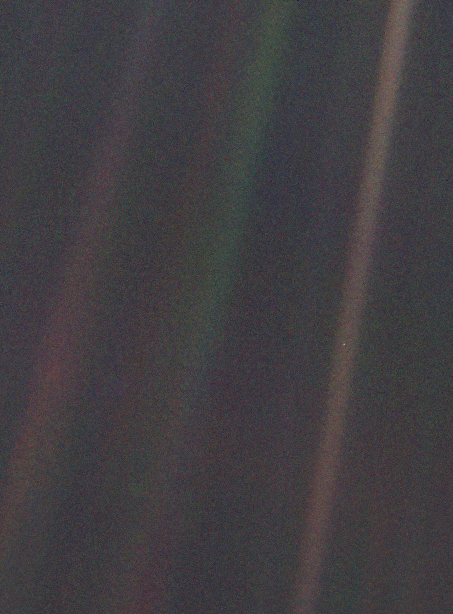
My usual way of dealing with such things is to look at this picture for a minute or so:
And to wonder why we think we're so special in gods eye that he/she/it chose to create all of this just for us. And then of course within 'us' there are those who think they are even more special in the eye of their deity.
The next thing that troubles me greatly about religion is that religious people can't seem to agree on any one thing in the aggregate. It usually seems to boil down to 'I believe what most people believe where my crib was located.'. Reasoning about religion should - if it was aimed at discovering some kind of truth, and so be more scientific - converge, but divergence seems to be the norm.
Science tends to converge when looked at over the longer term.
> There is no limit to the number of un-scientific things one can find in religion
M-theory. String theory. 2 theories unprovable with the scientific method. So there's at least 2 un-scientific things eating at the table of (scientific) science as we speak. Some scientific scientist hold them close to their hearts, even though their very unscientific. More unscientific than miracles.
> Miracles, Heaven, Hell, virgin births in humans and so on
Why can't miracles happen? Basic definition of miracle is an event that cannot be predicted by observed law governing similar events. It doesn't mean miracles can't happen. Arithmetic law of addition says that $1 + $1 = $2 (and it remains so indefinitely), assuming the thief doesn't pass by. If they do, $1 + $1 will be equal to how much money they left you. It doesn't mean the law of addition is unpredictable; it means it only governs normal events.
I think you may misunderstand how theoretical physics works. Theorists devise competing theories to explain existing evidence, while making some as-yet unproven predictions. Experimentalists then test those predictions using both controlled experiments (e.g. LHC) and observations (e.g. Hubble). Theories whose predictions were invalidated are then revised or discarded (e.g. Luminiferous Aether[0]).
That is the very definition of the scientific method, not at all "unprovable" as you claimed. The same process produced the current theory of evolution, and is just not as far along in the case of string theory. Seeing conflict in science and declaring it to be religious is like seeing a half-assembled car in a factory and declaring it to be undriveable. You are taking a snapshot and ignoring the process.
A note about the word "theory": it doesn't mean "untested"; it's the same sense as "music theory", that is, a comprehensive body of explanatory knowledge about a subject.
>I think you may misunderstand how theoretical physics works. Theorists devise competing theories to explain existing evidence, while making some as-yet unproven predictions. Experimentalists then test those predictions using both controlled experiments...
I think you're misunderstanding what the OP is saying. He is saying that many physicists consider string theory to be "untestable", not just that it hasn't yet been tested. He's saying that given the limits of reality it is likely unfalsifiable, and therefore it could be argued that string theory is outside of the realm of science.
Any theory that is untestable is meaningless and will be relegated to math for math's sake (which is also an incredibly valuable endeavor) or abandoned. So if string theory turns out to be untestable, it will find the same end. In fact theorists even study theories they have contrived to be knowingly unrepresentative of reality, for the math.
Science works by evidence-driven consensus. There is no central ruling body that decides what "science" is, or how long to keep working on it. Different scientists make proposals to different institutions, and those institutions decide what to fund. As long as there are tenured researchers or funding institutions that want to work on string theory, there will be people working on string theory. But if research into string theory stops yielding interesting results, those still researching it will get fewer publications and citations and they will change to a more promising line of research.
Also, scientific theories are never "proven", and the word "theory" doesn't have any sort of officialness to it, as is clear in the Wikipedia article you linked. To be a "theory", a set of ideas basically has to be comprehensive, logically sound, agree with existing evidence, and generally useful for something.
Experiments and consensus determine which theories are most promising for continued research and experimentation. In a given domain of science, the simplest theory (see Occam's razor[0]), with the best agreement with available evidence, with the most useful predictions, and with the greatest consensus, might be considered the "accepted" theory of the day. An accepted theory can be displaced if new evidence does not match predictions made by the theory and the theory cannot adapt to the new evidence, or if a new theory provides better agreement with evidence while being simpler or more predictive.
Science as a process transcends human lifetimes. Sometimes it takes a new generation of scientists to see past the blind spots of a previous generation, but that doesn't mean that the previous generation wasn't doing "science".
One cannot be the best possible scientist while maintaining a state of confusion as to what makes statements about reality true or not. Nor can you make the best possible decisions when you deny the means by which science evaluates which decisions are correct.


Men of faith need not be anti-science, indeed, many great men of science were men of faith. And not by an incidental flaw in their minds, as the article puts it, but as a driver and strengthener of their science.
In the last 100 years especially, religious people have grown anti-science, largely because we see science growing increasingly atheistic. Others feel threatened by evolution, as if natural selection undermines the existence of God.
I am working in my own religious circles to counteract that and to bring back a love of science and a love of knowledge back to my own Christian circles.
In the meantime, articles like this one are helpful to dispel the modern notion that one cannot be religious and still love knowledge and science.