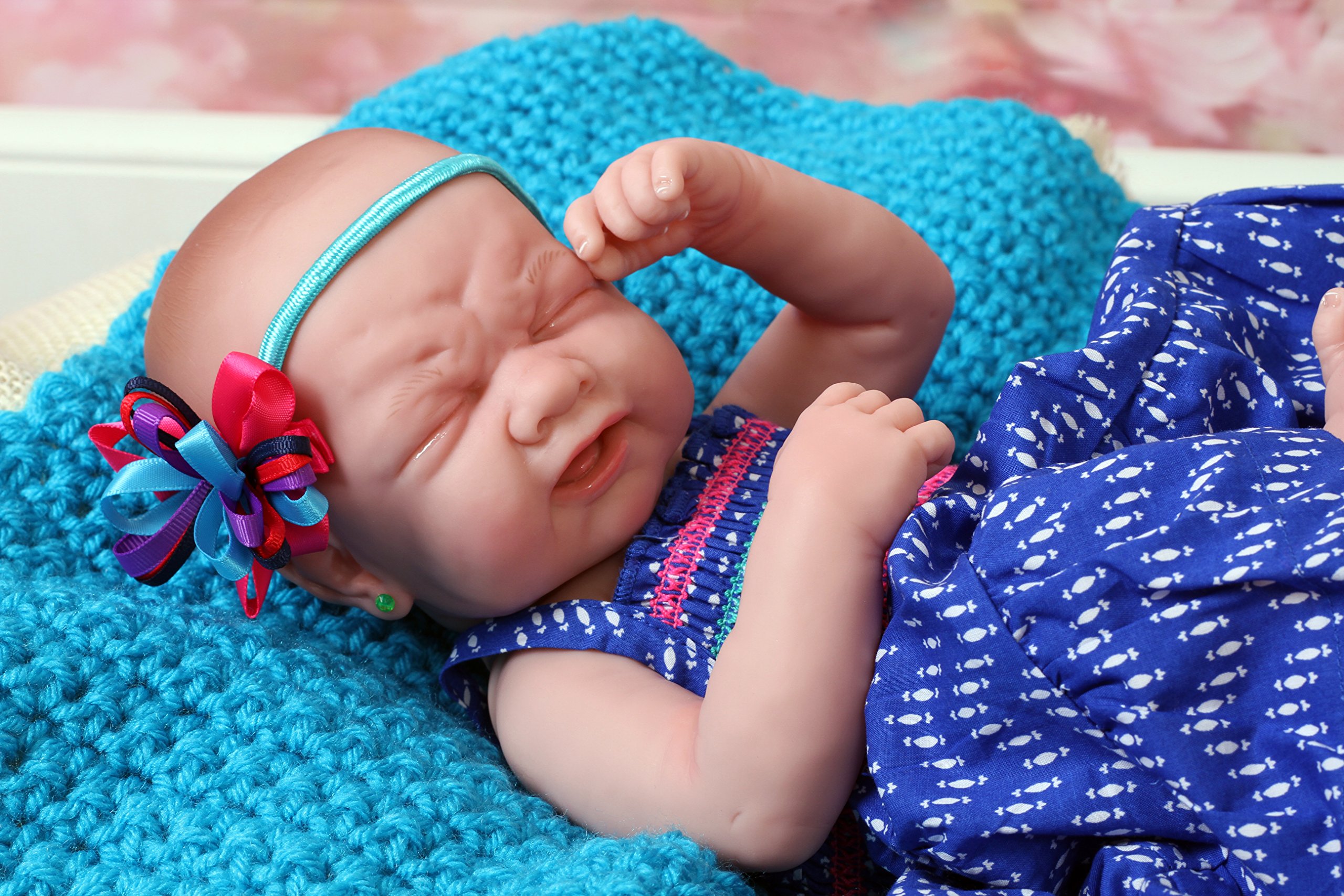
This is, I believe, one of the downsides of empiricism and the fixation on citation rather than observation and reason. The idea that a whole profession came to reject the idea that infants are able to feel pain is astonishing, especially considering anyone who has ever taken care of infants knows that these little human beings react to things which are known to be painful. Babies feeling pain is something that should be self-evident, shouldn't it? It may not be empirically evident, but decisions can still be made without such metrics.
Don't get me wrong, empiricism and citation is valuable. However, a myopic focus on it enables some very twisted conclusions.
We should find sympathy for the doctors here. Administering general anesthesia to a newborn was a terrifying and deadly prospect at the time, so it was much easier to find a way to pretend it was unnecessary - certainly many of these surgeries had to happen one way or another for the baby to survive.
I also suspect that the actual strand of opinion is being fairly uncharitably represented in that article, and the original perception was more along the lines of "they won't feel and process pain quite like adults, and they won't remember it, and they won't develop any pathological fears as a result of it, so anaesthetic is less important as well as riskier", not an assumption babies didn't have senses.
Let's not forget the profession used to perform operations on adults without anaesthetic before they understood safe ways of administering it too.
> they won't feel and process pain quite like adults, and they won't remember it
Mostly it's that second point. Nobody can complain about their treatment if they can't remember having it. That's how childbirth was done in the mid-20th century - you just give the woman memory blockers and don't worry about whether she's comfortable.
That's also how procedures are still done now, even though consensus has moved to the view that the mid-century treatment of women giving birth was an atrocity. When I was getting a stomach biopsy (involving a large tube being shoved down your throat), they told me to take a sedative. I asked if the sedative would help with undergoing the procedure. And they told me no, people are just as unhappy either way, but if I took the sedative I wouldn't remember the procedure afterwards.
There are numerous stories (maybe urban legends) about people suffering from aforementioned psychiatric issues after waking up amidst surgery but being not able to remember it afterwards. Curious if it is true or not, cause that casts a shadow on “no memories no problem” idea.
I couldn't find any stories about people that couldn't remember waking up, but still had psychological issues. How would they even know they had woken up?
The cases I could find were either people under general anesthesia (unconscious) that woke up and can remember at least parts of the procedure, or people under conscious sedation who probably didn't get a high enough dose of memory blockers.
I don't know enough about memory to say for sure, but I suppose it seems plausible to internalize a fear at an unconscious level even if the conscious memories are blocked. Similar to how some people have arachnophobia without ever having a bad experience with spiders.
I'm afraid it's the case that most all surgeries on infants (circumcision) are elective and performed for aesthetic reasons. For males it's likely they only time they will go into shock from pain during their lives.
I find it sad, how people universally agree that female genital mutilation is bad, because cutting off parts for no medical reason is bad.... but then do the same thing to boys, "just because".
Most people don't have anything remotely close to what you'd call "beliefs", so no consistency is required between one pseudo-belief they might hold and another.
If you want something even more shocking, ask them how they feel about docking a dog's ears or its tail, then ask them how they feel about routine infant circumcision. For maximum cognitive dissonance, inform them that docking ears and tails is done for both aesthetic and purported hygiene reasons.
Well, people don't universally agree that FGM is bad because there are people who practice FGM. Also, most people think MGM is… if not barbaric, at least weird, but are somewhat lenient in the name of religious tolerance. The US is the extremely weird outlier.
Yeah, i heard that about the US.. that hospitals in some places ask parents directly to do the circumcision after birth as a "default option", and parents have to "opt-out" of it. Really sad and barbaric.
Where i live (small eu country), there were some movements to make it illegal (unless medically needed), but it didn't pass, not to offend certain minorities.
> I'm afraid it's the case that most all surgeries on infants (circumcision) are elective and performed for aesthetic reasons
Circumcision is awful, for sure. However am I reading your comment correctly in that you think that "most all surgeries on infants are elective and performed for aesthetic reasons"? Because with my little one, he's had to undergo some pretty invasive procedures in his short life so far that are on the extreme opposite of aesthetic reasoning.
Circumcisions are "most all" surgeries on infants (in the US), since they are sadly done routinely on something like a quarter of them (half of anatomic boys).
In the US, yes… although I wonder whether non-MGM surgeries on infants are rare enough that the large number of circumcisions made in the US (and a bunch of smaller countries) actually make them the most common infant surgery worldwide.
True. Lobotomies used to be common practice as well. Even a surgery performed recently, UPPP, for treating sleep apnea is "no longer recommended"... It was only five or ten years ago where they would perform this incredibly invasive surgery, but enough research shows they're not that effective.
I get the impression that a lot of gynecological care is in the same realm, but I don't have the equipment to have first hand anecdotal evidence. Heard many a horror story about IUD placement / removal, where folks were told that a Tylenol would be enough.
I’ve traded chronic pain stories with women who have endometriosis and I am convinced that it would just be beyond my capacity to cope.
Many women (I’m not sure how many because, of course, it’s not well studied) with endometriosis are ignored for years because it’s assumed that they are experiencing period pain and period pain doesn’t “count” for some reason.
Common layman prejudice aside, it's more likely experience from people placing iv lines regularly. Black skin is more difficult for many reasons, and I can easily believe that many get the impression of thicker skin because of other associated factors.
Black people really do have black skin, you know? It's not all racism...
From a brief skim of the literature, the main difference seems to be that darker skin is better protected against aging effects from sun exposure, and better maintains its elasticity (etc.) when exposed to ultraviolet radiation over decades. But less research than might be expected has been done about other differences between the skin of different groups.
* * *
> There exists substantial evidence to support that Black skin has a higher transepidermal water loss, variable blood vessel reactivity, decreased skin surface pH, and larger mast cell granules compared with White skin. Although some deductions have been made about Asian and Hispanic skin, further evaluation needs to be done. Differences in water content, corneocyte desquamation, elastic recovery/extensibility, lipid content and skin microflora, although statistically significant, are inconclusive.
> The thickness of the skin is higher on the cheek compared with the dorsal and ventral forearm, with no ethnic or age-related specificity. We confirm that the sub-epidermal non-echogenic band is a sensitive marker of skin aging, and reveal for the first time that it is less pronounced in African Americans. From OCT images, we bring out evidence that the thickness of the dermal–epidermal junction (DEJ) decreased with age, and was higher in African Americans than in Caucasians. Finally, by comparing US images at 150 MHz with OCT images, we show that papillary dermis thickness can be measured and appears to be quite constant irrespective of age or ethnic group.
> Skin roughness, scaliness and stratum corneum hydration varied significantly in different anatomic areas and age groups. There was no racial variation in skin hydration between any anatomic site, nor significant differences in roughness and scaliness between races, except for the preauricular area. Skin roughness was significantly increased in the aged, compared to the young at the preauricle, volar forearm, lower back, thigh and lower leg. Older women demonstrated significantly more scaling at the preauricle than younger women. Stratum corneum hydration correlated with scaliness. No significant correlation between stratum corneum hydration and skin roughness was observed.
> the thickness of the dermal–epidermal junction (DEJ) [...] was higher in African Americans than in Caucasians.
There are traits that tend to travel next to each other for historical reasons, as well as because they physically are controlled by the same genes. It's important to pay attention to them; one of the facts that really wrecked the reputation of Kim's Convenience (an anodyne Canadian show I've never watched) was that they gave one of the Korean main characters multiple sclerosis, and Koreans almost never get multiple sclerosis. It made the actress playing the character hate the show.
I am pretty sure this is literally about skin thickness. Here is the list of false beliefs polled:
Blacks age more slowly than whites; Blacks’ nerve endings are less sensitive than whites’; Black people’s blood coagulates more quickly than whites’; Whites have larger brains than blacks; Whites are less susceptible to heart disease than blacks; Blacks are less likely to contract spinal cord diseases; Whites have a better sense of hearing compared with blacks; Blacks’ skin is thicker than whites’; Blacks have denser, stronger bones than whites; Blacks have a more sensitive sense of smell than whites; Whites have a more efficient respiratory system than blacks; Black couples are significantly more fertile than white couples; Whites are less likely to have a stroke than blacks; Blacks are better at detecting movement than whites; Blacks have stronger immune systems than whites
Apparently a majority of white laypeople think that black people literally have thicker skin. Among white first-year medical students, 40% believe this, dropping to 25% of white residents.
Though in the narrow context of skin condition, it is true that people with darker skin “age more slowly”, i.e. have less age-related deterioration in skin quality because they are less susceptible to UV radiation. Minority groups in the USA are also more susceptible to cardiovascular disease, though that’s largely if not entirely attributable to environmental factors.
I mean, as you hinted there are at least a few things on that list that are true. We’re in a weird period of time where people are desperate to ignore any differences between races but they absolutely exist as one would expect due to different evolutionary pressures.
I don’t know how you’d go about testing some of those and many shouldn’t matter to doctors, but I personally think the differences between us are fascinating.
> We’re in a weird period of time where people are desperate to ignore any differences between races but they absolutely exist as one would expect due to different evolutionary pressures.
This isn't really the case because 'races' aren't biologically definable categories, and hence have no direct relevance to evolution. There can be correlations between a person's assigned racial category in a given culture and certain biological features, such as e.g. propensity for sickle cell anaemia. However, this is just because there can be loose correlations between this category (which is usually assigned based on superficial features of appearance and cultural characteristics) and the areas of the world where the person's ancestors hail from. No serious scientific study of human difference pays any attention to race, as it is a largely arbitrary and culturally specific construct.
Grateful I turned that shit down in 2012. Even then the evidence against it was overwhelming (basically, it makes sleep apnea worse because scar tissue comes back fierce).
There are some pretty interesting procedures like MSE that aim to expand your skull internally by putting lateral outward pressure on your palate. The immediate effects are a new gap between your two front teeth and greatly expanded breathing capacity. Hopefully. People have various ways of describing the moment two parts of your internal skull bits separate, once described as "radiant pleasure without actual pleasure"
It was certainly not easy. I took 5 weeks off of work! It’s not in my nature to stop working for so long, so that was a strange experience. Recovery has been good. I look better now, so that’s awesome...a good side effect! I have some remaining “weird feeling” in my lower left chin area, but it doesn’t really bother me. I am 11 months post-op now and get my braces off next month. Overall I’d definitely recommend the survey if it’s medically warranted. It absolutely was for me.
Glad the procedure was successful for you. We're still trying to find what the best solution might be for my wife, but it gives me hope to hear success stories like this. Thanks!
Congrats I guess? Your wife is an exception to a very well established norm. Losing weight is a treatment so good (as in, effective, safe, cheap) that most doctors will recommend it as the number 1 step in treating sleep apnea.
"What is becoming increasingly clear is that we need to continue to strongly advocate weight loss for all our patients, regardless of the severity of their OSA or adherence to our other therapies. The benefits of weight loss are, to a degree, unquestionable. This study highlights that tangible benefits can be obtained with weight-loss interventions. The challenge, as always, lies in the implementation of our lofty goals."
I don't see your point. Obviously, some of those folks are just technically overweight - BMI at 25 - and aren't going to get as much help even though most of us picture obesity when looking at this. And that still leaves 10-40% that aren't and still have OSA.
> some of those folks are just technically overweight - BMI at 25 - and aren't going to get as much help
Citation needed. They are absolutely going to be benefited from weight loss.
"What is becoming increasingly clear is that we need to continue to strongly advocate weight loss for all our patients, regardless of the severity of their OSA or adherence to our other therapies. The benefits of weight loss are, to a degree, unquestionable. This study highlights that tangible benefits can be obtained with weight-loss interventions. The challenge, as always, lies in the implementation of our lofty goals."
"Results: Relative to stable weight, a 10% weight gain predicted an approximate 32% (95% confidence interval [CI], 20%-45%) increase in the AHI. A 10% weight loss predicted a 26% (95% CI, 18%-34%) decrease in the AHI. A 10% increase in weight predicted a 6-fold (95% CI, 2.2-17.0) increase in the odds of developing moderate-to-severe SDB. "
You are proving the OP's point. Cutting off your uvula? It sounds insane to me, and I wouldn't have the procedure even if a doctor recommended it to me.
There are so many totally insane medical practices that it's shocking we don't question the medical industry as a rule of thumb.
No, the post was attempting to demonstrate how the medical system is effective and works as intended by correcting the use of UPPP, when any sane rational person would never have suggested in the first place.
I feel like it's the opposite - that, historically, many people (regardless of profession) always generally assumed that certain living things did not feel pain or otherwise suffer for some definition of suffering. This status quo naturally persisted into the era of science until science demonstrated it to be wrong in this case. Should they have known better, sooner? Obviously - I don't fully comprehend what could lead to such a bizarre and terrible assumption. But the problem seems to predate the age of empiricism and medical science.
You can see this all the time right now. People always talk about dogs as though they are philosophical zombies that merely learned to imitate the emotional displays we see from them. I see people talking about animals frequently caveat their intuition by saying things like "I'm sure he's just learned that if he does that he'll get food" or the like.
But the notion that fellow mammals which evolved to live in social groups don't experience any of the same emotions we do despite using the same brain structures in the same contexts is absolutely insane to me. They clearly experience even fairly complex emotions like jealousy of their peers. I can give my child a snack that my dog likes and it's no big deal. But if I were to give the cat that same treat and not my dog, she will flip her shit. Another dog would be similarly. In fact, my dog will jealously guard a treat she doesn't even like from the cat or another dog. Like she won't even eat it in a neutral context. But in the jealousy eliciting context, she will take it and bring it somewhere and guard it.
Like it's insane to me that people think the entire range of our emotions and thoughts evolved solely in humans. There are other social mammals and have been for a long time.
It seems probable that (1) is a precondition of (2), such that we should not be surprised if there are sentient creatures (perhaps including dogs) that are capable of feeling pain, are intelligent, and able to produce apparently emotional displays without having evolved the underlying experience of emotion.
Human emotions are complex and came about as the result of a long period of evolution with an intricate social system built on top of it. The emotions that e.g. dogs show are the result of a few-thousand year history of humans selectively rewarding a particular animal for displaying a certain behavior.
It is, IMO, beyond the pale to suggest that animals like dogs don't experience pain or have subjective experience. (And the same goes for pigs, cows, and most other vertebrates.) That would come as a surprise to some rather intelligent historical figures like Descartes. I don't think it's similarly strange to think that these animals don't experience emotions in quite the same way we do, or that an apparent display of "sorrow" doesn't map 1:1 to an internal experience of sorrow in the way we might expect.
> You can see this all the time right now. People always talk about dogs as though they are philosophical zombies that merely learned to imitate the emotional displays we see from them. I see people talking about animals frequently caveat their intuition by saying things like "I'm sure he's just learned that if he does that he'll get food" or the like.
Dogs are a little bit different from other animals, though. I've always kept dogs and cats (currently have 3x dogs, 3x cats) and every single dog I've had over the years has been able to look at my face to see what I am looking at.
In other words, by looking at my face, they know where to turn their heads to look at what I am looking at, and by my expression, they know when to do it.
This is obviously not a "do action = get treat" type of scenario, and I don't know of any other animal that are in tune enough with humans to do that. To me, that's a very strong indication of higher-order thinking.
> Like she won't even eat it in a neutral context. But in the jealousy eliciting context, she will take it and bring it somewhere and guard it.
All my dogs have done the same; many of them will just bury it somewhere on the property and then forget about it.
There’s a huge difference in brainpower between an octopus and a lobster.
I don’t personally boil lobster alive, but I only place them slightly above plants and bivalves on my personal scale of how bad I feel bad for killing/eating them.
That's a great example because I disagreed with them and have no problem consuming anything based on its nervous system or perceptive capabilities
but then these same people, themselves, will suddenly have a cognitive maturity enough to notice things the same way I could my whole life, and then freak out about consuming them!?
I'm dumfounded! When was that the line!? It was only the line because in some cultures the humans were cognitively stunted the whole time!? Can I trust a single thing they say and perceive? Can they even pass the turing test?
If someone is making it up, that's terrible, but if they're basing it on some evidence it's not crazy. Not everything, not even all humans, have the same types of pain.
> I feel like it's the opposite - that, historically, many people (regardless of profession) always generally assumed that certain living things did not feel pain or otherwise suffer for some definition of suffering.
I'm not sure that's the case. Most people believe dogs feel pain by observing them, for example. Indeed, it is the most immediate common sense conclusion one can make based on observation. It wasn't until modern philosophy, specifically Descartes, characterized animals as zombie meat machines (pure res extensa). Aristotle, by contrast, did not deny non-human animals sensation or pain, as is evident in De Anima in which he reasons that sensation is in fact necessary for animals (this occurs in the context of determining the necessary faculties entailed by the nutritive soul, the sensitive soul, and the intellectual soul).
I believe it's the same with animal consciousness and intelligence.
It should be self evident.
Not that it mirror ours, but that they have something of a similar nature.
You have to remember that centuries ago, some humans assumed black people where, in fact, not human. Not having a soul. Not feeling pain as we do.
I remember the testimony of a person stating he once saw an African white master asking her black servant to check if electricity was on... by touching the wire. To her, they were not sensible enough to care.
I absolutely agree. I think there are many factors that make people look aside. We “believe” what’s convenient to us. What immediately comes to mind - and I’m a meat-eater - is eating meat and harming animals. For animals, we tell ourselves what we need so that we can continue eating meat.
“Babies feeling pain is something that should be self-evident, shouldn't it?”
I have yet to understand the historical underpinnings of this phenomenon, but as someone who deals with chronic pain, doctors don’t seem to be aware that people feel pain _in general_.
I’m being sort of facetious, but any chronic pain community is full to the brim with stories of various medical professionals being skeptical of patients’ pain reports or treating pain like it’s not a particularly important quality of life concern.
I have my own stories about this, of course, and some of them are pretty horrible.
It doesn’t surprise me, then, that we assumed at some point that infants don’t feel pain: after all, if we don’t take the pain of adult humans seriously, then why would we consider the pain of a creature who cannot even directly complain about it?
Even worse for you is how concerns about fentanyl are now a defacto war on pain relief. States have demonized long lists of pain meds, driving people in chronic pain to buy much riskier drugs on the street (something I witness fairly regularly).
States used to blame today's bans on the pill mill problem that was addressed over 20 years ago - but now don't even bother to do that. Now the argument reads like 'because fentanyl exists, you must live the rest of your life in pain'.
To make matters worse, the opioid epidemic is real; regardless of the cause, it’s not just war on drugs hysteria.
It ends up that opioids are terrible drugs. Aside from the obvious habit forming stuff, there’s things like hyperalgesia and central sensitization — long-term opioid use can screw up how your brain processes pain.
I witnessed the decline of opioids in the latter-half of the 2010s firsthand from the patient’s perspective. The response to these problems from the medical community was _sheer panic_. No one was concerned with “what are we going to do next”, it was just “we have to get these patients off of opioids”. Lots of people suffered. There were suicides. There were, as you mentioned, people who moved to street opioids. The whole thing was a fucking travesty.
Rolling up on a decade we’re just finally _starting_ to get a handle on this thing with responsible alternatives for pain management. The stench lingers; I think we will look back on this era with a similar lens to how we see surgeries before the work of Joseph Lister.
Opioids ruin lives. Opioids restore lives. People die from taking them. People are functionally dead when they're unobtainable.
The most false thing about opioids is that they are any one thing.
I've used hydrocodone for months at a time. It's addictive so there are protocols that need to be followed. Stick with the dose and taper when done. However, that was in the past. For severe pain, legal pain relief is no longer available - to me and to millions of others.
My state now has a hard 3 day limit and few Dr.s are willing to write even that. What has become routine everywhere is being Rx'd Tylenol for moderate to severe post-op surgical pain. I personally had to beg for tramadol following abdominal surgery. I recently had to enter into a protracted negotiation with my Dr - again, for tramadol - so I could exercise and get a little more life out of my failing knees.
The pendulum has swung way too far and the number of lives that are being ruined by that is nearly incalculable.
“The most false thing about opioids is that they are any one thing.”
That’s fair. A better way to say what I mean might be “our opioid therapy protocols aren’t very good” or “we’ve relied on opioids in ways that cause more harm than good”.
There are situations where opioids are the obvious right answer. I have a similar anecdote, having to beg for an opioid refill when I was suffering from post-op pain.
While I admit I don’t know the details, I wonder if your knee pain is one of those situations where opioids aren’t close to an ideal solution, but we never actually developed an ideal solution because it was easier to throw opioids at every pain problem. Now opioids are no longer allowed and you get to replace opioids with nothing.
> My state now has a hard 3 day limit and few Dr.s are willing to write even that.
I don’t mean to de-anonymize you, but what state is this? I know state laws vary, but I haven’t heard of anything close to those sorts of restrictions.
Fully agree. Spent 5 years going on and off Tramadol.
If I found myself craving it I would stop for a month. I was basically in bed in pure agony during those weeks off.
I've seen others that literally kidnap their own mothers to get opioids.
It’s because people lie for many reasons. To get out of work, get disability, make a claim, to get opioids because they’re addicted to them etc. As a doctor, you’re probably going to become cynical after a while.
This is very different from a baby because they have little motivation to lie and you can see them reacting to simple painful situations like bumping their head.
So? The first response should always be to take folks seriously. Always. Even if they are really searching for opioids. No doctor should assume folks are lying upfront.
Even if that means that a couple people are getting off work when they don't need it. And I'd much rather have a disability system that occasionally gives the wrong people benefits than to withhold benefits from someone and make their life torturous. Much like theft an loss are costs of retail, this should be the cost of a disability system: A few folks take advantage.
Spitballing, but maybe the problem is that no doctors wants to be the guy in town who's the most generous with opioid prescriptions, as then he'll get swamped by people seeking opioids?
People who look at the statistics after that, finding our doctor prescribing a significant amount of all opioids in the community, are liable to think that he's some sort of unscrupulous stooge of a pharmaceutical company.
That'd cause a race to the bottom of pain medication skepticism. To fix that you'd need some sort of liability reform (as just changing guidelines will never work if it's opposed to a self-sustaining incentive gradient), though I'm not sure what that would actually entail.
It's because of the chilling effect of lawsuits and the risk of losing their DEA license that doctors in the United States are skeptical of issuing pain medication. Americans with genuine pain problems that cannot be effectively treated by local doctors despite persistent good-faith efforts should instead find a doctor in a Mexican border town where pain medication is more readily available.
Wasn't the problem with opioids in the US that doctors already did prescribe them too freely? The fact that there's now a backlash after it caused a massive problem cannot be the reason that doctors have historically been sceptical about pain (and not just in the US but elsewhere where prescription opioid abuse has not been a problem!)
Spitballing, but maybe the problem is that no doctors wants to be the guy in town who's the most generous with opioid prescriptions, as then he'll get swamped by people seeking opioids?
Nope. In a well-designed system, this just be minimal. Design a better system with better access to medical records throughout the system, lesser liability (the US, mostly), and paid medical leave so that people can actually heal. The alternative is simply that we leave folks in different levels of pain. Heck, even just being able to see prescriptions nationally would be a bonus (Right now, in Norway, when I get an electronic prescription, I can go to any pharmacy to fill it and they can see my prescription history) Innocent people shouldn't have to go to the black market for pain relief because they can't get things figured out legally.
Again, I firmly believe that the first response should always be to believe the patient.
Was being given opioids for chronic pain (nerve pain from autoimmune). but not consistently, so I'd often run out.
I was constantly pushing doctors to try alternate treatments so I can deal with actual issue rather then take pain meds. They had no interest.
Took me 3 years to finally get a prescription to LDN, which finally worked for me.
> As a doctor, you’re probably going to become cynical after a while.
As my go to story on these sorts of issues, my partner had an ER doctor tell them that they hadn't been stabbed. The fact that there was an open wound oozing blood and multiple witnesses was not sufficient evidence. That wound was obviously a diabetic sore. That my partner is not diabetic was also a lie and the fact that their medical records showed no history of diabetes was merely proof of the incompetence of the previous doctors. Stitching the wound had to wait for two blood sugar tests to be performed, because the first test was could only have been a machine glitch. After a second negative test for diabetes, the doctor finally conceded that he couldn't rule out a stabbing.
How do some people end up making clearly counterproductive interpretations that ignore not only evidence in general, but clear evidence of harm to others?
I remember a Google employee changed a popular font for headings. It broke the layout on a very large number of websites.
Several people discussed this with the employee, suggesting the font should be forked rather than force-updated. The employee engaged, but refused. Eventually they said that if enough users contacted them with complaints, that would be evidence they would consider. When it was pointed out that it was very difficult to know how to contact them (they were not required to engage on the forum, or anywhere else, no contact information for them was otherwise findable, etc) they barely shrugged. It was as if part of the logic function in this human was managed by a 4 year old child internally.
Writers should use the singular “they” in two main cases: (a) when referring to a generic person whose gender is unknown or irrelevant to the context and (b) when referring to a specific, known person who uses “they” as their pronoun.
– apastyle.apa.org
I do not know the gender of the person under discussion, nor do I know if that person has pronoun preferences. I simply followed the "generic person whose gender is unknown" standard.
I've been using "they" in this manner for 50+ years. Never had anyone comment on it before. Are you attempting some kind of meta virtue signalling, considering "pronoun preferences" is a very recently added option?
> As a doctor, you’re probably going to become cynical after a while.
We should probably focus more on finding ways to reduce cynicism and lack of empathy in this profession than fighting false positives in the system.
> It’s because people lie for many reasons.
You should err on the side of caution and default to "they're probably not lying".
Most of us can agree that applying the logic you're describing to the law would be
wrong. Imagine that instead of having the presumption of innocence, we'd assume that certain types of people are probably guilty, so we'll punish them pre-emptively.
This already happens, of course, because of racism, xenophobia etc... but we do agree that it's morally wrong and at least we're trying to fix it.
Wondering if it might be possible to measure the pain people are feeling somehow. It’d be interesting to compare a person with a traumatic past vs one without
And if doctors are worried, the first step should be doing actual tests to see if people are experiencing pain. Not making some judgement based on their cynical bias whether someone is lying or being truthful.
It is amazing how much of the medical community states they believe in science, yet they seem entirely disconnected from it at times.
Sure, just like instead of prescribing anti-depressants, we should first do a depression test.
Unfortunately, neuroscience is not at a level where we can actually perform these tests. There is no objective measure to see if someone is in pain, or depressed, or suffering many other psychological symptoms.
Actually, there are tests now for depression. And yes, you can do objective tests like brain imaging to see people's responses to stimuli among other things. What should not happen is for doctors to meet someone for 20 minutes, do nothing but talk to the person and say.. oh, I don't trust them they must be lying. Except, that is what doctors do all the time and there is no scientific basis for their decisions.
Can you point to some tests for depression? A quick Google only turned out some studies, nothing approved and usable in clinical settings (and one of the studies had a test that couldnt differentiate between depression and bipolar disorder).
Similarly, brain imaging for pain is at the research level, and may come with several other risks. I doubt there are such tests that could be used to conclusively prove that someone is or is not in pain.
There are blood and urine tests for seratonin, but studies are mixed on how reliable they are. Since depression can also be accompanied by other factors though, there is a wide range of tests that can help provide objective evidence.
Sounds expensive, wouldn't it just be easier to trust them? I think the bigger problem is if a doctor doesn't know what's wrong or how to fix it, then they disengage.
How can you, with an objective test, determine whether or not I am experiencing chronic pain, or if I'm just pretending to be experiencing chronic pain?
Brain imaging would be a good example, but there is cortisol screenings among several other tests that can help determine that someone is actually in pain.
The same goes for fatigue or anything else they can’t actually test for. I would guess it mostly stems from them not having a way to objectively judge it. My pain tolerance is way higher than my wife’s, in part because I suffer from cluster headaches. 8/10 for me might be a broken bone. For her it might be a relatively superficial cut.
So what’s a doctor supposed to do when someone says something really hurts? Hell if I know.
> as someone who deals with chronic pain, doctors don’t seem to be aware that people feel pain _in general_.
I don't know your situation, but I wonder if it seems this way because doctors don't have many options for treating chronic pain. There are medications for acute pain, but when you use them chronically over many years—well, that's how we ended up with the Opioid epidemic.
That's not how we ended up with the opioid epidemic. We ended up with the opioid epidemic when doctors working in concert with drug companies engaged in criminal fraud to prescribe medication far beyond its normal dosages and in cases where it was not necessary.
It was all of the above. Some doctors were prescribing them at higher doses than necessary; others were prescribing them in normal doses for longer than is safe. I am sure that at least some of these doctors were driven by compassion for their patients.
I think you are correct, and that behavior is to the patients’ detriment.
Personally, I worked myself into the ground trying to both advance my career and to manage increasingly alarming health issues.
I would have benefitted from some “real talk” but that’s not baked into the contemporary western transactional model of medicine outside of those areas that routinely deal with terminal illness.
At least its changing these days now that THC is increasingly legal. Boomers have proved you can take it for six decades straight and be fine. Pro sports players are using it after getting beat up in games or practices too.
I am taking it for cca 25 years and I am fine too... sort of.
It can still become addictive, after tremendous amounts consumed over long time that don't make sense unless you just want to fuckup yourself as much as possible. But plenty of folks still end up there.
But its one of the easiest addictions to shed off, compared to say cigarettes, alcohol or well anything else (I would say even sugar is more difficult to wean off since its everywhere, joints not so much for now).
It has positive effects - pain management I guess especially with edibles, but for me its change of perspective/mindset on life matters, much higher creativity, michelin star level of taste experience even from relatively cheap food, and that sweet sweet high that is just so relaxing.
But it will make you overall less patient, which sucks. For parenting, for work, for life in general. Also, morning after is much better than alcohol binge night, but mental gears running on 20% isn't something that helps produce quality in your work. Plus most consumption methods mess up your lungs pretty badly, but quality vaping is I think cca good enough to not shorten your life considerably.
Individual doctors are rarely deserving of the implicit trust and praise they receive from proximity to the stereotypical hero doctor on this season's popular medical drama.
I went from a general naive faith in the profession to caveat emptor.
It is truly insane the things that doctors routinely recommend without doing any sort of real review. Get any of the asleep-at-the-wheel health organizations to support your finding and plenty of doctors will recommend even the laziest of new ideas with passion. General downward trend in SIDS over a decade? It's probably because babies that wear footie pajamas are less likely to get bad humors. You're a bad parent if you don't get Shekol brand sleepers.
I don’t think the AAP recommends footie pajamas to prevent SIDS. What you say may or may not happen, but your point would be a lot more poignant if you used a real example rather than contrived nonsense. If the issue you're talking about is widespread, then it should surely be easy to use a real example.
Criteria for c-section. Rates among doctors is 1/3 vs the 8% among midwives. Baby in bassinet and baby on back. SIDS is linked to improper sleep hormone regulation, not sleeping on your stomach. Breastfeeding only once every 4 hours during the day and giving a bottle the rest of the time. Supplimenting formula when mothers are trying to exclusively breastfeed. Waking the baby up to breastfeed despite no weight concerns. Circumcision. Prescribing amphetamines to prepubescent children. Prescribing hormone blockers to prepubescent children. Prescribing thalidomide to pregnant women. Continuing to gamble with mass casualties by railroading experiments that have not been adequately tested relative to the subject size (like Tdap for pregnant women or the COVID jab you probably got).
Doctors as a whole are not given the allowances they need to think about what they're doing. Today, they are little more than billable entities that follow someone else's flow chart to serve you McHealthcare as "efficiently" as possible.
My stock joke is that if the doctor or nurse says it won’t hurt, it will hurt at least a little. If they say it will hurt a little, it will hurt a lot. If they say it will probably hurt, time for serious anesthesia.
Also, there’s pretty much no such thing as minor surgery except maybe skin tag removal.
Lucky you, if you dont have genetics were anesthesia do not work properly. Then find a doctor, who accepts that problem and gets it over with painful but fast.
The hardest part is if you have a dentists that insist on anesthesia must work, but it wont, so you must act your ass off to prentend to not be in pain, so he wont push syringe after syringe, doing nothing and waiting for 15 minutes in between while your tooth is already open with the root canal drills in.
So you’re one too. No dental anesthetics work on me. I have to go under general anesthesia, where you’re knocked out so deep a machine has to take over your breathing. So every procedure starts at about $10,000 and that’s not counting the dental work. All out of pocket. No insurance coverage.
As someone with very low tolerance for pain, this seems like my worst nightmare. I’m curious though, did your tolerance for pain increase over the years as you had to endure it?
Decreased, if any. I think it’s probably because I know nothing has ever worked. FWIW I am old and get a major operation every two or three years: hernia, cancer, hydrocele, etc. I have no problem dealing with that kind of pain, even when it is considerable, which is often true post-op.
The likelihood of someone understanding something is inversely proportional to the impact on their ability to pay the mortgage.
Pain is recognized as “bad” innately. So if you can assert that no pain exists, you’re not accountable for causing, preventing or doing anything about it.
Doctors caring at all about pain is relatively new. When medicine started it was just about keeping you alive not keeping you out of pain.[1]
There is a fantastic book that is half about the history of pain medicine and half about a small region in mexico that distributes a lot of the heroin in the US. Dreamland[2]
The roots of the practice are not very clear, but it seems that for operating on infants, risk of death from Anesthetic is very high. And historically, anesthetics were given to induce muscle numbness (so they don't thrash around).
The argument is not whether they react to stimulus we consider painful, but if they feel it in a way that mature humans understand as pain. Babies take months just to understand that they have hands, they're incredibly simple minded, so the question was whether they even had a real concept of pain beyond "stimulus and instinctual reaction". Similar to how an insect will react to pain but it's just doing what it's programmed to do, there's no higher level thinking associated with it.
Completely agree. I suspect this wasnt just empiricism, it was also behaviorism which purported to be empirically based but added in a theoretically motivated (and ultimately empirically unsupported) skepticism about using minds to explain the observations of animals. If you don’t think babies have minds and pain is a mental state then this insane position follows quite logically.
It’s the same kind of insane lack of critical thinking that led people to be being buried alive because no one thought to check for the existence of a heartbeat despite heartbeats being known about since… forever
The thing that bothered me the most wasn't the awareness of pain in babies, it wqs the answer "they won't remember" when I mentioned the pain argument.
>little human beings react to things which are known to be painful. Babies feeling pain is something that should be self-evident, shouldn't it
Perhaps this is just semantics, but I think "feeling pain" implies a higher level of cognition than simply reacting to things which are known to be painful. Like the classic toddler move of painting with their feces. They're obviously physically capable of smell but it just doesn't seem to register the same way.
smell being good/bad seems to me to be learned? Go to Taiwan and smell stinky tofu 臭豆腐. To most non-Taiwanese it smells like cat poop or sewer water. Eating it as a non-fan feels like I'm eating in a dirty public restroom where the food itself doesn't taste bad but the smell from the over full toilet next to me is off putting. Similarly shrimp paste. Many cheeses also smell pretty bad.
All of them stop smelling so bad once you train yourself to enjoy them. Is the smell of poop any different?
And if you go to Taiwan and look around, empirically you can see that people try to avoid being immediately downwind of a stinky tofu cart. (It’s pretty tasty, mind you, but IMO not worth the hassle.)
Sure, but what about other examples. Tons of people like blue cheese. But it smells bad. It doesn't have "smells bad" in the name. Neither does "durian" 榴莲
But these aren't relevant examples. The claim was that people learn to think of certain smells as "good" or "bad". The example given was 臭豆腐, which makes no sense because it is thought of as smelling bad.
You don't even claim that your examples are thought of as smelling good. You don't have to have "smells bad" in your name in order to smell bad.
The lesson to draw here is that people are willing to eat things that both (1) taste good, and (2) smell bad. If you like blue cheese and it smells bad... how is that a counterexample?
(I'm open to the idea that people disagree on whether durians or blue cheese smell bad. But I'm less open to the idea that their opinion of the smell is learned - from what I've heard, some people think durian smells disgusting, and other people never saw anything wrong with the smell, but I haven't heard of people who initially thought the smell was disgusting but grew to like it.)
People tend to instinctively anthropomorphize, and this instinct is particularly strong when it comes to our offspring. Just because it seems conscious doesn't necessarily mean that it is.
That's a fair question. And I'm not saying it is wrong, only that it might be. Let me give a slightly less fraught example: we have an instinct to "honor our dead" and not to "desecrate their bodies." Does that make sense? The dead person doesn't care. Does it even make sense to talk about a dead "person"? One might argue that no dead thing can be a person, it's just a (dead) thing that was once a person and still happens to look like a person but isn't actually a person any more.
Likewise, a baby may look like a person, may even behave in some ways like a person, but not yet actually be one.
Again I have to emphasize: I am not saying this is the case, only that it is a possibility that needs to be taken into account when doing the moral calculus.
> Again I have to emphasize: I am not saying this is the case, only that it is a possibility that needs to be taken into account when doing the moral calculus.
An important thing to note about babies is that at some point in the past few months they objectively couldn't feel anything, despite having a human body.
So the question is when those various things switch over, not if.
> An important thing to note about babies is that at some point in the past few months they objectively couldn't feel anything, despite having a human body.
Is that actually true (if by "human body" you mean a humanoid body, rather than the vacuous-in-this-context sense of a body of a human)? I wouldn't be surprised if the ability to feel developed earlier than the human-like body.
Do people instinctively anthropomorphize? I bet the existence of that instinct has far less empirical support than the pain consciousness of newborn babies. Be that as it may, these comparisons to parents' "anthropomorphising" of their kids are not apples-to-apples.
Chatbots and machines programmed to show feeling responses are mimicry. People can be tricked. If you want to fool ships with a fake iceberg, you won't bother with more than the tip. But if you're a glaciologist, examples of sailors getting spooked by fake plastic iceberg tips would not lead you to question whether natural icy marine bodies (especially ones that usually develop into icebergs!) have any mass below sea-level. Or if you're studying carcinization, the fact that robot crab decoys can pass for real tells you exactly nothing about why unrelated phylogenetic lines independently develop crab-like features.
And the "people" in "dead people" refers to real people, who die. A corpse is a "dead person" like a puddle of water is "melted ice". Mourning, including respectful treatment of remains, is symbolic. None of that is anthropomorphism.
It is established that human babies develop into human adults. Their pain and other distinctly human responses resemble the adult forms profoundly. Are babies "a system [that] responds to painful stimulus" but feels no pain? Occam's Razor says no. I see zero downside to reckoning that possibility out of the moral calculus.
> I bet the existence of that instinct has far less empirical support than the pain consciousness of newborn babies.
I'll take that bet. Why do you think human children play with dolls?
> People can be tricked.
Indeed.
> A corpse is a "dead person" like a puddle of water is "melted ice".
You're kind of making my point for me here. A corpse is an inanimate object. An inanimate object cannot be a person. A corpse was a person, but when that person died it ceased to be a person just as when ice melts it ceases to be ice. When a person dies, when ice melts, they cease to exhibit any of the distinguishing properties that made them a person or that made them ice.
> It is established that human babies develop into human adults.
Sure, but that in and of itself does not make them people any more than the fact that people die makes live people corpses. A live person will some day become a corpse, but while it is alive it is not yet a corpse. A baby will some day become a person, but while it is a baby it may or may not be a person.
> Their pain and other distinctly human responses resemble the adult forms profoundly.
That's simply not true. A baby's response to pain is all but indistinguishable from its being, say, hungry, or just in a bad mood, whereas in adults these are pretty easily distinguished. But even if it were true, so what? You could make an automaton that mimicked adult responses to pain, but that automaton would not feel pain. You can't conclude anything about subjective experience from I/O behavior alone.
Look, I'm not saying that babies don't feel pain. I think they probably do. All I'm saying is that it's not the slam-dunk that many people here seem to think it is.
> Why do you think human children play with dolls?
Do children "play" with dolls? I don't think that is a slam-dunk. As far as we know, children may be mindless automata and what we call "doll-play" may be unfeeling mirroring of adult anthropomorphizing behavior absorbed through something like blindsight.
> You're kind of making my point for me here.
Not at all. My point was that calling a puddle "melted ice" has nothing to do with mistaking it for any kind of ice or ascribing characteristics of ice to it. Likewise with "dead people".
> A baby's response to pain is all but indistinguishable from its being, say, hungry, or just in a bad mood
That's simply untrue, even in neonates (not to mention babies several months older). Look into the abundant research applying the Facial Action Coding System and derived systems to infants and their pain vs. other distress responses.
> You can't conclude anything about subjective experience from I/O behavior alone.
This is a denkverbot, not productive skepticism. We can draw robust, valuable conclusions about subjective states without enjoying deductive certainty.
> Do children "play" with dolls? I don't think that is a slam-dunk.
Seriously?
> As far as we know, children may be mindless automata
Yes, that's possible. You can't prove that humans in general are not philosophical zombies. But I have memories of being self-aware around age 4 or so, so from my own personal experience I put that as an absolute upper bound on where humans might not be persons yet.
On the other hand, I also remember exhibiting I/O behavior that would cause an outside observer to conclude that I was experiencing much more intense pain than in retrospect I was actually experiencing.
> Facial Action Coding System
Of course it is possible to create a taxonomy of facial expressions and how those correlate to physical stimulus. What you can't do is know the subjective experiences that those expressions correspond to because no adult knows what it is like to be a baby. If anyone actually knew that, we would not be having this discussion at all.
> We can draw robust, valuable conclusions about subjective states without enjoying deductive certainty.
I don't deny that. What I'm saying is that you cannot draw those conclusions simply by observing a system's I/O behavior. You have to take the underlying mechanism into account. If you doubt this, look at this photo:
The subject of that photo appears to be in distress, but it is not in fact in distress. The way I know this is that the subject of that photo is actually a doll (look at the eyebrows), and dolls cannot be in distress. So there is an existence proof that merely because a physical system appears to be in distress that is not enough evidence to conclude that it is in fact in distress. You need something else.
The identity of someone is not just their body, and, while they may not be aware of how their body is being treated, an assault on their body can still be quite traumatic for those who do remember the person and in whom their identity still lives.
Yes, indeed, and I don't want to diminish in any way the value of mourning the dead. My point is just that that value accrues to the living, not to the dead.
So there may well be value in minimizing the pain of infants even if they don't actually experience pain. The policy decisions do not turn exclusively on the answer to the philosophical question.
But it's not a no-op either, because if you are going to (say) administer anesthetic to a baby you'd better be sure that the net benefits outweigh the costs to the baby.
This borders on solipsism. The same argument can be made about any human being. At the very least, we presume there is pain by observing the behavior of animals in response to stimuli and interpreting what we see analogically. An in light of certain reasonable assumptions (like "natura nihil frustra facit"), we can quickly rule out a host of preposterous interpretations to conclude that the sensation felt is painful. That
We don't need to factor into the moral calculus the possibility that no pain is felt since the most reasonable and rational conclusion is that infants do feel pain. What reason could there possibly be to believe that they don't that isn't some stretched exersize in special pleading and evasion? The baby is human!
I think you're misunderstanding what the OP is talking about. They aren't defending the practice, just that it's not necessarily an obvious answer to a question that should not be asked.
> the most reasonable and rational conclusion is that
In the context of science, this statement is a very dangerous one to make. There's many many many many things that people thought were "reasonable and rational conclusions" that turned out to be completely wrong after some actual rational experimentation and application of the scientific method.
It doesn't even make sense. What would it mean to anthropomorphize a human? It is a given and can't be fairly characterized like that. The only way to characterize it otherwise is to dehumanize.
I guess the word "anthropomorphise" here is conflating many understanding of "human" and humanity. In the same way, is a bunch of cells, an embryon or just a tissue sample, a human? Is an organ a human? Is a developing fetus a human? How many properties do each share with a typical example of a human?
There's a spectrum of biological complexity and other attributes we associate with the idea of "human". The question then is where does a baby fit on that spectrum.
The general idea of anthropomorphising, here, is to attribute characteristics and experience that we only know from our own experience as conscious, self-aware creatures capable of complex cognition and complex communication of that experience.
Babies get upset when you hurt them, and they communicate it bluntly. Conversely, they are unable to demonstrate “complex” communication. Behold, I have placed the babies ;)
You do know what the definition of anthropomorphize is right?
> attribute human characteristics or behavior to (a god, animal, or object).
As far as I'm aware, baby humans don't start off as non-humans and magically transform into a human at some age where they understand more. So it seems fitting to attribute human characteristics to humans. That is not anthropomorphizing.
If you ask someone to describe something generally anthropomorphic, the description would only tangentially fit a human newborn. “The weather is angry”, “trees strive to the light”, “this car is pretty demanding” are all examples of it. Not only newborns can’t express clearly what they strive to or angry of, they (likely or arguably, whichever) have no concepts of that in their minds, but we tend to attribute these to them either way.
Idk if it’s commenters here are nitpicky or not, but I recognized the sense of gp’s terminology without a doubt.
So because you couldn't find a single word to convey your meaning, you chose to shoehorn a semi-related word into the sentence in the hope that every reader would understand your tortured meaning? Why not use the more accurate multi-word construct? HN doesn't charge per word, last I checked.
You say "the more accurate multi-word construct" as if it were obvious that there is a single "accurate multi-word construct" that is already part of the English corpus that I could have employed here. If there is, I'm not aware of it, so I would have had to invent one. That would have taken considerable effort. Inventing new language constructs is not so easy, especially for subtle and emotionally fraught concepts like this.
And yes, I thought people would figure out what I meant because I provided three references, which were the actual substance of my comment. I thought people might read at least some of those and figure out what I meant.
Also, since you've decided to go all language-nazi on my ass, I looked up the dictionary definition of "anthropomorphize". There are two of them:
1. to attribute human form or personality to
2. to attribute human form or personality to things not human
So it is absolutely possible to anthropomorphize a human baby, and all the people who have criticized me for using that word can go eff themselves. Democracy and human civilization are crumbling and the best thing you can find to do with your time is criticize my choice of vocabulary, and get it wrong to boot? Bah to that. Life is too short.
Most people are familiar with the sound of a baby crying, and they think that's the worst sound a baby makes. It isn't. A normal baby's cry sounds absolutely nothing like a baby screaming in agony, which is a fact I discovered the first (and last) time I saw a video of a circumcision.
Today we look back and can't imagine how people of centuries ago saw things like slavery and religious oppression as normal. Sometimes I wonder if we are equally blind to our own failings, and whether to the people of two or three hundred years hence we won't be known as the people who wrestled with racism or late-stage capitalism, but only "that civilization who mutilated a third of their infants".
and also "that civilization which tortured billions of animals in factory farms for the daily pleasure". the past and present were and are barbaric for a whole clusterfuck, we shouldn't shortsell it as a single-issue failing.
This inflicted pain and damage appears to have no significant impact on adult quality of life though. Circumcision may also even reduce the bacterial load and hence reduce chances of infections and cancer: https://slatestarcodex.com/2019/12/10/acc-is-infant-circumci...
It's a form of genital mutilation. It would be wrong to call it a non-issue. It is moral one at the least.
I have no issue with consenting adults getting circumcised for what ever reason they want too. A baby, however, cannot possibly consent to such a thing.
> A baby, however, cannot possibly consent to such a thing.
Well, a baby cannot consent to anything. The parent's consent is the baby's consent.
Now I'm genuinely curious - I'm not affected, so I can't relate: Circumcision is genital mutilation, sure, but is it really "that" bad? Does it affect quality of life, from child to adult (excluding botched circumcisions)? Based on my understanding, I would rather focus on female genital mutilation in undeveloped parts of the world. In comparison, male circumcision seems to be ... ok. It's fine. Or is it? Please let me know.
(I'm not talking about the ignorance of infant's sense of pain here, that's clearly immoral).
What matters the most is the cohesion, functioning and productivity of society, which is unaffected by circumcision.
The notion of consent is arbitrary. You could also regard religious cults as primary, then you would need their consent to imposing your personal aesthetics.
Smashing one in a hundred babies to death with a frying pan wouldn't impair the functioning or productivity of society either. Seems like a pretty poor way to measure barbarism to me.
Cutting the outer ears off an infant would also have no significant impact on adult quality of life, yet if a parent tried to do that they'd be arrested.
As someone who didn't face circumcision complications until puberty, I'd like to track down the doctor who did it to me and see how he likes having pieces carved off of him.
So the idea is that not consented mutilation is defensible as long as the consequences after a few days or weeks are extremely minor? Just repeating this back to you so we're on the same page.
I'd say that attempting to prohibit this tradition has a net negative impact on the integrity and functioning of society because the harm in question is very minor but the reaction to such an attempt will be major. I'm sure you are trying to twist this into "but then I could anesthetize and then circumcise you", however, in that case I'd retaliate so drastically that it would negatively impact the functioning of society much more than say 100 circumcisions, hypothetically speaking.
I’m not trying to twist this into anything, I literally only repeated your own words back to you. So now this isn’t about whether the consequences are minor, but whether the person being harmed has the power to retaliate and how such retaliation impacts society? I’m having a really hard time following your rationale, and if I can be perfectly honest the impression I get is that you first decided that genital mutilations in infants is fine and are now retroactively looking for justifications.
Power is one factor informing policy, empathy is another. Neither is sufficient for a policy that sustains the system for long on its own. Only focusing on power would result in e.g. exploitation of Africa. But most don't like this due to empathy.
Focusing only on empathy often misses the point too as it tends to get politicized, overinflating minor issues as in this case, which will ultimately result in power conflicts, degrading long-term sustenance.
It's fucking scary, that this was recognized in 1987. In the 80s and even in the 90s most places did complex operations on newborns without any kind of painkillers -- imagine a heart surgery without painkillers. Not to mention "simple" stuff like circumcision.
Also by this time they knew this about animals too. I think people will look at us as barbarians that we ate them when we knew that they feel pain, can sense the world similar to us, and it would be just a minor inconvenience to eat something else.
> Not to mention "simple" stuff like circumcision.
You might have stumbled upon the real reason for this seemingly inexplicable delay in accepting that infants can feel pain: The circumcision industry. Presumably some doctors feared that parents would think twice about it if they knew that their son would be in agony (or need expensive painkillers) when undergoing that elective surgery.
Some days I think humans are pretty gosh darned sophisticated. Then I remember that it’s still controversial as to whether we should slice off healthy parts from children who cannot possibly consent.
And with all the regulation around healthcare in the US, male genital mutilation is not only perfectly legal, but also legal to be done by some with no medical certifications, outside of a medical setting, and it is legal for them to suck the blood from the mutilated area with their mouth, increasing risk of disease for the infant.
I'm a circumcised male who has decided to have all 3 male children circumcised. As a Jew, if I may weigh on this, you have my background for an conflicts or biases. Also, maybe content warning is in order for genital mutiliation.
1) It is absolutely not common practice to allow a mohel to orally suck the blood out of an infant's penis. If it's practiced at all, it is only in extremely fringe groups of Jews, not just orthodox or ultra orthodox but a very small group, truly some hundreds of people, practice it. I don't have the data, probably no one does, but saying Jewish circumcisions involve this would be like suggesting all baptisms look like this: https://www.youtube.com/watch?v=aFGHerqhSC8 To call metzitzah b'peh common practice, or at all part of ritual circumcision, is an anti-semitic trope. Comparing a key tenet of Judaism to a cult is both simplistic and demeaning.
2) I grappled with the decision to have brises for my sons. I don't think it's possible to know or define how traumatic such a procedure is; is it worse than giving a 6-month old pierced ears? Is it worse than travelling through the birth canal and having your umbilical cord severed? Who knows. As obvious as it may seem, the pain of a bris impossible to gauge. My sons all began crying as soon as their diaper came off, and their crying was no more intense once the cutting occurred. By the way, it's not like they make a dotted line with marker and snip around the foreskin; whatI witnessed involved a metal device (a type of clamp I suppose) that is slid between the shaft and foreskin, and like a modified cigar cutter, the mohel cuts away the foreskin in one motion. There's a lot of discomfort, maybe pain, but as a father of 3, I assure you every doctor's visit and many trips to the park involve similar levels of harm.
3) I realize mohels are not doctors, but there are mohel academies that train and certify these specialists. To say they are not doctors is one thing (and it's true), but to say they are not medically trained is another. They don't go to medical school but they learn about the biology of the procedure, proper methods, proper tools (including sterilization), post-op treatment & care, etc.
It's not an easy topic, but I don't think it should be hard to talk about. Complicated or interesting to describe, maybe hard to judge or rationalize, but let's talk about it openly, let's avoid disparagement, and most of all let's bring some nuance to this conversation.
> It is absolutely not common practice to allow a mohel to orally suck the blood out of an infant's penis. If it's practiced at all, it is only in extremely fringe groups of Jews, not just orthodox or ultra orthodox but a very small group, truly some hundreds of people, practice it.
They didn't say it was common, they said it was legal. And the practice is known to have caused dozens of HIV cases in New York alone, so I suspect it's a little more than hundreds.
> To call metzitzah b'peh common practice, or at all part of ritual circumcision, is an anti-semitic trope.
And yet the reason it remains legal is lobbying by organisations that represent the Jewish community (or at least claim to - if most Jewish people would support making this this practice illegal (something your post is not completely clear on), you should make that clearer to your representatives).
> There's a lot of discomfort, maybe pain, but as a father of 3, I assure you every doctor's visit and many trips to the park involve similar levels of harm.
Those things don't involve permanent removal of body parts. My objections to nonconsensual circumcision have nothing to do with how painful it is in the moment.
> I realize mohels are not doctors, but there are mohel academies that train and certify these specialists. To say they are not doctors is one thing (and it's true), but to say they are not medically trained is another. They don't go to medical school but they learn about the biology of the procedure, proper methods, proper tools (including sterilization), post-op treatment & care, etc.
To what standard, and how much legal enforcement is there of that?
> I grappled with the decision to have brises for my sons. I don't think it's possible to know or define how traumatic such a procedure is; is it worse than giving a 6-month old pierced ears?
Yes, the foreskin doesn't grow back
> Is it worse than travelling through the birth canal and having your umbilical cord severed?
Yes, because travelling through the birth canal is required to live, and doesn't affect sex in later life. Also, it doesn't result in any amputations.
> Who knows. As obvious as it may seem, the pain of a bris impossible to gauge.
We do. There's a ton of nerve endings there. Slicing of a particularly sensitive area (due to the concentration of nerve endings there) is going to be painful. If you want to do it, you need to show some evidence that it is not, not throw your hands in the air and say "well, we don't know").
> There's a lot of discomfort, maybe pain, but as a father of 3, I assure you every doctor's visit and many trips to the park involve similar levels of harm.
I think your are deluding yourself - few doctors visits or trips to the park results in cutting off a very sensitive part of the body.
> It's not an easy topic,
It is a fairly easy topic. The question of "Should we amputate a part of a newborns body, one that affects future enjoyment, and known to be incredibly sensitive" is an easy one to answer.
It becomes complex when the addition of "But my beliefs, unsupported by any evidence, mind, require me to perform this operation."
The long and short of it is, it doesn't matter how much evidence there is showing that the pain is real, and severe, and the lifelong effects are real; you've done it based on a belief that supercedes mortal pain and suffering.
In other words, it doesn't matter what the facts are, because the conclusions by the proponents have already been made[1].
[1] Imagine, for a moment, that we are in the near future where we have a device that lets us quantitatively determine (on a scale of 1-10) how much pain is being experienced, with 1 = barely perceptible and 10 = just below the point of passing out, with 5 = minor surgery without anesthetic.
What number would religious proponents need to see before they say "that's too much"? Five? Seven? Three?
> Yes, the foreskin doesn't grow back
Lip and tongue ties don't grow back. Neither do teeth. Parents remove their kids' body parts if they think it's best for them. Are straight teeth healthy or just aesthetically pleasing? Is clear speech healthy or just valued in our culture?
> Yes, because travelling through the birth canal is required to live, and doesn't affect sex in later life. Also, it doesn't result in any amputations.
How does circumcision affect sex in later life? If circumcision is amputation, what is removing an unsightly birthmark? Or as I've said, teeth, extra skin in one's mouth...
> We do. There's a ton of nerve endings there. Slicing of a particularly sensitive area (due to the concentration of nerve endings there) is going to be painful.
Being birthed causes extreme trauma. That's why doctors measure a baby's oxygen and heart rate. So clearly some amount of pain is worth it if the gain outweighs the pain, no? Then you have to ask what is gained through ritual circumcision. The gain is religious and cultural value, so it's hard to measure precisely. But, you know, Christians give alcohol to kids every Sunday and no one's complaining.
> If you want to do it, you need to show some evidence that it is not, not throw your hands in the air and say "well, we don't know").
I'm suggesting that we consider not everything that seems obvious is in fact obvious. Should I keep my kid from having routine blood drawn or vaccination because the needle hurts? Stop clipping their nails or cutting their hair? These are all cultural practices, there's nothing intrinsically good about grooming in this way.
> I think your are deluding yourself - few doctors visits or trips to the park results in cutting off a very sensitive part of the body.
I am trying not to delude myself. I am trying to clarify one thing for myself and one thing for others. For others, I want them to understand oral suction during a bris is basically unheard of outside of a fringe group. For myself, I'm trying to clarify if circumcision results in long term pain (psychological or physical)
> It is a fairly easy topic.
I think we agree. As I said, it should be easy to talk about and yet there are multiple factors one must weigh. This makes it compicated, but I'm happy we're talking about it.
> The question of "Should we amputate a part of a newborns body, one that affects future enjoyment, and known to be incredibly sensitive" is an easy one to answer.
I think the question is based on a false premise. How can one measure the joy of sex, and even if you could how would you say "this person gets less out of sex than if he had his foreskin." How can you say what the same person would feel in a hypothetical scenario? I'll just point out this very argument dates back to antiquity. Plutarch has a piece about Jews and discusses ritual circumcision - iirc he takes the stance that circumcision leads to more sexual activity and depravity because the penis is always uncovered. Greeks and Romans thought uncircumcised penises were vulgar, gross, and a sign of overt sexuality. So I would be fascinated to understand the opposite position, which you put forth, that circumcised men get less joy from sex.
> 'm suggesting that we consider not everything that seems obvious is in fact obvious.
Sure, but if you make extraordinary claims, then you have to provide extraordinary evidence. A claim of "amputation is no severe than drawing blood" is an excessively extraordinary claim, and you have yet to provide any evidence.
> I think we agree. As I said, it should be easy to talk about and yet there are multiple factors one must weigh. This makes it compicated, but I'm happy we're talking about it.
What factors? There's only one I am aware of - superstition.
> So I would be fascinated to understand the opposite position, which you put forth, that circumcised men get less joy from sex.
This isn't actually under contention, unless you contend that less feeling during sex is better.
Besides, for at least 3 decades there's been a ton of papers correlating ED with circumcision.
The only people "just asking the question" are those who are not happy with the answers we already have. We already have the answers, we already have the research, it's a very widely researched thing due to the large number of amputations performed.
You may not like the answers, but they're out there, and they've been validated.
Now ...
You are proposing it as a fairly harmless procedure, you should be providing evidence that there is no harm. It is both unscientific and primitive to make claims and ask others to disprove them.
The fact that you are ignoring much of the evidence that is already well-known and then you go on to compare lifelong mutilation for a superstitious belief to a temporary pain with no negative permanent effect makes it seem that you are willfully deluding yourself.
Circumcised men get less joy from sex. The only credible reports we have from consenting adults are those who get circumcised as adults, and the large majority did indeed get less joy from sex. A significant minority suffer from ED. A small minority never have sex again.
> A claim of "amputation is no severe than drawing blood" is an excessively extraordinary claim, and you have yet to provide any evidence.
I keep returning to the same examples, but there are many "amputations" performed for non-medical benefits. Frenectomy; tooth extraction; mole/skin tag removal. I don't know if circumcision fits somewhere on this scale, I think it does, many believe it is of a different nature. I don't see how removing connective tissues in the mouth is any less injurious than removing connective tissues from the genitals. They both sound bad on paper, but in life this is a common occurrence with benefits (real or perceived seems to be up for debate)
> This isn't actually under contention, unless you contend that less feeling during sex is better.
I'm asking you genuinely how someone can tell. Is my kid going to enjoy food less just because his tongue tie is removed? I had a painful skin tag removed from my back, so yea I suppose I'm less sensitive there now but in a good way; it is less painful taking a shirt on and off. I am not making a broad based claim, I'm saying on an individual scale I've not suffered diminished sexual pleasure.
> You are proposing it as a fairly harmless procedure, you should be providing evidence that there is no harm.
Ok, I think every male in my family is evidence that you can get circumcised and no ill effects come from it. No infections; no ED; no pain. It'd be fascinating to find data on ED etc in Jews compared to the rest of the world. I can't find anything, but if you can, please share.
> lifelong mutilation for a superstitious belief to a temporary pain with no negative permanent effect
Is it not possible for both to be true? Lifelong mutilation to fulfill a belief can involve temporary pain with no negative permanent effect. I'm suggesting circumcision is just that. Are these necessarily contradictory?
> Circumcised men get less joy from sex. The only credible reports we have from consenting adults are those who get circumcised as adults, and the large majority did indeed get less joy from sex. A significant minority suffer from ED. A small minority never have sex again.
I'm not debating adult circumcision, we have to agree that is of a different nature than adult circumcision. Just like so many other procedures that have different risks/outcomes as an infant vs as an adult.
I'm not convinced me that circumcision is barbaric. If you are someone who believes a child cannot make their own informed decisions about their body, but that a parent is also not in a position to make such decisions, then you seem to be arguing that kids shouldn't have anything done to their body. Unless you're proposing there should be a committee or something to make decisions for kids? That seems kind of fascist though.
> I'm suggesting that we consider not everything that seems obvious is in fact obvious. Should I keep my kid from having routine blood drawn or vaccination because the needle hurts? Stop clipping their nails or cutting their hair? These are all cultural practices, there's nothing intrinsically good about grooming in this way.
How could one have raised 3 kids and write there is nothing intrinsically good about clipping nails? Or even done manual labor? It is one of the most basic tasks a parent has to do with a baby unless they want a baby that makes itself bleed all the time. Cutting nails is just a practice, it has obvious practical benefits.
And comparing blood tests, vaccines, and cutting hair to genital mutilation makes me think either you are trolling or our realities are so incongruent that there is no purpose in conversing.
I'm not trolling. I'm trying to give examples of different degrees of mutilation to understand where circumcision fits on the scale of "accepted body alteration" and "unacceptable body alteration." Is circumcising a newborn much different from having orthodontics placed in an 12 year old's mouth? That is, dental work that is done for purely aesthetic purposes. Or what about a frenectomy on a baby, or a toddler? While a frenectomy function to improve clarity of speech, I would argue clarity of speech is aesthetic in an aural sense. People with a lisp are understood, they can communicate, but their speech isn't considered as "pretty sounding" as those without a lisp. Is a frenectomy controversial in your opinion? If so, you're in the minority. If not, why is it ok to snip out part of a kid's mouth but not ok to snip off part of a kid's penis? A part that serves no benefit, mind you. Unless foreskin does provide a benefit that I'm unaware of.
The distinction is about the purpose of altering someone else’s body. Is there a medical benefit or not? If not, then the answer is leave the other person’s body alone.
I do not know enough about tongue ties or frenectomy’s to comment. I have heard it is over diagnosed and might be done just so parents can feel something was done, but again, I have not delved into it much.
I have delved into cutting off foreskins, and that one, as you even claimed, is all about tribal affiliation. In other words, the procedure is not being done for the medical benefit of the person. At minimum, you would be causing unnecessary pain and risk of infection, but while I am not a urologist, I do know that foreskins have a role in providing lubrication.
Maybe it is mostly inconsequential. But that is irrelevant to the principle that people should be in control of their own body as much as possible. Obviously there is a ton that will not be, but cutting off the foreskin on penis to signify which tribe the male belongs to is a pretty easy one to conclude that violates that principle.
> I'm trying to give examples of different degrees of mutilation to understand where circumcision fits on the scale of "accepted body alteration" and "unacceptable body alteration."
We aren't talking about temporary and reversible body alterations, we're talking about amputations.
> Is it worse than giving a 6-month old pierced ears? Is it worse than travelling through the birth canal and having your umbilical cord severed?
Since you asked the question, I’ll give what I think is the obvious answer: yes, of course it’s far worse than both of those things. By the way, I wouldn’t pierce a baby’s ears either, but at least that heals over and leaves minimal lasting damage. You can’t get foreskin back once it’s gone. This might be no big deal to someone who doesn’t know what they’re missing, but try applying that standard to any other part of the body.
What is the downside of leaving it until the age of 18 when they can decide to get it done if they want?
There are medical procedures parents must decide to pursue or not, many are voluntary. Should I get my toddler's fremulum snipped even if there's no guarantee it helps their speech? Should teeth be extracted to help straighten out other teeth even if it results in weeks of pain? Are you saying that straight teeth are of more value than religious identity?
There are many hard choices a parent must make; I think circumcision is singled out because it bears cultural and religious value but no clear medical value. So let's get down to the core of this discussion: ritual circumcision bears religious and cultural value and that's pretty much it. So long as it's done safely, of course. If you want to debate the biological merits of circumcision, you're missing the religious or cultural value.
> What is the downside of leaving it until the age of 18 when they can decide to get it done if they want?
My understanding is that if you wait until 18, the procedure is much more involved/more difficult, more in terms of pain and in terms of health risk. Judaism puts health above all other factors, whether it's driving to seek medical attention on shabbat, or not increasing the risk of infection in newborns. Oral suction goes against the highest Jewish principle. If circumcision caused harm - bodily or psychologically - Jews (or most would not practice it. I'm not sure I understand the physical or psychical harm done
> If you want to debate the biological merits of circumcision, you're missing the religious or cultural value.
If you are assigning religious or cultural value to an act that needlessly mutilates your child’s body, you are missing the principle of freedom and letting people have ownership of their bodies. There are cultures that “value” binding feet, stretch out lips and earlobes, poke holes in various places, and face tattoos.
That has no bearing on the fact that people should not have a cosmetic alteration done to their body without their permission.
Do you believe a child should have the power to decide what happens to their body even at a young age? What if a 6 year old wants to get a permanent tattoo? Or a middle schooler wants a subcutaneous horn implanted on the forehead to look cool? Or a toddler refuses medical treatment? I doubt that's what you mean.
Maybe you mean a parent and child should decide together? I don't think a child has the capacity to make, or even weigh in on, decisions. Not just a newborn, even older children (most anyway) would have a difficult time making big decisions like if they should have a body part altered by surgical operation. Is it your position to postpone all non-emergency decisions regarding bodily alterations until the person is old enough to decide for themselves what happens to their body? If so, that doesn't seem practical. If you mean something else, please go on
That is a different discussion about what age a person gains autonomy for altering their body, and it gets into nuances such as what kind alterations at what age.
But that is neither here nor there about this discussion, which is someone making an alteration to someone else’s body with zero medical benefit to the someone else.
What is the medical benefit of a frenectomy? Or of braces? Tooth extraction to straighten one's teeth? Removing a mole? The list goes on. Procedures are performed on kids because parents think it will give them a happier life. Not everything in this world is based on measurable, medical benefits.
> So let's get down to the core of this discussion: ritual circumcision bears religious and cultural value and that's pretty much it.
Indeed, and there is a long list of harms that humans have perpetrated on each other in the name of religious and cultural value. Ditching these superstitions and taking a human-centric evidence-based perspective is how we have progressed from valuable cultural practices such as foot binding, witch burning, pederasty… honestly, every evil deed in history’s entire rogues gallery has at some point been justified by the religious and cultural benefits that we would miss out on. I mean, a good witch burning surely did wonders for bringing the community together.
> I'm not sure I understand the physical or psychical harm done
That is apparent, and I wonder if it is truly possible for someone to understand the harm of losing something if they have no experience of what was lost.
There is a more common version which uses a glass pipette for the suction stage, in order (presumably) to avoid direct contact between mouth and wound, but crucially, this offers little or no hygiene advantage compared to the full-on ritual. The prevalence of either version, however, is of little consequence, considering that they are both legally permitted and widely defended.
Not all mohels use the pipette, but what make you think using a sterile glass instrument is less hygienic than using one's mouth? And again you say both practices are widely defended. Who is defending oral suction outside of this fringe enclave of Ultra Orthodox Jews?
Yes, this seems to be acknowledged by all comments here. The initial comment you responded to said, "it is legal for them to suck the blood from the mutilated area with their mouth", which, in my interpretation, seems to cover both the direct contact version (no pipette), and the version which just adds a pipette in between. Both involve suction applied by the mouth. The latter version, as an aside, is hardly "fringe" in its prevalence. But I think the important part is the "it is legal", i.e. presumably anybody could add in a sucking part if they wanted to without breaking the law, which has nothing to to with how many actually do go through with it. Anyway, this discussion seems to be going in circles, but I will say, if you are serious in your stated desire for "nuance", there is a wealth of literature discussing the harms and morality (or lack thereof) of circumcision in general (although not necessarily specifically the religious versions), if you cared to look for it.
I have googled it, nothing I've read describes it as common or main stream. Many describe it as being performed only within a very small segment of the ultra orthodox community. I haven't found a place with reliable stats, which is unfortunate, but here is a paragraph with a recent and prety clear comment from a leading Jewish authority https://www.thehastingscenter.org/ritual-circumcision-ban-me...
Most mohels, even among the Orthodox, do use a sterile pipette, avoiding direct oral-genital contact. In 2005, the Rabbinical Council of America, the main union of modern Orthodox rabbis, issued a statement urging the abandonment of direct suction. Rabbi Moshe Tendler, a medical ethicist and dean of Yeshiva University’s (Orthodox) rabbinical school, was quoted in The JewishDaily Forward as saying: “There is no requirement to make metzitzah b’peh. The Talmud says plainly it is not part of the ritual but belongs to the medical, post-surgical component. There is no doubt that insistence on metzitzah b’peh is wrong. I firmly believe that making metzitzah b’pehis a criminal act.”
Do you have sources showing this practice is commonly accepted?
PS this says (estimates) 3600 children a year. That's 3600 too many, but far from "common place" in my understanding of the term. I can't predict how many Jewish males are born each year, but if someone wants to provide that, I'd be curious to know what portion these 3600 represents.
The only community that practices this archaic ritual is in NYC, so I'm not sure the specificity matters in this case.
Let me also point out that the community is estimated to comprise 250K, "many" though not all of whom practice this. Avoiding granularity, there are approximately 7 million Jews in the US, which means this 250K community represents roughly 4% of all Jews. Given that (from what I gather) all examples of the practice are contained within this enclave, calling it "commonplace" is a mischaracterization at best. It is a practice held by a very small group within the broader community, which means calling this commonplace for Judaism is inaccurate. This is at most commonplace within a fringe group. My conclusion would be that outside of this fringe group, this method is not practiced by Jews at all.
>This is at most commonplace within a fringe group
If you describe the practitioners of this as a "fringe group", on what basis do you consider the comparison (not even identification) above to a (hypothetical!) "cult" offensive? And do followers of small religions which have been stigmatized with the label "cult" not also deserve the same respect for their beliefs and protection from discrimination as other religions?
I think my gripe is the same as all racist comments. Applying something that's true for a small subset to the whole group. If you want to be specific about what type of Jews support this practice, it's a very specific community of Ultra Orthodox Jews. I tend to fall on the side of all extremism being bad, so if someone wants to say the most extreme practitioners of a given religion are bad, then that's fine. But one should not don't talk about Jews as a whole when it is but a small subset within the Ultra Orthodox community.
It's sad you have to explain all of this. For some reason casual bigotry is now considered acceptable if it's for the sake of what they believe is a good cause. That's a shift I've noticed recently, as a member of a religion that gets a lot of hate. It portends sad things for our society
It's not bigoted to be against mutilating boys. Don't hide behind religion to justify barbaric practices. Most Americans don't mutilate because of religious reasons.
Somehow we all agree that female mutilation is horrible, but when it comes to boys it's controversial.
Is it ok to have your 12 year old's teeth pulled? Is it ok to get your toddler's fremulum removed? I can argue that the very idea that the body should remain intact is itself steeped in religiosity. The belief that the body we start with, we should end with, is tied to the idea of Resurrection and the Last Judgment.
> Somehow we all agree that female mutilation is horrible, but when it comes to boys it's controversial
FGM is something that affects their body's function. What is the function of the male foreskin? What malfunction arises after circumcision?
It’s bigoted to support cutting some babies but not other babies.
Tell me I can cut off the tip of my daughter’s ear. Tell me anyone who opposes me is a bigot. Tell me I don’t need her permission, and I don’t need to wait to discuss it with her.
Or, more probable: find some little gotcha in my analogy so that you don’t have to confront it.
Attacking religious belief should not be considered within "bigotry", outside of situations like ethnically Jewish people (and their religious beliefs and practices should not enjoy special protection, but their actual ethnicity should).
Could you please stop posting unsubstantive and/or flamebait comments to HN? You've unfortunately been doing a lot of that, and we're trying for a different sort of forum. We want curious conversation, not (for example) ideological battle, regardless of what you're battling for or against.
You've been posting a lot of comments with tons of flamebait and little to no information. I don't think that's hard to understand, and if you keep doing it, we will ban you.
The whole point of circumcision is to control the actions of the person later in life. This is extremely harmful, as you are removing another individual's agency for your own religious beliefs (or even worse, the mere notion "I was circumcized and I don't want my son to look different", which is pure vanity).
Genital mutilation is abhorrent. It should be illegal to perform on any infant or child unless there is a rare medical necessity to do so.
> The whole point of circumcision is to control the actions of the person later in life.
How so? According to Judaism, the whole point of circumcision is to bear the mark of the promise between God and Abraham. But if you ask me, a modern non-orthodox Jew, circumcision is a rite of passage just like Communion, or Bar Mitzvahs, or any other non-natural step in growing up. It's different for everyone and no one has asked me why it is important. But I think that's really what it comes down to,
Circumcision in Judaism is a physical and indelible representation of our belonging to a community whose practices have shifted and adapted over the millennia. One of the very few practices that is described in the Torah and is also carried out today is the brit milah. So, it's carrying on tradition. It is a connection (membership?) to a rather diverse group of people. It transcends geography and time, culture and language. It may be arbitrary - maybe Jews could've figured out another way to achieve all this. But I still don't understand the harm caused by circumcision. At least, no more harm than is caused by a huge number of medical procedures all types of kids may undergo as minors.
> > The whole point of circumcision is to control the actions of the person later in life.
> How so? … Circumcision in Judaism is a physical and indelible representation of our belonging to a community
You ask how circumcision controls a person, and you have provided the answer. The indelibility robs the person of the agency to choose not to belong to that community.
Could they leave anyway? Sure, the same way a person with gang tattoos can leave the gang.
> The indelibility robs the person of the agency to choose not to belong to that community.
Most males born in the US are circumcised regardless of religious affiliation. It's not like circumcision alone makes someone part of the Jewish community. As I revealed earlier, I am a circumcised Jew, but What authority is controlling me? I am free to observe (or not) Jewish practices and traditions as I deem fit. Now having a US passport, or a driver's license, or a mortgage, or student loan debt? Those definitely place me under under control (financial or otherwise) of an authority. Being circumcised? I don't see how or by whom I am controlled.
> Could they leave anyway? Sure, the same way a person with gang tattoos can leave the gang.
Comparing membership of Jewish to membership of a gang seems pretty judgey. Maybe you're just anti-religion, and that's cool, but lets not compare Judaism, a world religion with thousands of years of history, to a gang. Unless you think all Christians also belong to a gang? Or like the vast majority of the world?
In ancient tribes where the practice arose, circumcision may well have been an effective and irreversible marker of tribal identity. If it has since become sufficiently widespread that it is no longer effective in that goal, then perhaps we can add that to the list of reasons why the practice belongs in the past.
I mention gangs not to equate them with any particular religion, but to highlight by example the difficulty of leaving a group identity when that group has permanently changed you.
Groups control their members through various means, the most insidious being engrainment of group attributes as identity. Once a person adopts an idea not merely as something they believe but as a core part of who they are, the idea becomes far harder to challenge as it starts to feel like personal attack rather than debate.
Identity is what controls you, when you cannot choose it. So I partly agree with your example - being a US citizen is not easy to choose (though not impossible), and your status and identity as a US citizen shapes many aspects of your life. If you could freely choose citizenship, it would be a far lesser part of your identity and you would be far less controlled by it.
That is why agency to choose, or not, to be circumcised, and thus agency to adopt that into your identity, is important.
German law, BGB §1631d (last updated 2012) allows circumcision by qualified non-medical religious practitioners. Non-medical implies that they do not have access to proper painkillers.
edit: within first 6 month of birth.
This speaks to the power religion (which is after all just a belief system) still has to be exempt from various laws. Religion is grandfathered in so many ways.
> German law, BGB §1631d (last updated 2012) allows circumcision by qualified non-medical religious practitioners. Non-medical implies that they do not have access to proper painkillers. edit: within first 6 month of birth.
Now imagine getting circumcized at 6 or 8, with scissors, without anesthesia by someone that isn't a doctor... this is the fate of many young boys in Africa.
Anesthesia is dangerous. It's easy to say "solve pain", but there are trade-offs.
Mothers giving birth need to be closely monitored when they're given pain meds. It's hard to believe that infants' frail bodies can handle strong pain-killers at the levels used in surgery. There's also a long-term damage to consider. Infants' bodies are growing and changing so rapidly. Similar to smoking or drinking while pregnant, a change to the chemistry of the body is a change that can have long-lasting and hard-to-study negative effects.
This type of hyperbolic commentary is not productive discussion.
> It's hard to believe that infants' frail bodies can handle strong pain-killers at the levels used in surgery.
Not true, we are giving them strong pain-killers now. Just we have not 30 years ago.
> There's also a long-term damage to consider.
As with every medical procedure there are pros and cons. But there is a reason why one is given painkillers for every surgical procedure. One can opt out in some cases, but its very rare. Just because a baby cant consent its not a reason not to use them. I've yet to hear a story where an adult opted not to take painkillers for an operation, just because it might be better for his health.
> This type of hyperbolic commentary is not productive discussion.
Its not hyperbolic, we have evidence that babies (even few month old fetuses in their mothers womb) can feel pain. There is nothing ambigious about this now.
The link you're looking for is the main article here, no? It doesn't explicitly say that heart surgeries were done without painkillers, but its literally talking about how surgeries for newborns (heart surgeries are in that set) generally did not involve anesthetics?
> Most American hospitals are now believed to give anesthesia for major surgery.
Key words being: most, believed, major, and now.
But also to answer your question:
> In the preface to the book 1000 Doctors Against Vivisection, Hans Ruesch cites the Lancet and Parade Magazine:
>> So the Lancet, Britain's most authoritative medical journal, could report with its usual professional aloofness in its January 31, 1987 issue that at Oxford's John Radcliffe Teaching Hospital eight premature babies had been subjected to open-heart surgery without any anesthesia. The controversy that flared briefly in a few press organs concerned mainly the question as to whether the babies had or had not received painkillers during the operation.
N = 1 here but I have an (uncircumcised) friend who was born around 1987. He told me that his parents were planning on getting him circumcised but changed their mind when they were told that the procedure would be performed without any kind of anesthetic.
I mean, painful procedures are still done on newborns today - if it can't be avoided. You can even bring your newborn into a store and have their ears pierced.
My point is that by the 80's no physician would say "newborns don't feel pain".
While I view the modern approach--give the infant some anesthetic--as best, here is another thought about not being able to remember the pain afterwards (reportedly babies that were operated on without anesthesia have no memory of it, even years later).
I have had several colonoscopies, dating back 20 years or more. (Yes, I am that old, and get off my lawn.) For the first couple, I remember it as at best uncomfortable, and at times painful. But ten or so years ago, they started giving some kind of anesthesia. I've heard that you're not really unconscious from this, and from what I've been able to squeeze out of the doctors and anesthesiologists, it sounds like you still feel some pain. But I (and apparently other patients) have absolutely no memory of that; I can recall getting the IV and being told to lay on my side, and that's all until I woke up in recovery. And the odd thing about that is, I'm perfectly ok with it. I don't go into colonoscopies now dreading the discomfort, and I don't worry afterwards that I might have been in pain. I don't understand it, but There It Is.
Yeah, this is an interesting aspect of the problem for me. Is it unethical to hurt someone if you're doing it in a way that they definitely won't be able to remember later?
Would you like to go through extreme torture (without lasting physical damage) if you could get a guarantee that you wouldn't remember any of it once it's done?
Are we who we are now, or are we our memories of our past?
This is not just academical, it has practical polic consequences: our perception of how painful a procedure was is based primarily on two things: how painful it was at its worst, and how painful it was at the very end. So a procedure can seem a lot less painful if you subject the patient to pain over a longer time (instead of an intense peak) and end on a softer note.
But of course, that's when you're asked to judge the painfulness of the procedure after the fact -- not while you're undergoing it. When you're undergoing it, you might want it to end quickly, even if that means higher intensity pain.
Who should you satisfy? Patient on the table now, or patient tomorrow after a good night's sleep?
My dad is an anesthesiologist and I've heard similar things from him. Anesthetics have three goals: 1. Elimination of pain; 2. Loss of consciousness; 3. Loss of memory. Of these, he was saying that the most important is the last. If you have no memory of the pain, in some sense it didn't really happen.
It does sort of make sense that they are okay with the patient experiencing some pain because anesthetics (at least those used for general anesthesia) are very dangerous drugs. There is a metric called the "therapeutic index" given to drugs, which is the ratio between the amount needed to get the medical benefit to the amount needed to kill you. Most drugs in medicine have a very high therapeutic index, like 1:100 or 1:1000. (Morphine is around 1:70 for instance.) But the drugs used for general anesthesia are closer to 1:2. So there's very little margin for error which means they try to provide lower doses if at all possible.
> Of these, he was saying that the most important is the last. If you have no memory of the pain, in some sense it didn't really happen.
That strikes me as a very strange thing to think. When I am dead, I will have no memory of anything. I should not conclude on this basis that any pain I have during my lifetime "didn't really happen", or doesn't matter. On the contrary, it seems like the only thing that could matter is the pain I actually do feel, for as long as I feel it. Of course, given the choice, it would probably be preferable to not have to remember the pain later, but I wouldn't call the gap between the two an enormous one.
I think that it is partly because the drugs generally have an amnesiac effect at lower doses, so if you don't give enough of the drug to cause amnesia, there will almost certainly be pain, too. But maybe there's a more cynical interpretation that it it "didn't happen" in a liability sense. If the patient has no memory of the pain then they have no reason to sue you for messing up the dosage.
Incidentally I recently watched through Severance and I can't help but see the parallels to the show.
I have no doubt that people have no conscious memories of surgery that happened when they were babies; Few people have conscious memories of any time before 2 years old [1]. That doesn't mean you're not learning before then. It doesn't mean you're not making associations.
What I want to know is this: Of babies who had surgery with and without anesthesia, how many of them are afraid of doctors 10 years later? 20? Hospitals? Knives and needles? There's a ton of psychological effects that it could or could not be having! You will not get answers from anything less than a huge study, probably too huge to be remotely practical to consider.
So the reason they don't recognize pain in infants is simply that they have no voice or memory. Simple as that. Can't make the doctor feel the pain. Same with psych ward inmates, same as senile people, same as the blind or deaf, same as prison inmates, same as the mentally retarded, same as the very ugly, same as the canceled, same as those needing to protect their privacy (eg HIV or gay), same as the poor, same as the evicted, same as the tortured, same as immigrants.
None of them feel pain. It's like the pain nerves don't extend from outside their body and into doctor's body and manifest as pain in the doctor's nervous system, because when a doctor decides to fuck with eg a senator or CEO, that's different, I've seen that, the doctor recognizes that pain.
Particularly a Silicon Valley moghul who asked for a colon exam and the doctor denied it, meaning he couldn't get it since he didn't have a doctor's permission, meaning he died of colon cancer which went undetected too long, and wrote a book as he was suffering about how much he hated that doctor. That doctor apologized, though really he should have gotten cancer up his own tract as a consequence, let's be honest, that would be justice if GOD carried it out. That moghul should have sued for malpractice, gotten the guy denied from even teaching medical school, end up mopping up at the IHOP that's the afterlife of a callous doctor. Drive a taxi after fucking up, just like everybody else. If that. Beg.
A doctor recognizes pain when it is his own. Empathy or consequences, one of the two.
Somehow this makes me think of a Homer Simpson quote: "Lisa, monkeys don't have feelings. If they did, then my experiments could be considered cruel!"
Why would anyone think infants do not feel pain? Sure, they react to pain in the same way they react to being hungry or tired or wanting to be hugged by their parents. But their behavior clearly indicates - from what I have observed, not having children of my own - that they do.
It's pretty wild seeing experts claiming that AI isn't sentient within a few days of a post lambasting the ethical myopia of experts self-assured about the subjective experience of others.
A little over 35 years ago, you'd have had a room full of experts arguing that babies can't even feel pain.
No matter how much time passes from Socrates' wisest utterance of "I do not think that I know that which I do not know" we still as a society and species overlook the value in being willing to say "I don't know" and in not giving a concrete answer until we do.
Even if I agree that I think it's unlikely that AI is there yet, the degree to which we don't really understand sentience in humans, let alone across the animal kingdom, means 90% of the conversation that was taking place was BS.
I don't know what others necessarily experience, and the more different they are than me right now, the less about their experience I concretely know.
And the reluctance to admit that led to the torture of babies less than half a century ago.
On some topics, we really should be more ready to acknowledge our own ignorance.
The article mentions that premature babies feel pain (not clear how premature, back in 1987 that might have been six or seven months' gestation. My late wife was a neonatal intensive care nurse, and like most such nurses had a great deal of empathy for their tiny patients.
And of course this has implications for the abortion debate, as noted by many commenters further down this page.
I'm gonna be annoying and contrary here from a position of ignorance and for that I apologize but this is a good example to discuss something interesting and kind of what we often do around here - hopefully with some humility about it.
Was the "infants don't feel pain" thing just a rank justification to make everybody feel better about the unpleasantness of doing "the right thing." Yet another paternalistic lie "for the greater good." E.g. Here's a study, says what we need, sure we can "science" parents with that, let's not look too hard at it.
For us, now, let's go with the idea that infants /do/ feel pain and basically everyone knew it then.
A doctor has to operate on a newborn, possibly premature, deeply unwell baby. Analgesia is an additional layer of risky over and above the effing awful odds this infant is already facing to cling to life and have it become one of a reasonable quality. No anesthesia or analgesic is deeply unpleasant but it's their best damn shot. The parents are distraught of course they are. How could you not be? How to make them feel better. "Got studies babies this age don't feel pain. Science." It must have been a horrible business trying to keep babies alive and failing so often. We've come a long way.
Now what's the downside, of what for an older child and certainly for an adult would be an extremely traumatic experience, for the infant? Do we have science on that?
The infant won't remember it, that's clear. Is it doing something to the neural pathways or similar that causes lasting negative impact because analgesia and anesthesia sure can do that. Including death.
Is this horrible situation of just operating without pain relief something that the future child and adult will never know nor care about because the pain does not affect them? Is the opposite true? What evidence do we have? What does our probability distribution look like on that? I note the answer to this concern may well be well known and superbly well supported and I'm just ignorant of it.
On top of that, medical science, the real stuff, has advanced since the 40s and was significantly better in the 80s when this was written including analgesia and anesthesia understanding. The correct trade off changes over time. Then you have to dump the lie you told to justify.
Now I'm super-strong on the idea that you do not "lie for the greater good" ever. When this is done and the bill becomes due the interest rate is far too steep to justify and in ways that can't be anticipated.
I'm also deeply, deeply aware there is a full spectrum of doctors from extremely kind to actually sadistic as well as from wonderfully competent to not that in any way. Most of us have read research and shook our heads that its authors are allowed out in public with minders because they can't be competent as humans.
Anyway there it is. "AKTSHUALLY." I said. But I'm also pretty aware that these concerns might also all be nonsense with quality research, replicated successfully showing it to be so. Someone around here may know to what extent that is true.
Which fetuses is that a fact for? "fetus" spans 80% of the development process. The nerves that transmit pain don't even exist for a big part of that period, let alone worrying about the ability to process those signals.
> around whether the fetus takes priority over the woman it is in.
My understanding is that the question that is posed is: "When does a fetus becomes a living child?"
Since at _some point_, there is clearly a living human shaped and abortion can no longer be performed AFAIK. For example in Canada it's ~23 weeks, other countries have different limits.
Just wanted to clarify, though this is not the right place to discuss it..
In the United States, unless Roe is stricken down, then there is no point at which a fetus becomes a living child. States can regulate, but cannot restrict abortion up until birth.
Really? I'm not very active in these conversations, but I was always under the impressions that a predominant argument in favor of abortion is that the fetus is just a bunch of cells that has no consciousness and can't feel anything anyway so who cares?
I've met damn few people on the pro-choice side who were pro-abortion, no matter how you'd like to frame it. We just don't trust the government to be involved in this very personal decision.
I shared that view I thought Obama, while supporting the right to abortion said, “we already have agreement, we both respect life, we both view abortion as a moral tragedy.” This seemed to recognize that no one should really be "pro-abortion" even if they have different views as to what role the government should be involved.
My view changed when I heard Ilyse Hogue give a speech where people applauded and cheered when she said she had an abortion. It was at that moment that I realized that some people are indeed pro-abortion and do not see it as a tragedy.
I expect there are outliers, of course. Or people who've become so deeply attached to their tribal identity that their support for various wedge issues is extreme.
My wife and I are very much pro-choice. At the same time, before we started our family, we had a deep discussion on the topic of abortion and how we felt about it. We decided we would only be able to abort the pregnancy if the child had trisomy 18, or was already dead. We had no other exceptions in mind. But we don't think that this is a good policy decision the government should make on behalf of its citizens.
In my wider circle of friends, I don't know a single person who thinks that abortion is anything other than a tragedy. I don't know any real whack jobs, though.
I would view such pro-choice people as making the same mistake that anesthesiologists once made about infants: if you can't hear the unborn complain, they must not be complaining. Therefore it's a personal decision of the mother, because you can hear her complain.
The opposite side of this debate is that maybe the unborn do complain, even if we can't hear them. And it's our moral obligation to stand up for them, because they can't stand up for themselves.
I've never engaged in this debate before but I'll try this once. We'll see if I regret it.
From what I understand, abortions happen. Period. People get rid of unwanted children before they are viable. The question is not whether or not this should happen, because it will happen -- it happens all the time, even when it's strictly illegal with severe punishment. It's a tragedy, but it happens a lot and apparently we can't control it.
The question is whether -- once it happens -- we want it to be safe, above board, with medical professionals informed. Or if we want it to happen in a moldy basement with a coat hanger, at significant risk to the woman involved.
From what I understand, gang murders happen. Period. People just naturally form tribal alliances, that can escalate into murderous feuds. The question is not whether or not this should happen, because it will happen (history provides countless examples) -- it happens all the time, even when it's strictly illegal with severe punishment. It's a tragedy, but it happens a lot and apparently we can't control it.
The question is whether -- once it happens -- we want it to be safe, above board, with medical professionals informed. Or if we want it to happen in our streets, with a coat hanger, at significant risk to the instigator.
My take on that is that we thus need 'gang feud centers' where gang members can play games of rock, paper, scissors and the loser is sent to the gas chamber. That's so much better than having people become disabled due to shootings and thus become drains on the systems, or have to live with that for the rest of their lives.
> I've never engaged in this debate before but I'll try this once. We'll see if I regret it.
>
> From what I understand, abortions happen. Period. People get rid of unwanted children before they are viable. The question is not whether or not this should happen, because it will happen -- it happens all the time, even when it's strictly illegal with severe punishment. It's a tragedy, but it happens a lot and apparently we can't control it.
>
> The question is whether -- once it happens -- we want it to be safe, above board, with medical professionals informed. Or if we want it to happen in a moldy basement with a coat hanger, at significant risk to the woman involved.
>
> What's your take on this?
I'm not the OP, and I can see your argument in the good faith that you intended it, but I gotta question whether the argument "It happens whether you want it to or not" is valid at all.
Murder happens all the time, we still criminalize it.
Rapes happen even more frequently, and have a very low successful prosecution rate, and yet we still criminalize it.
Suicides happen often, harms no one but the subject, is criminalized in many jurisdictions and is also not financed by the insurance industry[1].
There are plenty more less severe actions that are criminalized, like Jaywalking, gambling, solicitation, drunk-driving, etc[2] that, in 999 out of every thousand cases, result in no harm. But, they're still criminal acts.
For any $FOO, do you really want to:
a) Argue that because it will still happen, we may as well make it legal
and
b) Because it is legal, the insurance must cover it. Because even in places where suicides are not necessarily illegal, the insurance still will not cover it!
This has nothing to do with whether abortions @ whatever trimester should be legal or not, it's whether we want to go down the path of legalizing things purely because enforcement is difficult.
I don't find that argument compelling at all, because if that is the reasoning then I feel that a lot of the more serious crimes should just be decriminalized due to difficulty in enforcement.
[1] No death benefits are paid for suicides.
[2] I'm not going anywhere near the subject of drug usage.
I think you're making my argument sound simpler than it is, by presenting it as a false dichotomy. There's a large range of options between "strictly illegal" and "encouraged as a fun Sunday activity for the entire family".
So for example, there are jurisdictions in which there is a way to get murder approved by the authorities – that's what capital punishment is. Instead of illicitly murdering someone, you go through the system to make sure it's an appropriate murder. Similarly, there are jurisdictions where suicide can happen above board, often going by the nicer sounding term assisted euthanasia.
Jaywalking is also not as strictly illegal as one might at first think: in most jurisdictions I'm familiar with, taking the proper precautions and following procedure, road workers are allowed to traverse roads in active use. Many forms of gambling are also allowed, often disguised as "providing financial services", with plenty of regulation to make sure it's done somewhat responsibly.
I'm not saying I agree or disagree with these legal choices, mind you. All I'm saying it's not as unimaginable as you make it out to be that sometimes things which we think of as criminal offenses at base could be justified in some cases, and that doesn't mean it automatically becomes a free-for-all.
However, I do find it harder to even imagine a situation in which something like rape or drunk driving could be justified and that it should be allowed to happen as long as its done responsibly with relevant professionals involved.
----
So I guess now I'm in a tricky position: as a general rule, I would like to say that "yes, things that are going to happen anyway, we might as well provide a legal route for, with the proper checks and controls, and the professional support necessary to make sure the application is proper".
On the other hand, if you asked me outside of this argument whether I'm a proponent of capital punishment, rape, or drunk driving in any shape, I would give you a firm no.
Alternatively, it is possible to find something morally objectionable while still concluding that it is not the job of the government to enforce morality.
Five seconds on Google to find the answer to your question.
Embryos don't have a human brain when you use an abortion pills as well, and second/third-trimester abortions that are not "the mother's life is in danger" are incredibly rare, even in the United States where people are incredibly uneducated on the subject because of antiscientific religious pressure ( https://www.kff.org/womens-health-policy/fact-sheet/abortion... ).
I find it really weird that this phrase is used when talking about things like abortion, but never gets used when talking about infant circumcision.
Isn't the only reason that infants are allowed to be permanently mutilated along with lifelong loss of sensation due to intense lobbying by antiscientific religious pressure?
First you'll note they dispute the fact fetuses can feel pain at all, because fetuses are not conscious. One questions at what point in the vagina consciousness develops. Inquiring minds want to know.
And my point is that even when the mother's life is in danger is no excuse to not anesthesize the child. Anesthesia for the child has nothing to do with the woman's body. Anesthetic does not cross the placenta from child to mother. The only explanation is we don't want to consider the fact that the child feels pain, whether the mother's life is in danger or not.
Is this a real cause for concern? I don't really know how abortions are performed, but doesn't the fetus die quickly? I imagine that once it's "unplugged", depending on its age, it's seconds to a minute from death.
You're really letting your partisanship shine through. Late term abortions are so exceedingly rare that they don't warrant serious discussion. They are exclusively happening when the risk to the mother is extreme, or the fetus is already dead (or has something like Trisomy 18, which is painful and 100% fatal within moments after birth, should the fetus survive long enough to see the outside of the womb).
> Late term abortions are so exceedingly rare that they don't warrant serious discussion.
Executions are exceedingly rare, yet they do warrant discussion. School shootings are also incredibly rare, yet they warrant discussion. Terrorist attacks are incredibly rare, yet they warrant discussion. All these discussions are warranted.
You're showing your partisanship by refusing to discuss something simply because it's rare. How many abortions of the kind I described would you be willing to tolerate? Why?
The CDC (hhttps://www.cdc.gov/mmwr/volumes/69/ss/ss6907a1.htm) says that about 5000 abortions occured in 2018 after 21 weeks. This is more than the total killed in 9/11, the total killed by school shootings (169 killed since 1999), etc.
So again, how many?
EDIT; downvoted for citing data. Sad that we can't have productive discussions on hacker news. My partisanship used to lie solely with the democrats until they became intolerant of any view other than abortion anytime, anywhere; now I'm a political outsider. When one sees engagement like this, these sorts of stories become unsurprising.
They are mostly happening for those reasons, but in many states it is legal through 3rd trimester with no restrictions [1].
If this argument was obvious partisanship, there would simply be a national ban on elective 3rd trimester abortion (as you argue, it's a no-brainer). Yet that is not a bill which can pass congress today, suggesting there is considerable support for elective 3rd trimester abortion.
Congress has come together to pass sweeping bills to prevent far fewer deaths than those abortions (think Patriot Act).
It may or may not be different, because there are many places you could arbitrarily draw a line along the development continuum, but drawing the line after the "infant" stage was rather ridiculous.
Just to be clear, the fetal stage is defined arbitrarily as being between week 9 and week 40. The ability to feel pain, along with minimal consciousness, starts around week 30.
There is very literally a continuum from "two single cells" to "a bag of cells" to "a mass of undifferentiated tissue" to "functional but not fully organized tissue" to "a minimally viable human". There is no stage at which the thing suddenly becomes a human. It would be a lot simpler if there was, but that's not how it is.
In the context of abortion, I stand by my previous comment: abortions are done as early as possible, and this is usually much earlier than week 30. Less than 1% of abortions happen after week 20 in the US, and these are exceptional cases.
> As ‘fetal anesthesia’ does not exist in standard medical practice, the law does not specify how doctors are supposed to administer anesthesia or analgesic in these situations.
Is it at all common in the first place for medical procedures to be codified in law?
I was under the impression that laws tend to speak in very broad and general terms, and how to actually carry them out is left as an exercise for the licensing boards, or for the practitioners themselves to reach some kind of consensus on. Because that takes actual medical expertise, something legislators rarely have. And every time a procedure needs to be updated because of some new research or technological advancement, it would waste a lot of time on legislators debating the changes while the patients risk suffering or dying because they can't have the benefit of the updated procedure. And that's if the amendment is even deemed important enough to debate.
I can't speak for the necessity of fetal anesthesia after week 20 since I don't have any medical knowledge, but those who are supposed to have it asking to be spoon-fed by legislators is not a good look, and sets a very dangerous precedent for the micromanagement of healthcare by politicians.
Anyone who has seen their infants instantly cry when they receive their moment of birth vaccinations knows that they feel pain. The infant's pain creates more pain in the parents....what a cycle!
Presumably it doesn't switch on from nothing at birth, and pre-borns feel pain too. I'm pro-choice on abortion, but perhaps we should at least anaesthetise the fetus before late term abortions. Is that done? Or is their pain denied? Or is compassion toward that pain too difficult in the circumstances?
Anyone getting an abortion (at least an invasive late term abortion that isn't just induced miscarriage) is going to have some form of anesthesia administered. Since they share a bloodstream, giving general anesthetic to the mother also anesthetizes the fetus. Whether local shares an effect or not I think depends on the type, but it is usually administered along with a sedative. It appears from this that most sedatives other than muscle relaxers will also sedate the fetus, but whether local anesthetic crosses the placenta depends on a lot of things: https://www.openanesthesia.org/placental_transfer_anesth_dru...
Here is a study of how effective various forms of anesthesia are for abortions, but it's not going to tell you the prevalence with which each form is actually used: https://www.ncbi.nlm.nih.gov/books/NBK561096/
Unfortunately, for various reasons, there is quite a bit of need for privacy on both the patients and the providers parts as the act of getting or performing an abortion will make you a target in a lot of places.
That answer is heavily nuanced and is likely difficult to answer. First, there's the likelihood that some of that 10% occurred very early in the second trimester but prior to the development of the ability to feel pain. One should also consider the circumstances of each specific abortion relative to whether or not they would feel pain.
Your link very clearly states that Utah is the only state, as of 2016, that legally requires the use of anesthesia. Lack of legal requirement does not mean a lack of anesthesia whatsoever in other states.
Edit: This sort of thing is never as black-and-white as one would like it to be, which complicates these discussions given the high level of emotions involved.
This doesn't answer your question, but I thought it was worth sharing in the broader context and actually changes the figures we're looking at just a bit.
>The problem? Thorough reviews of medical evidence reject the idea that fetuses can actually feel pain at 20 weeks. They don't fully develop the proper neurological structures to feel pain until later, around 29 to 30 weeks in the third trimester.[1]
>The bigger problem? There's really no such thing as "fetal anesthesia" in standard medical practice. And the law doesn't specify how doctors are supposed to make it happen.[1]
So now, goalposts have shifted to pain not being present until 29+ weeks, which is the third trimester.
>Abortions at or after 21 weeks are uncommon, and represent 1% of all abortions in the US.[2]
Which means that the question you're asking pertains to likely less than 1% of abortions in the US, rather than 10%.
1% of abortions is a lot as there are many abortions each year. According to the CDC (https://www.cdc.gov/mmwr/volumes/69/ss/ss6907a1.htm), after 21 weeks, this is about 5000 abortions a year, which is a lot.
I can't answer that. I know the basic statistics, as it was not long ago a question my wife and I sought out the answers to, but I don't know anything deeper about medical policies.
I suspect that answer is probably some version of no. Aren't most abortions just induced miscarriages anyway?
A miscarriage / stillbirth isn't the same occurence as an intentional abortion, because if you intend to end a fetal life, you must also take care to make sure the ending is humane.
People die naturally in ways we would never allow a person to do intentionally (assisted suicide does not mean you get to assist someone to die in any way possible)
> Many women in the US are about to lose their rights to end a pregnancy EVEN WHEN THE FETUS IS DEAD.
No they are not. This is simply misinformation. Before Roe v Wade, women regularly had D&Cs for stillbirths or late miscarriages. No one is trying to stop that. This idea only prevails because a large portion of the populace cannot differentiate between a living fetus and a dead one, and assigns the same moral weight to each.
You appear to be confusing abortions and inductions. Both procedures end a pregnancy, but the former by definition involves the intent to kill the unborn child.
In the case of a dead child, the procedure is an induction that results in a stillbirth. Or, if necessary, a caesarean section. Regardless an abortion is impossible on account of there no longer being an unborn baby in that case.
It refers to both: “Induced termination of a pregnancy with destruction of the embryo or fetus.” As you and anyone else capable of using a dictionary can see, killing the unborn child is a defining characteristic of an abortion and differentiates it from other pregnancy ending procedures.
I typically agree, but not when it comes to this. Very few percentage of Americans are executed, but we all agree that the way in which they are ought to be humane, for some definition of humane. Most people today seem to agree that 'painless' is a desirable property.
So if it's true fetuses feel pain past some time in pregnancy, then I think it's imperative than anesthesia is used, and that medicine create such a thing, lest we betray our own convictions.
> we all agree that the way in which they are ought to be humane
Do we? As far as I can tell, the currently accepted execution protocol (for lethal injection) is more about ensuring that the execution looks painless, and only secondarily about whether or not it is in fact painless.
We don't use drugs to paralyze muscles and stop the heart when we humanely euthanize someone, why do we do this for executions?
That’s a good question. Why couldn’t they use the cocktail given to assisted suicide subjects in Switzerland? Or any variety of cocktails (OD) known to be lethal to people?
This still leaves an open question though. Why are people more concerned about the mode of execution of an adult vs the mode of termination of a foetus that could survive ex-utero in and neo-natal ICU?
Almost no fetuses are terminated anywhere near the date of viability, much less afterwards. It is a non-issue. The vast majority of terminations happen before week 12, and no fetus is viable until sometime around week 22 (and only with heroic measures).
Then why do we not incorporate those two drugs in assisted suicide prescriptions? That's my point. We stop the heart because we intend to execute and we need to be sure. We paralyze the muscles because stopping the heart hurts, a lot, and people would squirm. We hope that the anesthetic is dulling the pain of that drug, but just in case it isn't we make sure the condemned can't show how much it hurts.
I think we don't actually care if they hurt, and in fact we sorta do hope it hurts like hell. They're criminals, after all. We strongly deny, even in the face of pretty good evidence, that anyone innocent has ever been executed.
Truth is we could execute people quite reliably with a small dose of fentanyl. Or we could use the accepted protocol for assisted suicide -- after all, we kill a lot more people with assisted suicide than by lethal injection, so we have a good amount of experience getting it right. I wonder about the stats on that -- how many failed suicides (of the assisted variety) compared with botched executions?
Honestly, I have no idea about assisted suicide, as i don't follow it that much. In oregon, i thought they give people a bunch of barbituates, which is like fentanyl? I don't know anything about failed assisted suicides. Sorry, I would like to engage in this discussion, but I simply know nothing. I do know about executions and wanting them to appear painless. Many people still want that despite never intending to witness an execution.
Maybe they can't mandate it? There could be legal precedence that anything that can feel pain must be a living being and therefore to end it's life could be considered a criminal act.
In general, I am a proponent of European style abortion laws. I believe today the Supreme Court will release their opinion on Mississippi's abortion law, which emulates the european ones. Hopefully, we can come to a reasonable compromise.
> IIRC the consensus is that a fetus likely starts to experience pain in the second trimester. Over 90% of all abortions happen in the first trimester.
Isn't that just a different way of saying that 10% of abortions are painful to the fetus?
To me, that seems like a significant number. Why not just legislate that those 10% fetuses get some pain relief? Is there any opposition to this?
It's thought that the structures required for consciousness haven't developed until around 20 weeks. I'm not sure how based in evidence that position is.
Yup, in fact I assumed this article from 1987 surfaced primarily because of the recent firing of the Google employee that claimed that Google's Lambda AI was sentience [1]
Same way the fact that someone needs an organ transplant doesn’t result in forcing anyone to donate said organ. Even if fetuses were people, it wouldn’t be a proper argument to force anyone to donate their uterus.
We are not talking about a uterus! Or an organ from a person who is dead. We are talking about a mother and a foetus.
The foetus is nascent life. Also, the foetus and the mother separate - and become different people - everyone was a foetus once. No one is disputing this! Or are you?
A mother/woman plainly feels pain, and in this study, it states that babies do too. (I didn't need the study to tell me this, but whatever.) Its not a big step (for me) to imagine that foetuses feel pain too. Nor that they do not want to die - they would have a will to live. Do you dispute any of this?
No one is saying the mother needs to 'donate her uterus' whatever that means. The mother keeps the uterus - there is no loss. The loss is entirely with the foetus' - it has no choice and losses its life in what must probably be a very painful way.